QUESTION IMAGE
Question
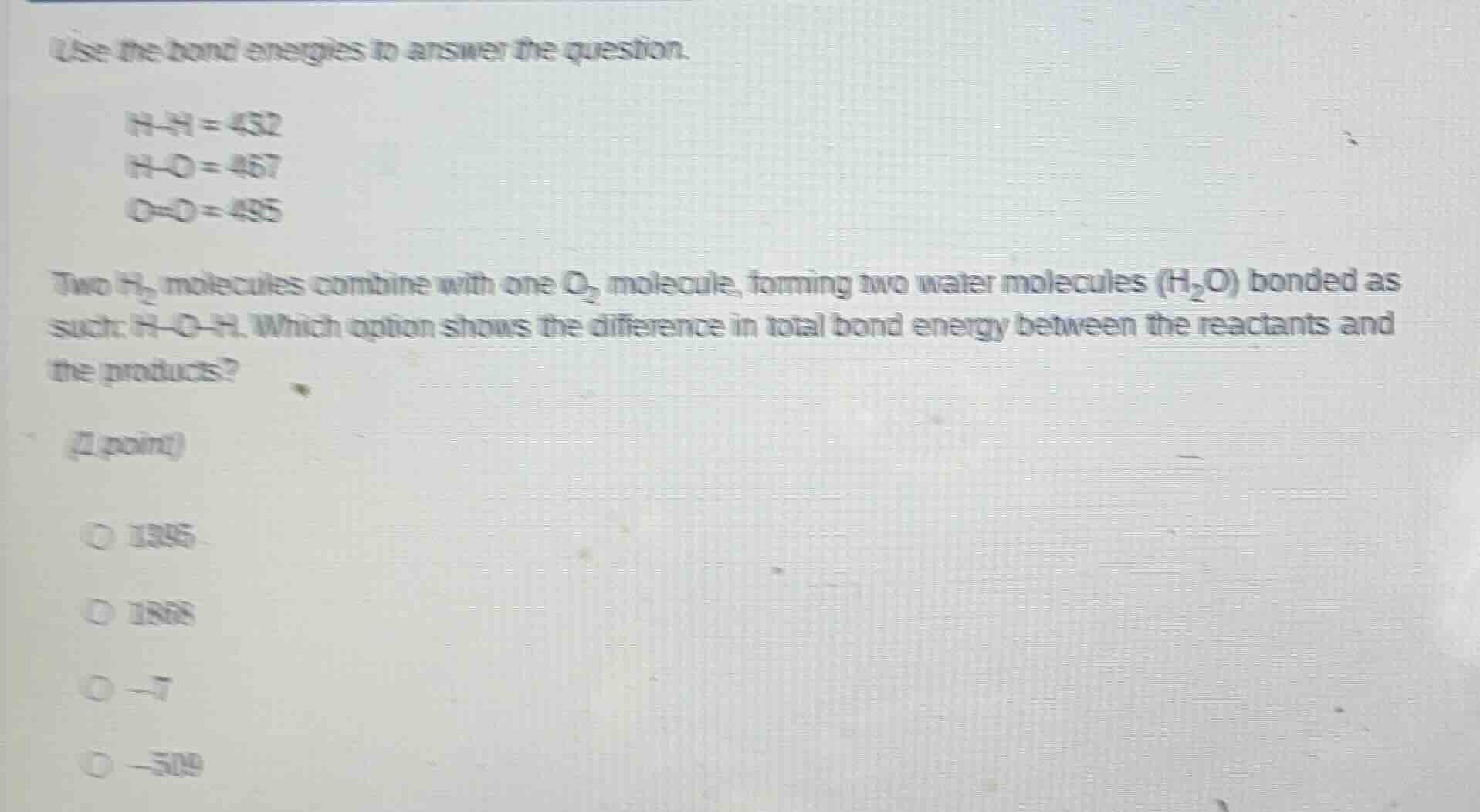
use the bond energies to answer the question.
h-h = 432
h-o = 467
o=o = 495
two h₂ molecules combine with one o₂ molecule, forming two water molecules (h₂o) bonded as such: h-o-h. which option shows the difference in total bond energy between the reactants and the products?
(1 point)
1395
1868
-7
-509
Step1: Calculate energy of reactants
Reactants: 2 H₂ and 1 O₂.
H-H bonds: 2 molecules × 1 bond × 432 kJ = \( 2 \times 432 = 864 \) kJ.
O=O bond: 1 molecule × 1 bond × 495 kJ = \( 1 \times 495 = 495 \) kJ.
Total reactant energy: \( 864 + 495 = 1359 \) kJ.
Step2: Calculate energy of products
Products: 2 H₂O. Each H₂O has 2 H-O bonds.
H-O bonds: 2 molecules × 2 bonds × 467 kJ = \( 2 \times 2 \times 467 = 1868 \) kJ.
Step3: Find energy difference (Products - Reactants)
Difference: \( 1868 - 1359 = 509 \)? Wait, no—wait, the question says "difference in total bond energy between reactants and products". Wait, actually, the formula for enthalpy change (ΔH) is Bonds Broken (Reactants) - Bonds Formed (Products). But here, we need (Products - Reactants) or (Reactants - Products)? Wait, the problem says "difference in total bond energy between the reactants and the products". Let's recheck:
Wait, maybe I mixed up. Wait, bond energy: breaking bonds (reactants) requires energy (endothermic), forming bonds (products) releases energy (exothermic). The difference is (Energy of Products) - (Energy of Reactants)? No, actually, the total bond energy change is (Energy required to break reactant bonds) - (Energy released when product bonds form). But the question is "the difference in total bond energy between the reactants and the products". So total bond energy of products minus total bond energy of reactants? Wait, no—bond energy is the energy required to break a bond. So the total bond energy of a molecule is the sum of the bond energies of its bonds (since breaking them requires that energy). So for reactants: total bond energy is the energy needed to break all their bonds. For products: total bond energy is the energy needed to break all their bonds. The difference is (Products' total bond energy) - (Reactants' total bond energy). Wait, but in the reaction, bonds are broken (reactants) and formed (products). Wait, maybe the question is (Products - Reactants) or (Reactants - Products)? Wait, let's recalculate:
Wait, reactants: 2 H₂ (2 H-H bonds) and 1 O₂ (1 O=O bond). So total bond energy of reactants (energy to break them) is \( 2 \times 432 + 495 = 864 + 495 = 1359 \) kJ.
Products: 2 H₂O, each with 2 H-O bonds. So total bond energy of products (energy to break them) is \( 2 \times 2 \times 467 = 1868 \) kJ.
Now, the difference between products and reactants: \( 1868 - 1359 = 509 \). But the options include -509. Wait, maybe the question is (Reactants - Products)? No, wait—maybe the question is asking for (Products - Reactants) but with a sign? Wait, no, let's check the options. The options are 1395, 1868, -7, -509. Wait, I must have made a mistake. Wait, let's re-express the reaction: 2 H₂ + O₂ → 2 H₂O.
Bonds broken: 2 H-H (each 432) and 1 O=O (495). Total broken: \( 2 \times 432 + 495 = 864 + 495 = 1359 \) kJ (energy absorbed).
Bonds formed: 4 H-O (each 467). Total formed: \( 4 \times 467 = 1868 \) kJ (energy released).
The enthalpy change (ΔH) is (Bonds Broken) - (Bonds Formed) = \( 1359 - 1868 = -509 \) kJ. Ah! So the difference (Reactants - Products) is -509? Wait, no—ΔH = Bonds Broken - Bonds Formed. So if the question is "difference in total bond energy between the reactants and the products", maybe it's (Products - Reactants) but with sign? Wait, the options include -509. Let's check:
Total bond energy of reactants (energy to break them): 1359 kJ.
Total bond energy of products (energy to break them): 1868 kJ.
Difference (Products - Reactants): \( 1868 - 1359 = 509 \). But ΔH is (Bonds Broken - Bonds Formed) = \( 1359 - 1…

Snap & solve any problem in the app
Get step-by-step solutions on Sovi AI
Photo-based solutions with guided steps
Explore more problems and detailed explanations
-509