QUESTION IMAGE
Question
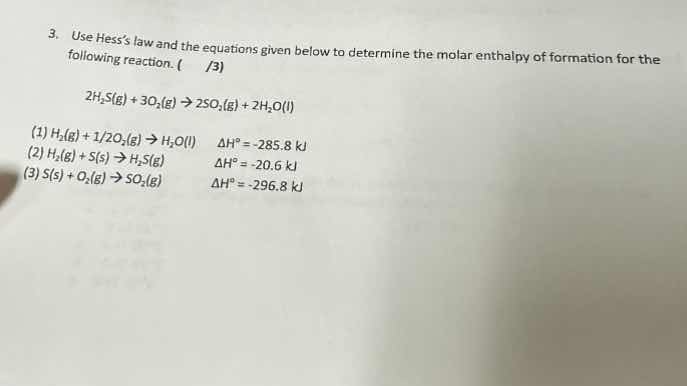
- use hesss law and the equations given below to determine the molar enthalpy of formation for the following reaction. ( /3)
2h₂s(g) + 3o₂(g) → 2so₂(g) + 2h₂o(l)
(1) h₂(g) + 1/2o₂(g) → h₂o(l) δh° = -285.8 kj
(2) h₂(g) + s(s) → h₂s(g) δh° = -20.6 kj
(3) s(s) + o₂(g) → so₂(g) δh° = -296.8 kj
Step 1: Analyze the target reaction and given reactions
The target reaction is \(2H_2S(g)+3O_2(g)
ightarrow2SO_2(g)+2H_2O(l)\). We have three given reactions:
- \(H_2(g)+\frac{1}{2}O_2(g)
ightarrow H_2O(l)\) \(\Delta H^{\circ}=-285.8\ kJ\)
- \(H_2(g)+S(s)
ightarrow H_2S(g)\) \(\Delta H^{\circ}=-20.6\ kJ\)
- \(S(s)+O_2(g)
ightarrow SO_2(g)\) \(\Delta H^{\circ}=-296.8\ kJ\)
Step 2: Manipulate reaction (2)
We need to reverse reaction (2) and multiply it by 2 to get \(2H_2S(g)\) on the reactant side. Reversing a reaction changes the sign of \(\Delta H\), and multiplying by 2 multiplies \(\Delta H\) by 2.
Reversed and multiplied reaction (2): \(2H_2S(g)
ightarrow2H_2(g)+2S(s)\) \(\Delta H^{\circ}=(-20.6\ kJ)\times(- 2)= + 41.2\ kJ\)
Step 3: Manipulate reaction (1)
Multiply reaction (1) by 2 to get \(2H_2O(l)\) on the product side.
Multiplied reaction (1): \(2H_2(g)+O_2(g)
ightarrow2H_2O(l)\) \(\Delta H^{\circ}=(-285.8\ kJ)\times2=-571.6\ kJ\)
Step 4: Manipulate reaction (3)
Multiply reaction (3) by 2 to get \(2SO_2(g)\) on the product side.
Multiplied reaction (3): \(2S(s)+2O_2(g)
ightarrow2SO_2(g)\) \(\Delta H^{\circ}=(-296.8\ kJ)\times2=-593.6\ kJ\)
Step 5: Add the manipulated reactions
Now, add the three manipulated reactions:
- \(2H_2S(g)
ightarrow2H_2(g)+2S(s)\) \(\Delta H^{\circ}= + 41.2\ kJ\)
- \(2H_2(g)+O_2(g)
ightarrow2H_2O(l)\) \(\Delta H^{\circ}=-571.6\ kJ\)
- \(2S(s)+2O_2(g)
ightarrow2SO_2(g)\) \(\Delta H^{\circ}=-593.6\ kJ\)
Adding the left - hand sides: \(2H_2S(g)+2H_2(g)+O_2(g)+2S(s)+2O_2(g)\)
Adding the right - hand sides: \(2H_2(g)+2S(s)+2H_2O(l)+2SO_2(g)\)
Simplifying (the \(2H_2(g)\) and \(2S(s)\) cancel out): \(2H_2S(g)+3O_2(g)
ightarrow2SO_2(g)+2H_2O(l)\)
Step 6: Calculate the total \(\Delta H\)
Now, sum up the \(\Delta H\) values of the manipulated reactions:
\(\Delta H_{total}=\Delta H_{manipulated(2)}+\Delta H_{manipulated(1)}+\Delta H_{manipulated(3)}\)
\(\Delta H_{total}=41.2\ kJ-571.6\ kJ - 593.6\ kJ\)
\(\Delta H_{total}=41.2-(571.6 + 593.6)\)
\(\Delta H_{total}=41.2 - 1165.2=-1124\ kJ\)

Snap & solve any problem in the app
Get step-by-step solutions on Sovi AI
Photo-based solutions with guided steps
Explore more problems and detailed explanations
The molar enthalpy of the reaction \(2H_2S(g)+3O_2(g)
ightarrow2SO_2(g)+2H_2O(l)\) is \(\boldsymbol{-1124\ kJ}\)