QUESTION IMAGE
Question
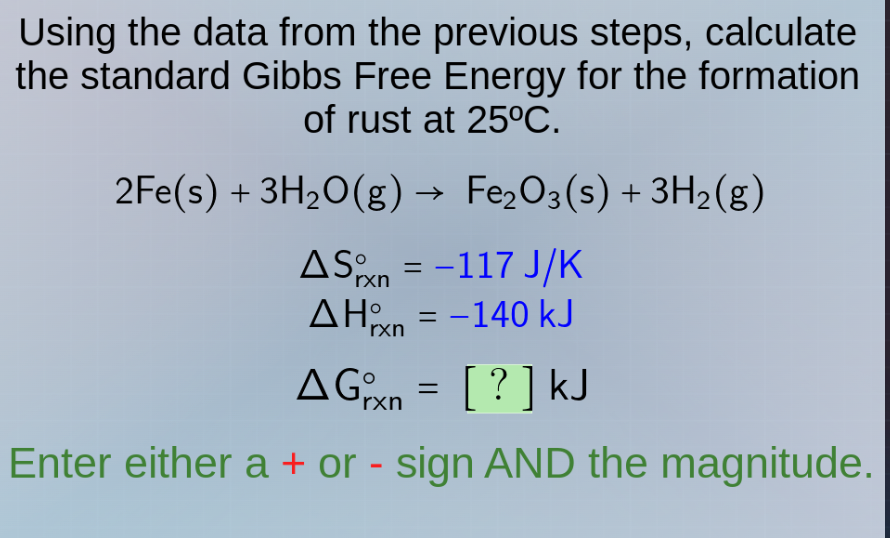
using the data from the previous steps, calculate the standard gibbs free energy for the formation of rust at 25°c.
2fe(s) + 3h₂o(g) → fe₂o₃(s) + 3h₂(g)
δs°ᵣₓₙ = -117 j/k
δh°ᵣₓₙ = -140 kj
δg°ᵣₓₙ = ? kj
enter either a + or - sign and the magnitude.
Step1: Recall the formula for Gibbs Free Energy
The formula for standard Gibbs Free Energy change is $\Delta G^\circ_{\text{rxn}} = \Delta H^\circ_{\text{rxn}} - T\Delta S^\circ_{\text{rxn}}$. First, we need to convert the temperature to Kelvin. At $25^\circ\text{C}$, $T = 25 + 273.15 = 298.15\ \text{K}$. Also, convert $\Delta S^\circ_{\text{rxn}}$ to kJ/K: $\Delta S^\circ_{\text{rxn}} = -117\ \text{J/K} = -0.117\ \text{kJ/K}$.
Step2: Substitute the values into the formula
Substitute $\Delta H^\circ_{\text{rxn}} = -140\ \text{kJ}$, $T = 298.15\ \text{K}$, and $\Delta S^\circ_{\text{rxn}} = -0.117\ \text{kJ/K}$ into the formula:
\[
\]
Rounding to a reasonable number of significant figures, we get approximately -105 kJ (or more precisely, -105.12 kJ).

Snap & solve any problem in the app
Get step-by-step solutions on Sovi AI
Photo-based solutions with guided steps
Explore more problems and detailed explanations
-105 (or -105.12 depending on precision, but -105 is a common approximation here)