QUESTION IMAGE
Question
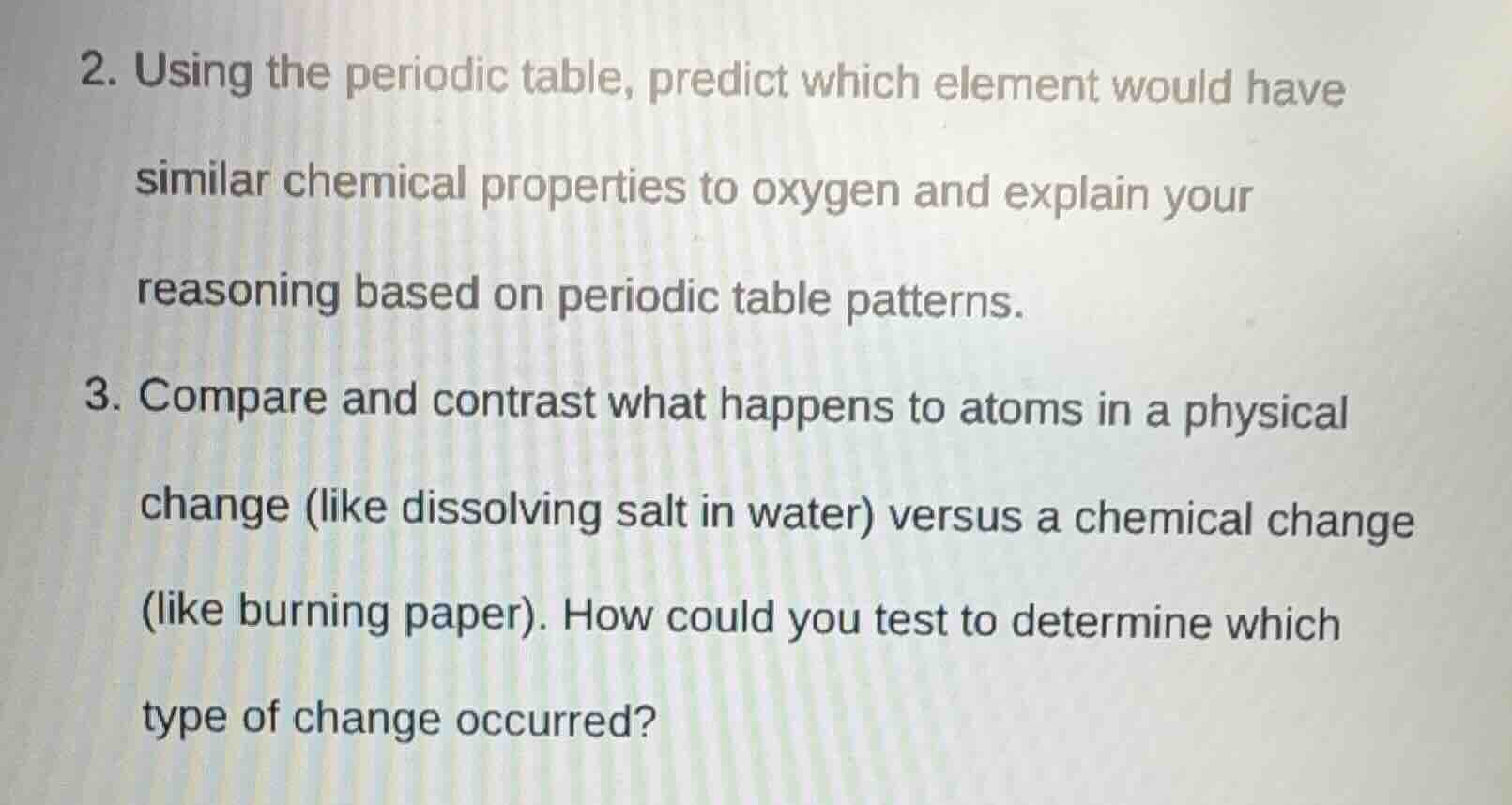
- using the periodic table, predict which element would have similar chemical properties to oxygen and explain your reasoning based on periodic table patterns. 3. compare and contrast what happens to atoms in a physical change (like dissolving salt in water) versus a chemical change (like burning paper). how could you test to determine which type of change occurred?
Brief Explanations
- Oxygen is in Group 16 of the periodic table. Elements in the same group have the same number of valence electrons (6 for Group 16), which dictates chemical reactivity and properties.
- Physical changes only alter the physical state/arrangement of matter, not chemical composition. Chemical changes break and form chemical bonds, creating new substances. Reversibility and testing for new substances are reliable ways to distinguish the two change types.

Snap & solve any problem in the app
Get step-by-step solutions on Sovi AI
Photo-based solutions with guided steps
Explore more problems and detailed explanations
- Elements like sulfur (S), selenium (Se), tellurium (Te), or polonium (Po) (most commonly sulfur) have similar chemical properties to oxygen.
- In a physical change (dissolving salt in water): Atoms remain in their original chemical species; no new substances form. In a chemical change (burning paper): Atoms rearrange into new chemical species, forming new substances. To test: Attempt to reverse the change (physical changes are easily reversible, e.g., evaporate water to recover salt; chemical changes cannot be reversed to recover the original paper), or test for new substances (e.g., test for ash/gas from burned paper vs. no new substance from dissolved salt).