QUESTION IMAGE
Question
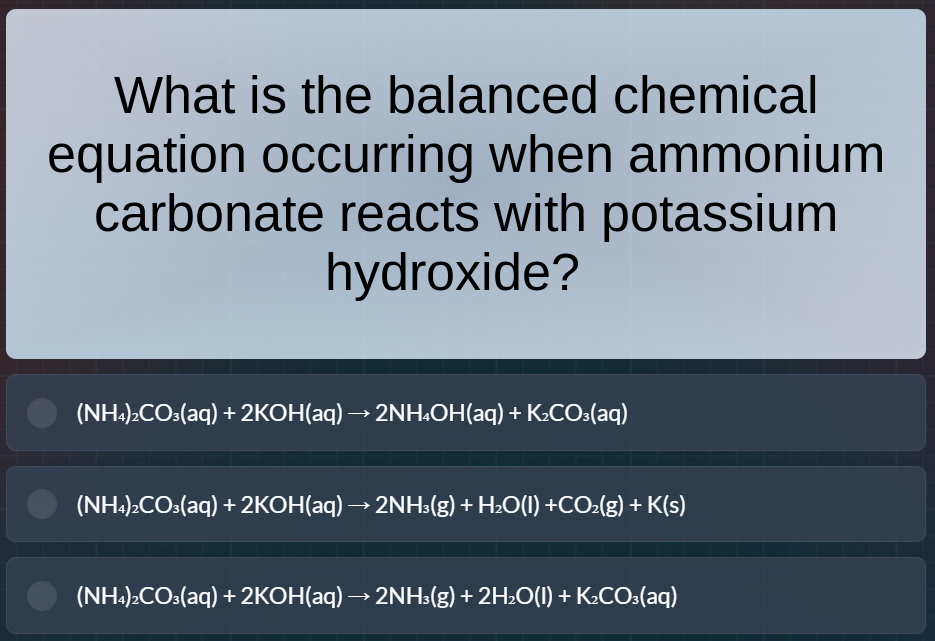
what is the balanced chemical equation occurring when ammonium carbonate reacts with potassium hydroxide? (nh₄)₂co₃(aq) + 2koh(aq) → 2nh₄oh(aq) + k₂co₃(aq) (nh₄)₂co₃(aq) + 2koh(aq) → 2nh₃(g) + h₂o(l) +co₂(g) + k(s) (nh₄)₂co₃(aq) + 2koh(aq) → 2nh₃(g) + 2h₂o(l) + k₂co₃(aq)
Step1: Analyze Reactants and Products
Ammonium carbonate \((NH_4)_2CO_3\) and potassium hydroxide \(KOH\) are reactants. Let's recall the reaction type: this is a double - displacement reaction (or acid - base reaction, as ammonium carbonate can act as an acid - source and KOH as a base). But also, ammonium hydroxide \(NH_4OH\) is unstable and decomposes into ammonia \(NH_3\) and water \(H_2O\): \(NH_4OH
ightarrow NH_3 + H_2O\)
Step2: Analyze Each Option
- Option 1: \((NH_4)_2CO_3(aq)+2KOH(aq)
ightarrow2NH_4OH(aq)+K_2CO_3(aq)\)
- But \(NH_4OH\) is unstable and does not exist as a stable aqueous solution in this reaction. It should decompose, so this reaction is not correct as written (the products are not the actual products of the reaction).
- Option 2: \((NH_4)_2CO_3(aq)+2KOH(aq)
ightarrow2NH_3(g)+H_2O(l)+CO_2(g)+K(s)\)
- The production of elemental potassium \(K(s)\) is not feasible in this reaction. Potassium is a very reactive metal and will not be produced from the reaction of a carbonate and a hydroxide in aqueous solution.
- Option 3: \((NH_4)_2CO_3(aq)+2KOH(aq)
ightarrow2NH_3(g)+2H_2O(l)+K_2CO_3(aq)\)
- First, let's check the number of atoms on each side:
- Nitrogen (N): Left - hand side (LHS): In \((NH_4)_2CO_3\), the number of N atoms is \(2\). Right - hand side (RHS): In \(2NH_3\), the number of N atoms is \(2\). Balanced.
- Hydrogen (H): LHS: In \((NH_4)_2CO_3\), there are \(2\times4 = 8\) H atoms from ammonium, and in \(2KOH\), there are \(2\times1=2\) H atoms, so total \(8 + 2=10\) H atoms. RHS: In \(2NH_3\), there are \(2\times3 = 6\) H atoms, and in \(2H_2O\), there are \(2\times2 = 4\) H atoms, so total \(6+4 = 10\) H atoms. Balanced.
- Carbon (C): LHS: In \((NH_4)_2CO_3\), there is \(1\) C atom. RHS: In \(K_2CO_3\), there is \(1\) C atom. Balanced.
- Oxygen (O): LHS: In \((NH_4)_2CO_3\), there are \(3\) O atoms, and in \(2KOH\), there are \(2\times1 = 2\) O atoms, so total \(3 + 2=5\) O atoms. RHS: In \(2H_2O\), there are \(2\times1 = 2\) O atoms, and in \(K_2CO_3\), there are \(3\) O atoms, so total \(2 + 3=5\) O atoms. Balanced.
- Potassium (K): LHS: In \(2KOH\), there are \(2\) K atoms. RHS: In \(K_2CO_3\), there are \(2\) K atoms. Balanced.
- Also, the reaction is a valid acid - base (or double - displacement with decomposition of ammonium hydroxide) reaction. Ammonium carbonate reacts with potassium hydroxide to form potassium carbonate, ammonia gas, and water (since ammonium hydroxide decomposes into \(NH_3\) and \(H_2O\)).

Snap & solve any problem in the app
Get step-by-step solutions on Sovi AI
Photo-based solutions with guided steps
Explore more problems and detailed explanations
(NH₄)₂CO₃(aq) + 2KOH(aq) → 2NH₃(g) + 2H₂O(l) + K₂CO₃(aq)