QUESTION IMAGE
Question
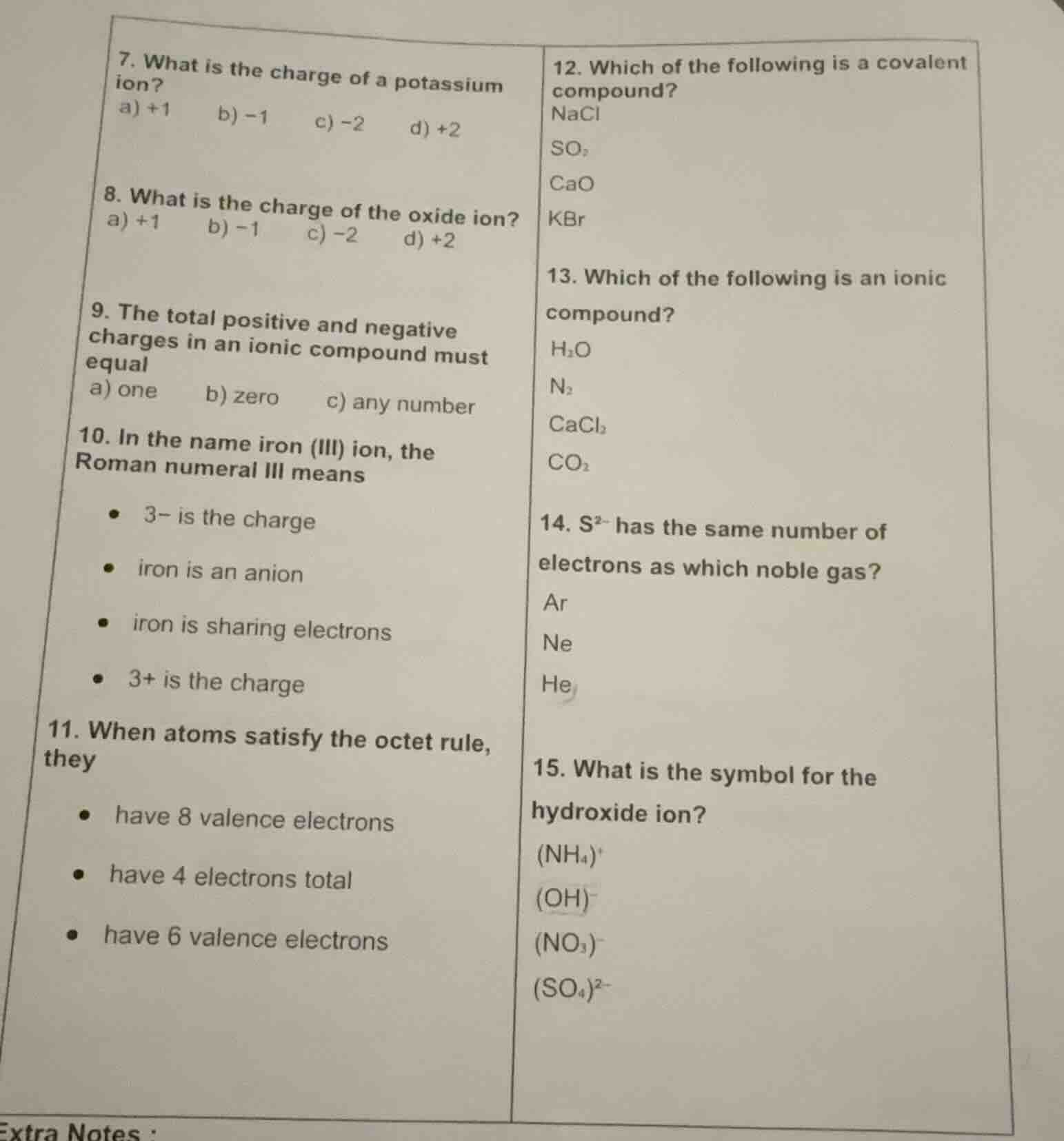
- what is the charge of a potassium ion?
a) +1 b) -1 c) -2 d) +2
- what is the charge of the oxide ion?
a) +1 b) -1 c) -2 d) +2
- the total positive and negative charges in an ionic compound must equal
a) one b) zero c) any number
- in the name iron (iii) ion, the roman numeral iii means
- 3- is the charge
- iron is an anion
- iron is sharing electrons
- 3+ is the charge
- when atoms satisfy the octet rule, they
- have 8 valence electrons
- have 4 electrons total
- have 6 valence electrons
- which of the following is a covalent compound?
nacl
so₂
cao
kbr
- which of the following is an ionic compound?
h₂o
n₂
cacl₂
co₂
- s²⁻ has the same number of electrons as which noble gas?
ar
ne
he
- what is the symbol for the hydroxide ion?
(nh₄)⁺
(oh)⁻
(no₃)⁻
(so₄)²⁻
Brief Explanations
7. Potassium (Group 1) loses 1 electron, forming +1 ion.
8. Oxygen (Group 16) gains 2 electrons, forming -2 ion.
9. Ionic compounds are neutral, so total charges sum to 0.
10. Roman numerals in ion names indicate positive charge.
11. Octet rule means 8 valence electrons for stability.
12. Covalent compounds form between nonmetals; SO₂ has S and O (nonmetals).
13. Ionic compounds form between metal and nonmetal; CaCl₂ has Ca (metal) and Cl (nonmetal).
14. Sulfur (16 electrons) gains 2 to make 18, same as Ar (18 electrons).
15. Hydroxide ion is a combination of oxygen and hydrogen with -1 charge.

Snap & solve any problem in the app
Get step-by-step solutions on Sovi AI
Photo-based solutions with guided steps
Explore more problems and detailed explanations
- a) +1
- c) -2
- b) zero
- 3+ is the charge
- have 8 valence electrons
- SO₂
- CaCl₂
- Ar
- (OH)⁻