QUESTION IMAGE
Question
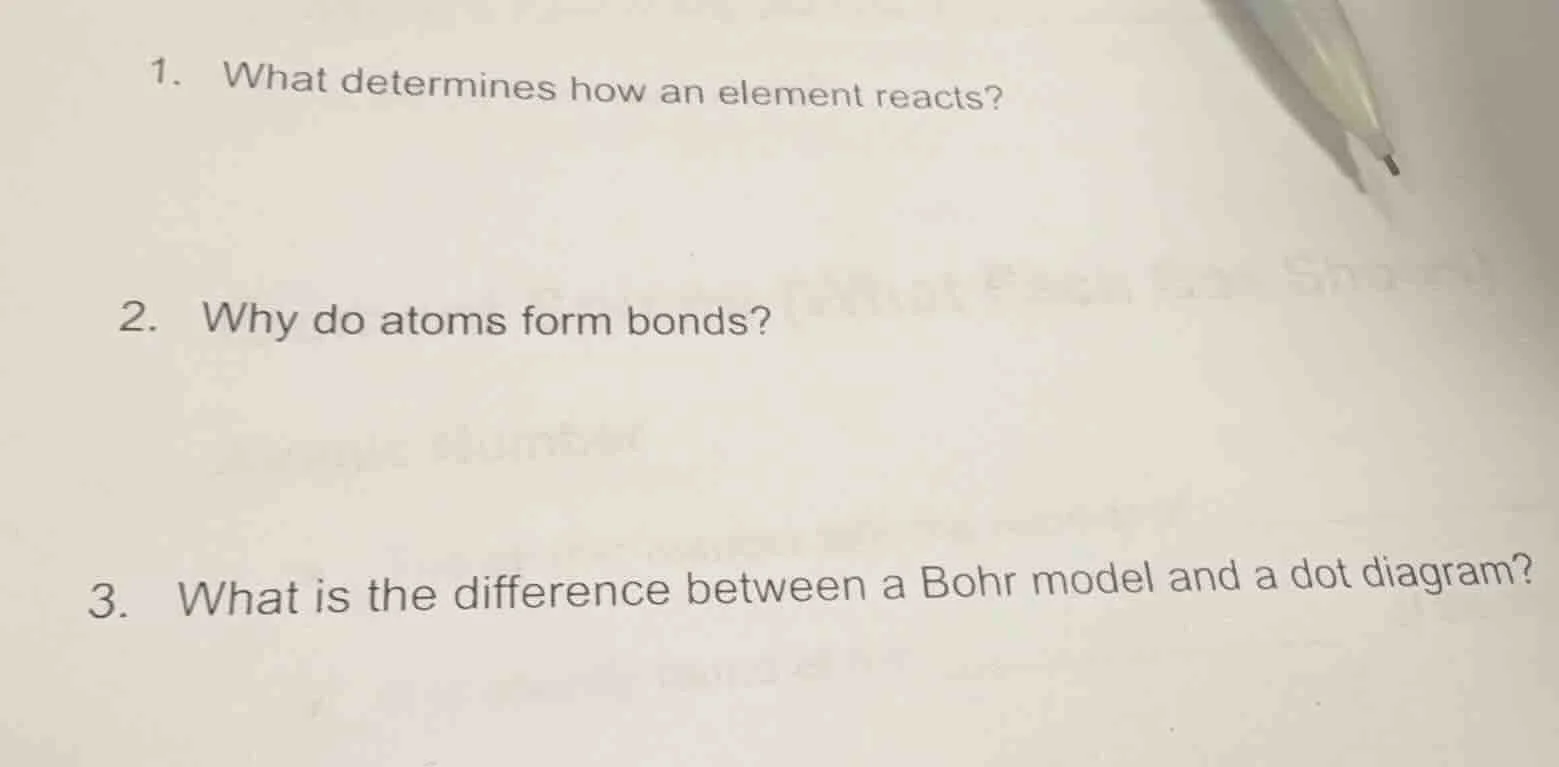
- what determines how an element reacts?
- why do atoms form bonds?
- what is the difference between a bohr model and a dot diagram?
Brief Explanations
- An element's reactivity is governed by the number and arrangement of electrons in its outermost (valence) energy level; atoms tend to react to fill or empty this shell for stability.
- Atoms form bonds to achieve a more stable electron configuration, typically matching the full valence shell of a noble gas, which lowers their overall energy.
- A Bohr model depicts the entire atom with a nucleus and electrons in distinct energy levels/orbits, while a dot (Lewis) diagram only shows the atom's chemical symbol and its valence electrons, focusing on bonding behavior.

Snap & solve any problem in the app
Get step-by-step solutions on Sovi AI
Photo-based solutions with guided steps
Explore more problems and detailed explanations
- The number and arrangement of valence electrons (outer-shell electrons) of the element determine how it reacts.
- Atoms form bonds to achieve a more stable electron configuration (usually a full valence shell, like noble gases) and lower their overall potential energy.
- A Bohr model illustrates the atom's nucleus and electrons in layered energy orbits, while a dot (Lewis) diagram only shows the element's symbol and its valence electrons, omitting the nucleus and inner electron shells.