QUESTION IMAGE
Question
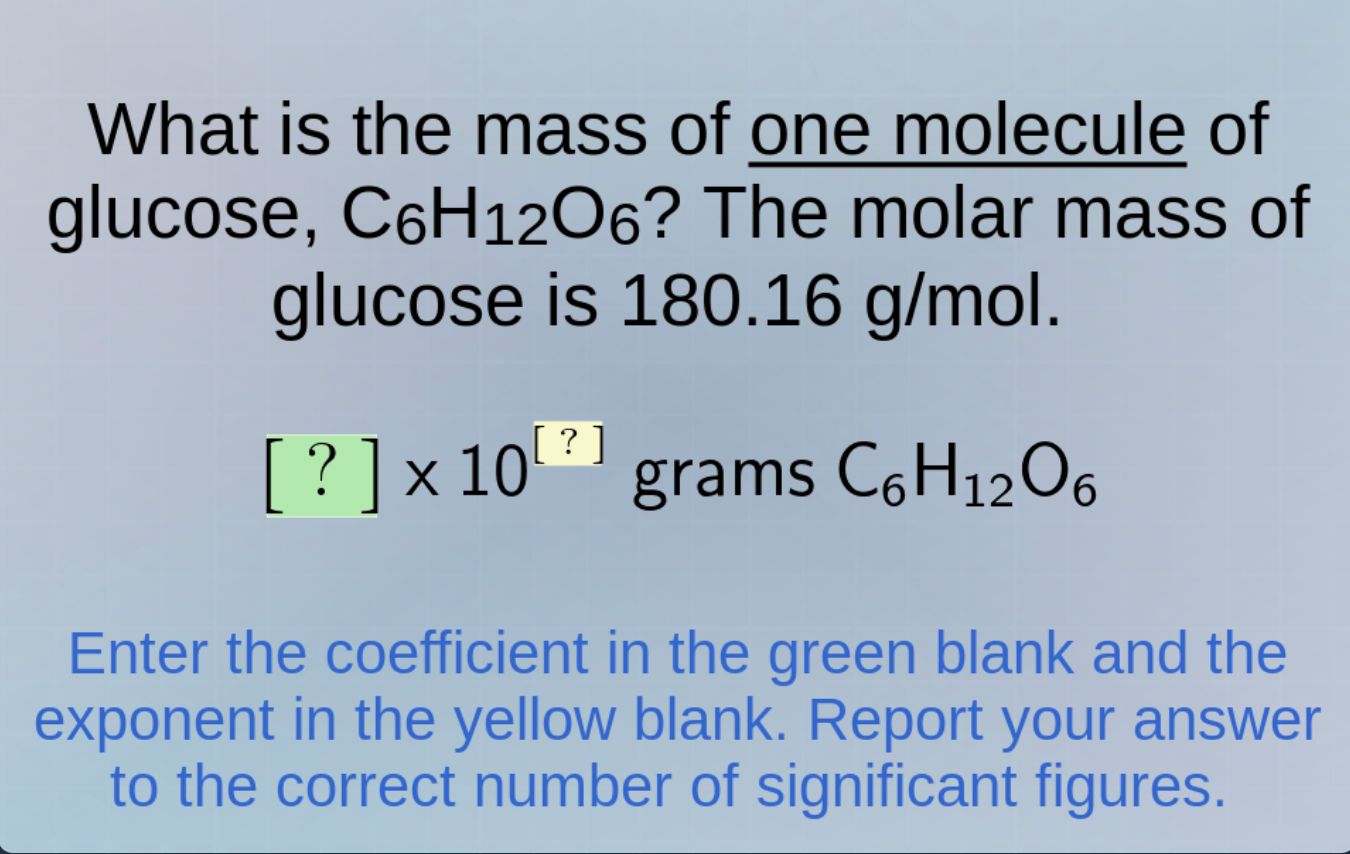
what is the mass of one molecule of glucose, c₆h₁₂o₆? the molar mass of glucose is 180.16 g/mol.
? × 10^? grams c₆h₁₂o₆
enter the coefficient in the green blank and the exponent in the yellow blank. report your answer to the correct number of significant figures.
Step1: Recall Avogadro's number
Avogadro's number is \( 6.022 \times 10^{23} \) molecules/mol, which means 1 mole of any substance contains \( 6.022 \times 10^{23} \) molecules.
Step2: Calculate mass of one molecule
To find the mass of one molecule, we divide the molar mass by Avogadro's number. The molar mass of glucose is \( 180.16 \) g/mol. So the mass of one molecule (\( m \)) is given by:
\[
m=\frac{\text{Molar mass}}{\text{Avogadro's number}}=\frac{180.16\ \text{g/mol}}{6.022\times 10^{23}\ \text{molecules/mol}}
\]
First, calculate \( \frac{180.16}{6.022}\approx 29.92 \). Then, \( \frac{29.92}{10^{23}} = 2.992\times 10^{-22}\) g (after adjusting the exponent). Rounding to the correct number of significant figures (the molar mass has 5 significant figures and Avogadro's number is known precisely, so we can keep 4 significant figures), we get approximately \( 2.992\times 10^{-22}\) g. If we consider the significant figures from the molar mass (180.16 has 5, but when dividing by \( 6.022\times 10^{23}\) which is a constant with more sig figs), the result should be reported with 5 sig figs? Wait, no, 180.16 is 5 sig figs, 6.022×10²³ is 4 sig figs (the 6.022 part). So when dividing, the number of sig figs is determined by the least number, but 6.022 is 4, 180.16 is 5. So we can present it as \( 2.992\times 10^{-22}\) (or more accurately, let's do the calculation precisely: \( 180.16\div6.022 = 180.16\div6.022\approx29.917\), then \( 29.917\times 10^{-23}=2.9917\times 10^{-22}\approx2.992\times 10^{-22}\) g.

Snap & solve any problem in the app
Get step-by-step solutions on Sovi AI
Photo-based solutions with guided steps
Explore more problems and detailed explanations
The coefficient (green blank) is \( 2.992 \) (or \( 2.99 \) or \( 3.00 \) depending on rounding, but more accurately from the calculation above \( 2.992 \)) and the exponent (yellow blank) is \( - 22 \). So the mass of one molecule of glucose is \( \boldsymbol{2.992\times 10^{-22}} \) grams (or with appropriate significant figures, if we take 180.16 as 5 sig figs and 6.022×10²³ as 4 sig figs, the result should have 4 sig figs, so \( 2.992\times 10^{-22}\) g, so coefficient is \( 2.992 \), exponent is \( -22 \)).