QUESTION IMAGE
Question
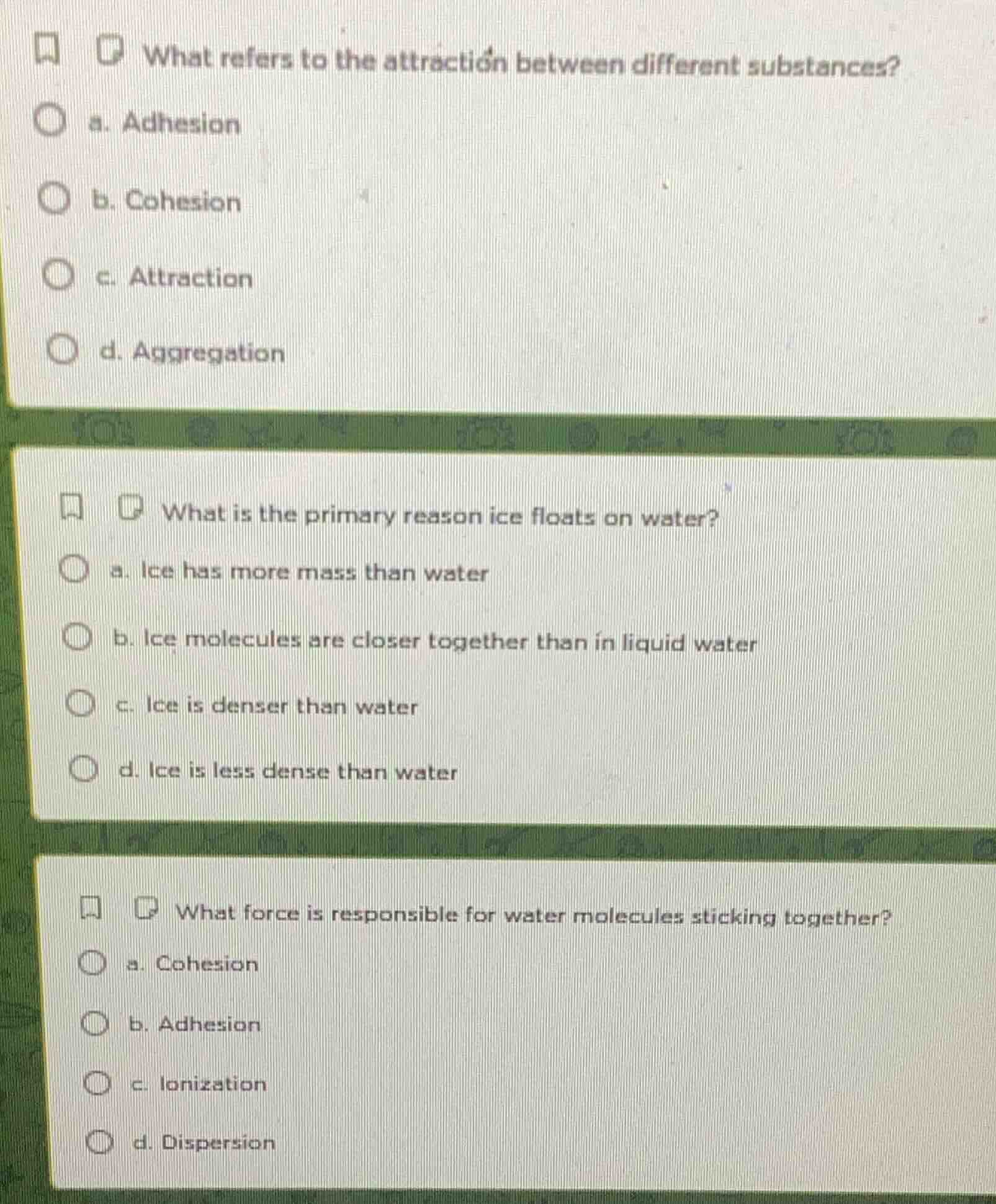
what refers to the attraction between different substances?
a. adhesion
b. cohesion
c. attraction
d. aggregation
what is the primary reason ice floats on water?
a. ice has more mass than water
b. ice molecules are closer together than in liquid water
c. ice is denser than water
d. ice is less dense than water
what force is responsible for water molecules sticking together?
a. cohesion
b. adhesion
c. ionization
d. dispersion
First Question:
To determine the term for attraction between different substances, we analyze each option:
- Adhesion is the attraction between different substances.
- Cohesion is attraction between similar substances (e.g., water molecules to each other).
- "Attraction" is a general term, not specific to different substances.
- Aggregation refers to clustering of particles, not inter - substance attraction.
To find why ice floats on water, we consider density:
- Density determines if an object floats (less dense objects float on more dense fluids).
- Ice is less dense than liquid water.
- Option a is wrong (mass doesn't determine floating, density does).
- Option b is wrong (ice molecules are farther apart, making it less dense).
- Option c is wrong (ice is less dense, not more dense, than water).
To identify the force for water molecules sticking together:
- Cohesion is the attractive force between similar molecules (like water molecules to each other).
- Adhesion is for different substances.
- Ionization is about forming ions.
- Dispersion is a weak intermolecular force, not the main force for water molecules sticking together.

Snap & solve any problem in the app
Get step-by-step solutions on Sovi AI
Photo-based solutions with guided steps
Explore more problems and detailed explanations
a. Adhesion