QUESTION IMAGE
Question
when a fluorine atom gains an electron from a lithium atom and the stable compound lif results, the bond that is formed is...
select one:
○ a. covalent.
○ b. diatomic.
○ c. electric.
○ d. ionic.
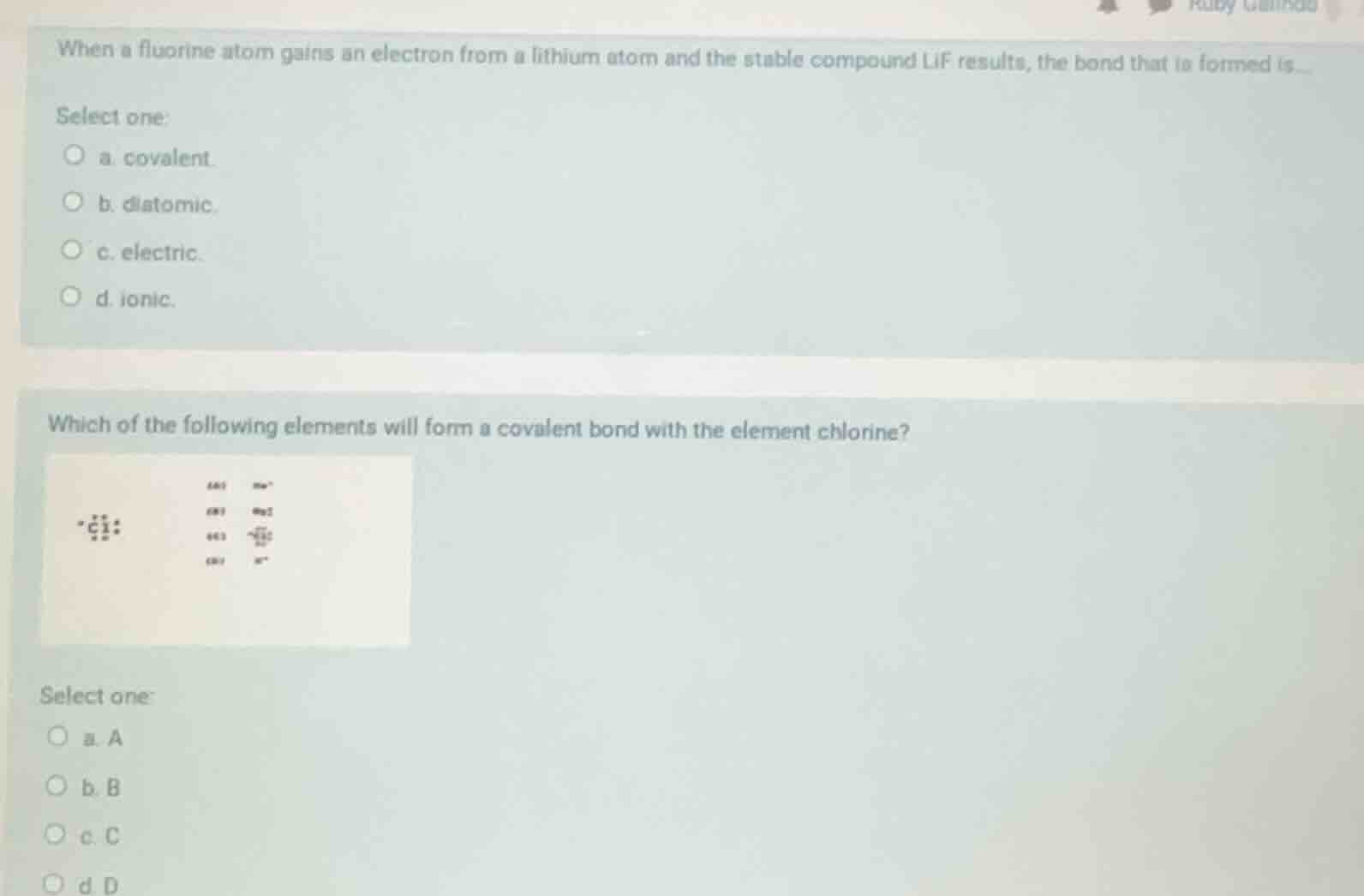
which of the following elements will form a covalent bond with the element chlorine?
select one:
○ a. a
○ b. b
○ c. c
○ d. d
For the first question: Ionic bonds form when electrons are transferred between a metal (lithium) and a nonmetal (fluorine), creating charged ions that attract. Covalent bonds share electrons, diatomic refers to two-atom molecules, and "electric" is not a bond type.
For the second question: Covalent bonds form between nonmetals by sharing electrons. Chlorine is a nonmetal, so it forms covalent bonds with another nonmetal. Option C (chlorine, another nonmetal) will form a covalent bond (Cl₂) via electron sharing, while options A (neon, noble gas, inert), B (magnesium, metal, forms ionic bond with Cl), and D (potassium, metal, forms ionic bond with Cl) do not form covalent bonds with chlorine.

Snap & solve any problem in the app
Get step-by-step solutions on Sovi AI
Photo-based solutions with guided steps
Explore more problems and detailed explanations
- d. ionic.
- c. C