QUESTION IMAGE
Question
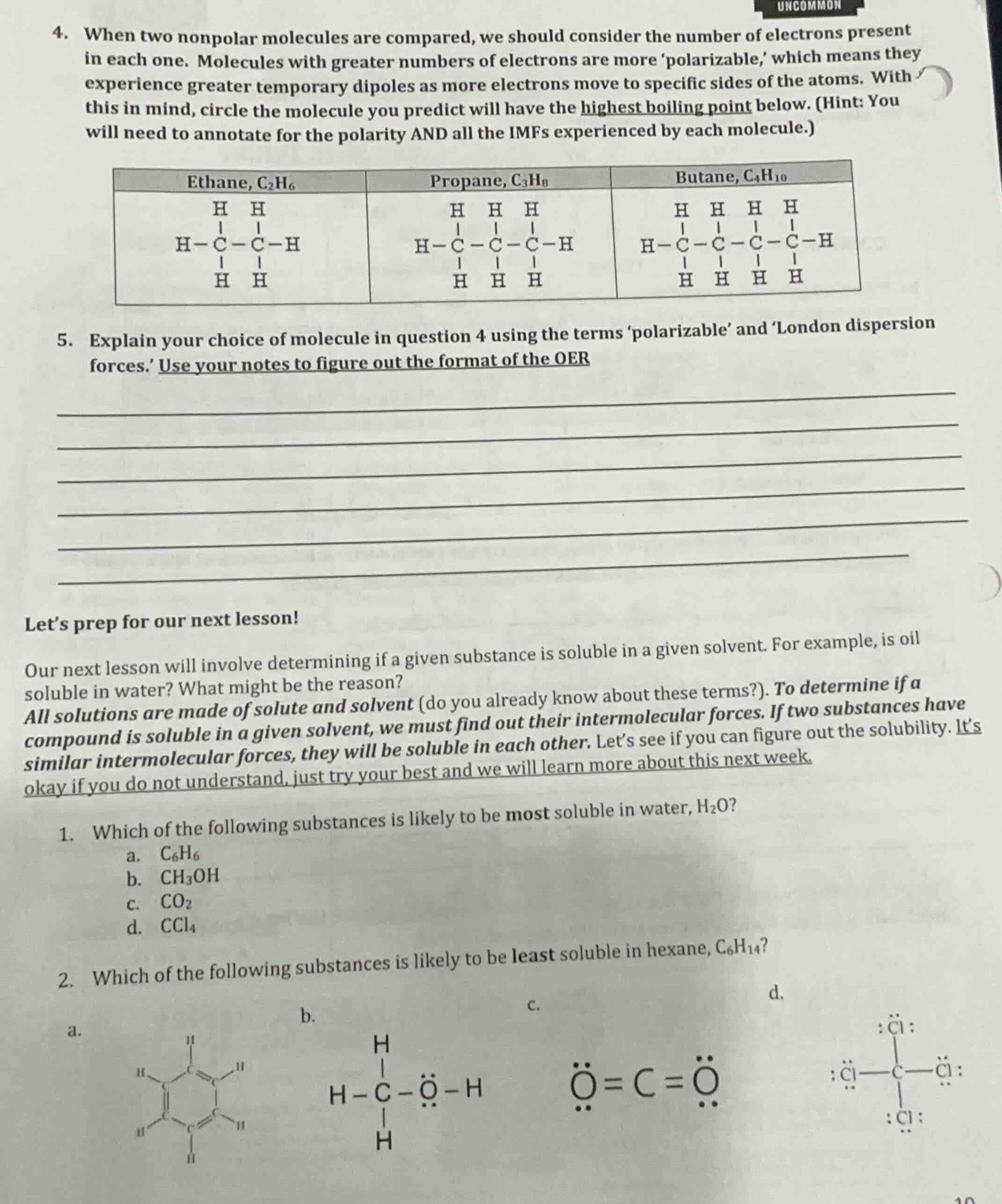
- when two nonpolar molecules are compared, we should consider the number of electrons present in each one. molecules with greater numbers of electrons are more polarizable, which means they experience greater temporary dipoles as more electrons move to specific sides of the atoms. with this in mind, circle the molecule you predict will have the highest boiling point below. (hint: you will need to annotate for the polarity and all the imfs experienced by each molecule.)ethane, $ce{c_{2}h_{6}}$propane, $ce{c_{3}h_{8}}$butane, $ce{c_{4}h_{10}}$5. explain your choice of molecule in question 4 using the terms polarizable and london dispersion forces. use your notes to figure out the format of the oerlets prep for our next lesson!our next lesson will involve determining if a given substance is soluble in a given solvent. for example, is oil soluble in water? what might be the reason?all solutions are made of solute and solvent (do you already know about these terms?). to determine if a compound is soluble in a given solvent, we must find out their intermolecular forces. if two substances have similar intermolecular forces, they will be soluble in each other. lets see if you can figure out the solubility. its okay if you do not understand, just try your best and we will learn more about this next week.1. which of the following substances is likely to be most soluble in water, $ce{h_{2}o}$?a. $ce{c_{6}h_{6}}$b. $ce{ch_{3}oh}$c. $ce{co_{2}}$d. $ce{ccl_{4}}$2. which of the following substances is likely to be least soluble in hexane, $ce{c_{6}h_{14}}$?a. b. c. d.
Step1: Count electrons per molecule
Ethane ($\text{C}_2\text{H}_6$): $(2 \times 6) + (6 \times 1) = 18$ electrons
Propane ($\text{C}_3\text{H}_8$): $(3 \times 6) + (8 \times 1) = 26$ electrons
Butane ($\text{C}_4\text{H}_{10}$): $(4 \times 6) + (10 \times 1) = 34$ electrons
Step2: Evaluate polarity and IMFs
All three molecules are nonpolar (symmetrical C-H bonds, no permanent dipoles). Only London dispersion forces (LDFs) act between them.
Step3: Relate polarizability to boiling point
More electrons = higher polarizability = stronger temporary dipoles = stronger LDFs = higher boiling point. Butane has the most electrons.
Step4: Explain solubility for water
Water ($\text{H}_2\text{O}$) is polar, with hydrogen bonding IMFs. Solubility follows "like dissolves like":
- $\text{C}_6\text{H}_6$: nonpolar, LDFs only
- $\text{CH}_3\text{OH}$: polar, has -OH group for hydrogen bonding
- $\text{CO}_2$: nonpolar, LDFs only
- $\text{CCl}_4$: nonpolar, LDFs only
Only $\text{CH}_3\text{OH}$ matches water's IMFs.
Step5: Explain solubility for hexane
Hexane ($\text{C}_6\text{H}_{14}$) is nonpolar, LDFs only. The least soluble substance has mismatched IMFs:
- Option a ($\text{C}_6\text{H}_6$): nonpolar, LDFs
- Option b ($\text{CH}_3\text{OH}$): polar, hydrogen bonding
- Option c ($\text{CO}_2$): nonpolar, LDFs
- Option d ($\text{CCl}_4$): nonpolar, LDFs
$\text{CH}_3\text{OH}$ has polar/hydrogen bonding IMFs, mismatched with hexane.

Snap & solve any problem in the app
Get step-by-step solutions on Sovi AI
Photo-based solutions with guided steps
Explore more problems and detailed explanations
- Question 4: Butane, $\text{C}_4\text{H}_{10}$
- Question 5: Butane has the greatest number of electrons of the three molecules, making it the most polarizable. More polarizable molecules form stronger temporary dipoles, which create stronger London dispersion forces (the only intermolecular force present in these nonpolar molecules). Stronger intermolecular forces require more energy to overcome, so butane has the highest boiling point.
- Prep Question 1: b. $\text{CH}_3\text{OH}$
- Prep Question 2: b. $\text{H}-\underset{\underset{\text{H}}{|}}{\text{C}}-\ddot{\text{O}}-\text{H}$