QUESTION IMAGE
Question
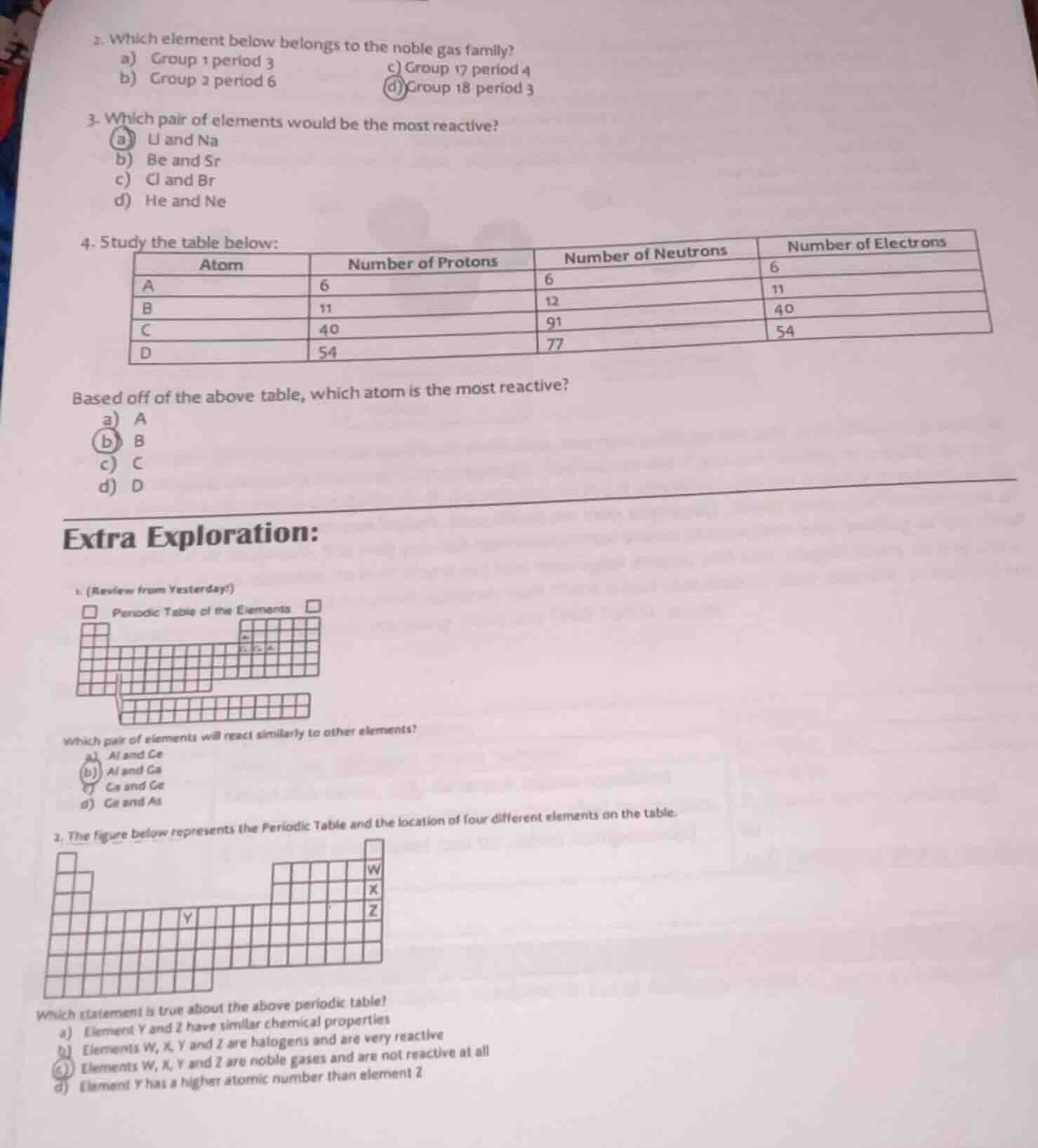
- which element below belongs to the noble gas family?
a) group 1 period 3 \tc) group 17 period 4
b) group 2 period 6 \td) group 18 period 3
- which pair of elements would be the most reactive?
a) li and na
b) be and sr
c) cl and br
d) he and ne
- study the table below:
| atom | number of protons | number of neutrons | number of electrons |
|---|---|---|---|
| b | 11 | 12 | 11 |
| c | 40 | 91 | 40 |
| d | 54 | 77 | 54 |
based off of the above table, which atom is the most reactive?
a) a
b) b
c) c
d) d
extra exploration:
- (review from yesterday)
which pair of elements will react similarly to other elements?
a) al and ce
b) al and ga
c) ce and ge
d) ga and as
- the figure below represents the periodic table and the location of four different elements on the table.
which statement is true about the above periodic table?
a) element y and z have similar chemical properties
b) elements w, x, y and z are halogens and are very reactive
c) elements w, x, y and z are noble gases and are not reactive at all
d) element y has a higher atomic number than element z
Question 2
Noble gases are in Group 18 of the periodic table. So we check each option:
- a) Group 1 period 3: Group 1 is alkali metals, not noble gases.
- b) Group 2 period 6: Group 2 is alkaline earth metals, not noble gases.
- c) Group 17 period 4: Group 17 is halogens, not noble gases.
- d) Group 18 period 3: Group 18 is noble gas group, so this element belongs to noble gas family.
Reactivity: Alkali metals (Group 1) and halogens (Group 17) are highly reactive. Let's analyze each pair:
- a) Li and Na: Both are Group 1 (alkali metals), highly reactive.
- b) Be and Sr: Group 2 (alkaline earth metals), less reactive than Group 1.
- c) Cl and Br: Group 17 (halogens), reactive but alkali metals are more reactive in general (or compare reactivity trends: for Group 1, reactivity increases down the group; for Group 17, reactivity decreases down the group. Li and Na are more reactive than Cl and Br).
- d) He and Ne: Noble gases, non - reactive.
Among the options, Li and Na (Group 1) are the most reactive.
First, determine the element for each atom:
- Atom A: Protons = 6, so element is C (carbon). Carbon is non - metal, relatively less reactive.
- Atom B: Protons = 11, element is Na (sodium). Sodium is Group 1 (alkali metal), highly reactive.
- Atom C: Protons = 40, element is Zr (zirconium), a transition metal, less reactive than alkali metals.
- Atom D: Protons = 54, element is Xe (xenon), a noble gas, non - reactive.
So the most reactive atom is B.

Snap & solve any problem in the app
Get step-by-step solutions on Sovi AI
Photo-based solutions with guided steps
Explore more problems and detailed explanations
d) Group 18 period 3