QUESTION IMAGE
Question
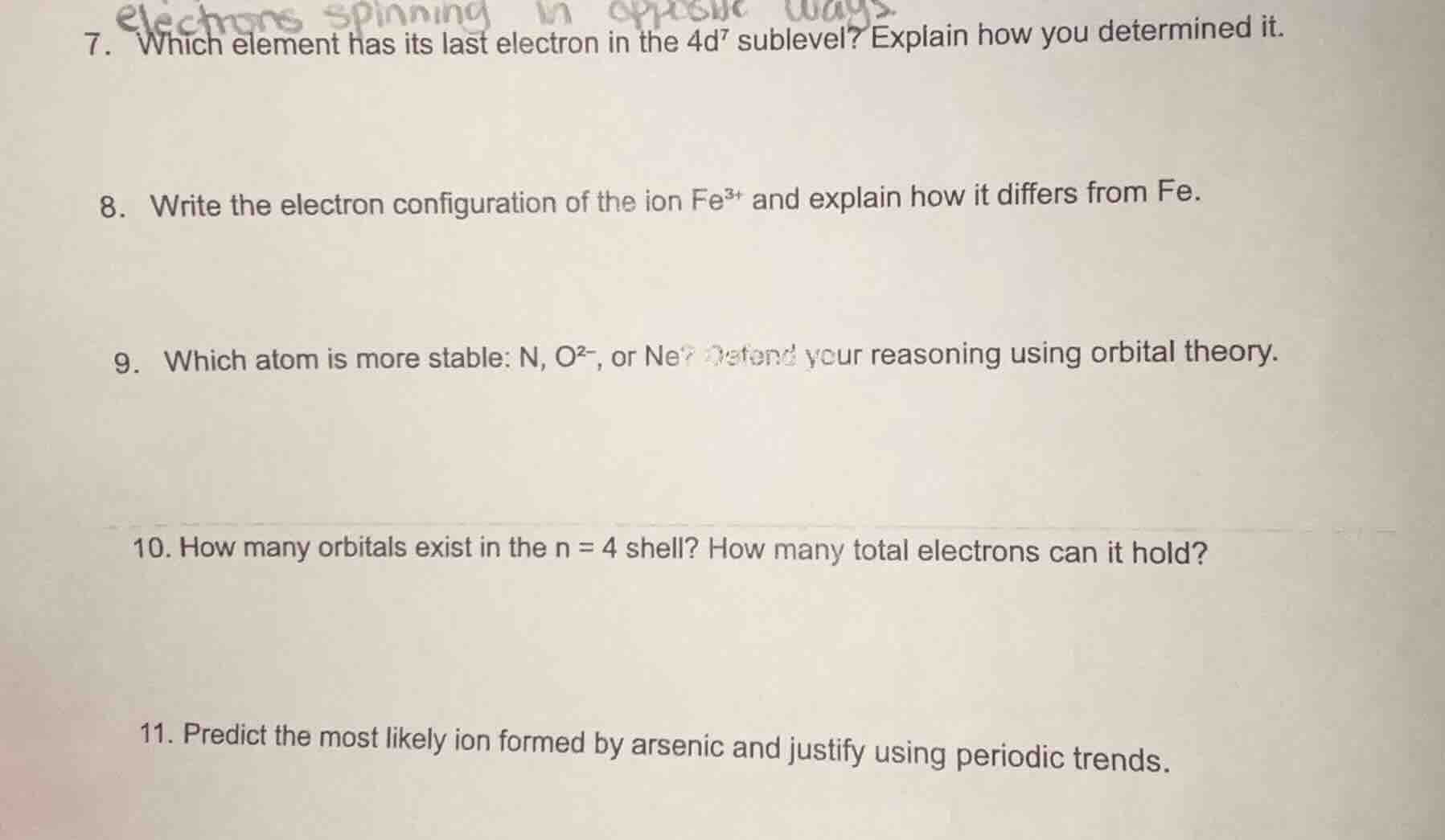
- which element has its last electron in the $4d^7$ sublevel? explain how you determined it.
- write the electron configuration of the ion $fe^{3+}$ and explain how it differs from fe.
- which atom is more stable: n, $o^{2-}$, or ne? defend your reasoning using orbital theory.
- how many orbitals exist in the n = 4 shell? how many total electrons can it hold?
- predict the most likely ion formed by arsenic and justify using periodic trends.
Question 7
Step1: Find noble gas core
The noble gas before the 4d block is Kr (atomic number 36, electron configuration: $[Kr]$).
Step2: Add 4d⁷ electrons
Add the 7 electrons in the 4d sublevel: $[Kr]4d^7$.
Step3: Count total electrons
Total electrons = $36 + 7 = 43$. The element with atomic number 43 is Technetium (Tc).
Step1: Find neutral Fe configuration
Iron (Fe, atomic number 26) has an electron configuration of $[Ar]3d^64s^2$.
Step2: Remove 3 electrons for Fe³⁺
When forming $Fe^{3+}$, electrons are lost first from the 4s sublevel, then the 3d sublevel: remove 2 from 4s, 1 from 3d.
Stability is determined by having a full valence electron shell (octet rule) and minimized electron-electron repulsion. Neon (Ne) has a full valence shell ($2s^22p^6$) with no unpaired electrons and no excess charge. Nitrogen (N) has a $2s^22p^3$ configuration (half-filled p sublevel, but not a full octet). $O^{2-}$ has the same electron configuration as Ne, but carries a -2 charge, which introduces electrostatic repulsion from excess electrons, making it less stable than neutral Ne.

Snap & solve any problem in the app
Get step-by-step solutions on Sovi AI
Photo-based solutions with guided steps
Explore more problems and detailed explanations
Technetium (Tc). The noble gas core before the 4d sublevel is Kr (36 electrons). Adding 7 electrons in the 4d sublevel gives a total of 43 electrons, which matches the atomic number of technetium.
---