QUESTION IMAGE
Question
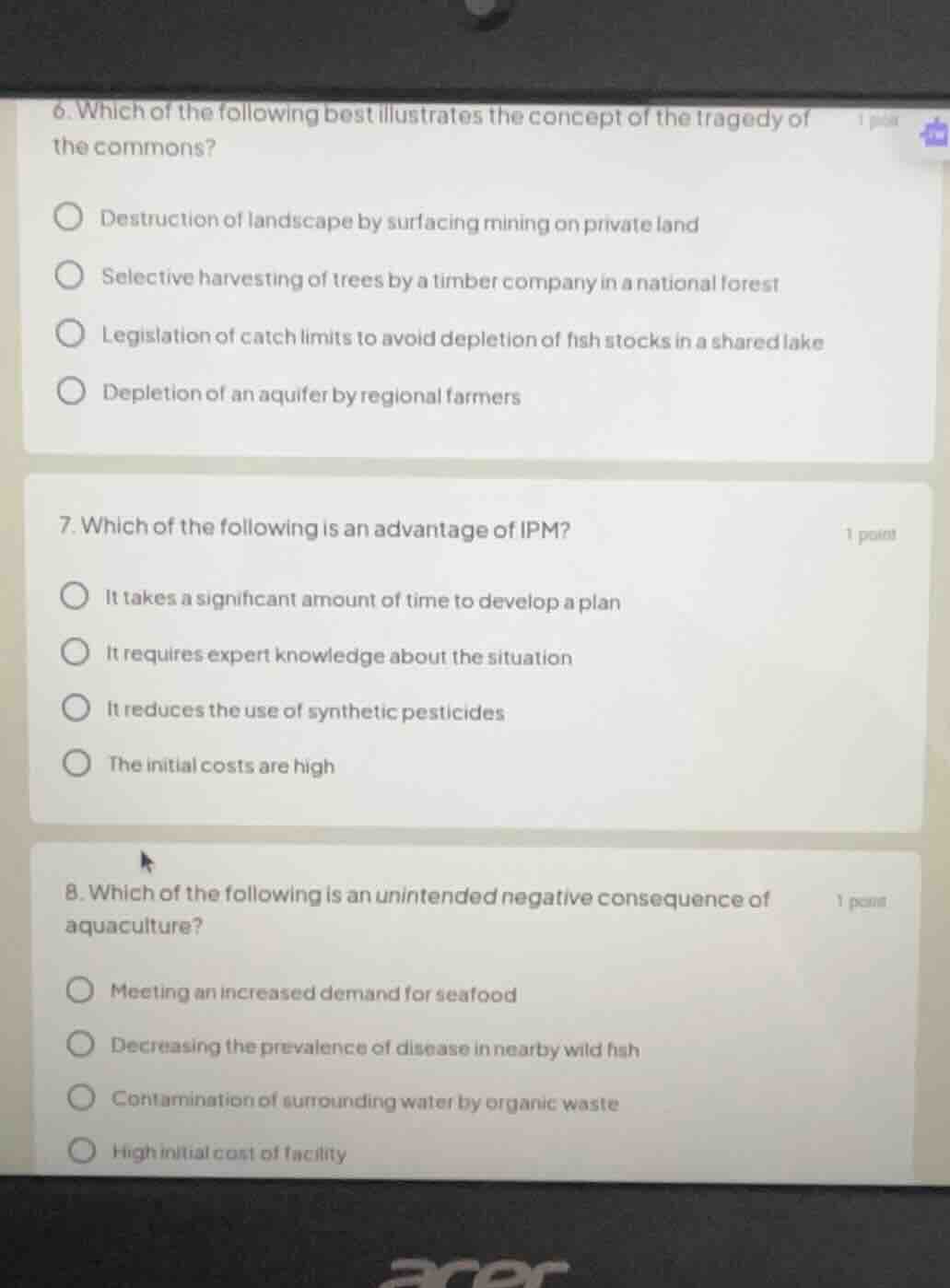
- which of the following best illustrates the concept of the tragedy of the commons?
options:
- destruction of landscape by surfacing mining on private land
- selective harvesting of trees by a timber company in a national forest
- legislation of catch limits to avoid depletion of fish stocks in a shared lake
- depletion of an aquifer by regional farmers
- which of the following is an advantage of ipm?
options:
- it takes a significant amount of time to develop a plan
- it requires expert knowledge about the situation
- it reduces the use of synthetic pesticides
- the initial costs are high
- which of the following is an unintended negative consequence of aquaculture?
options:
- meeting an increased demand for seafood
- decreasing the prevalence of disease in nearby wild fish
- contamination of surrounding water by organic waste
- high initial cost of facility
Response
Question 6
Brief Explanations
The tragedy of the commons refers to the overuse or depletion of a shared resource by individuals acting in their own self - interest.
- Option 1: The land is private, not a common resource, so it does not illustrate the tragedy of the commons.
- Option 2: Selective harvesting in a national forest, if done sustainably, is not overuse. Also, a national forest is managed, and selective harvesting is not the same as the unregulated overuse of a common resource.
- Option 3: Legislation of catch limits is a solution to prevent the tragedy of the commons, not an illustration of it.
- Option 4: An aquifer is a shared resource (common pool resource). Regional farmers, acting in their own self - interest (to get water for their farms), deplete the aquifer, which is a classic example of the tragedy of the commons.
Brief Explanations
Integrated Pest Management (IPM) is a pest control strategy that aims to minimize the use of synthetic pesticides.
- Option 1: Taking a significant amount of time to develop a plan is a disadvantage, not an advantage.
- Option 2: Requiring expert knowledge is a requirement, not an advantage in terms of the benefits of IPM.
- Option 3: Reducing the use of synthetic pesticides is a key advantage of IPM as it is more environmentally friendly and can reduce the development of pesticide - resistant pests.
- Option 4: High initial costs are a disadvantage, not an advantage.
Brief Explanations
We are looking for an unintended negative consequence of aquaculture.
- Option 1: Meeting an increased demand for seafood is a positive or intended outcome of aquaculture.
- Option 2: Aquaculture often increases the prevalence of disease in nearby wild fish (due to escaped farmed fish or contamination), so decreasing disease prevalence is not a consequence, let alone an unintended negative one.
- Option 3: Aquaculture facilities produce organic waste (from fish excrement, uneaten food, etc.). This waste can contaminate the surrounding water, and this is an unintended negative consequence as the main goal of aquaculture is to produce seafood, not to contaminate water.
- Option 4: High initial cost of the facility is a financial consideration during setup, not a consequence of the aquaculture operation itself (in terms of environmental or other operational impacts).

Snap & solve any problem in the app
Get step-by-step solutions on Sovi AI
Photo-based solutions with guided steps
Explore more problems and detailed explanations
D. Depletion of an aquifer by regional farmers