QUESTION IMAGE
Question
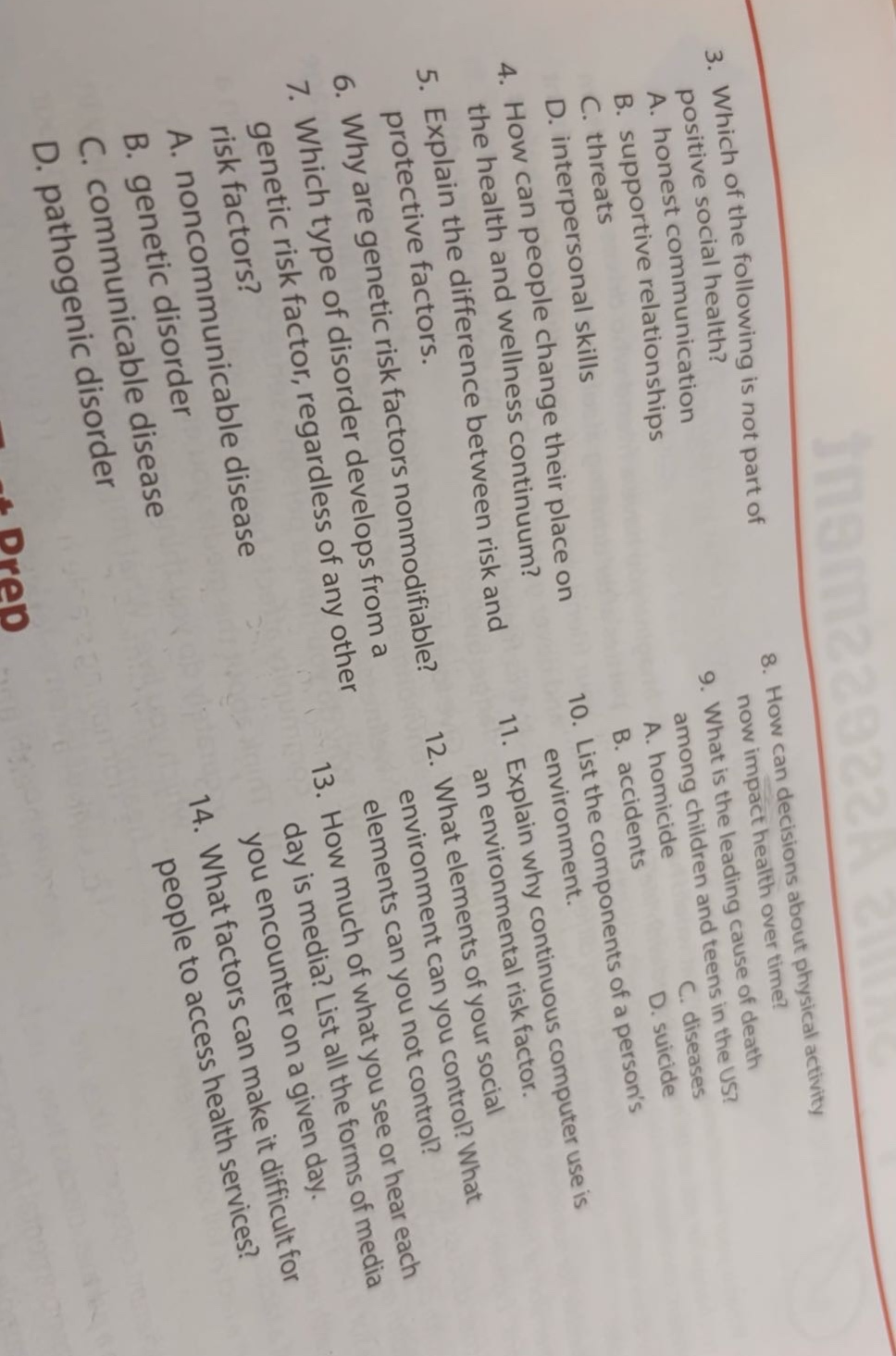
- which of the following is not part of positive social health?
a. honest communication
b. supportive relationships
c. threats
d. interpersonal skills
- how can people change their place on the health and wellness continuum?
- explain the difference between risk and protective factors.
- why are genetic risk factors nonmodifiable?
- which type of disorder develops from a genetic risk factor, regardless of any other risk factors?
a. noncommunicable disease
b. genetic disorder
c. communicable disease
d. pathogenic disorder
- how can decisions about physical activity now impact health over time?
- what is the leading cause of death among children and teens in the us?
a. homicide
b. accidents
c. diseases
d. suicide
- list the components of a person’s environment.
- explain why continuous computer use is an environmental risk factor.
- what elements of your social environment can you control? what elements can you not control?
- how much of what you see or hear each day is media? list all the forms of media you encounter on a given day.
- what factors can make it difficult for people to access health services?
Question 3
Positive social health includes aspects like honest communication, supportive relationships, and interpersonal skills as they relate to social well - being. Threats are negative and not part of positive social health.
A genetic risk factor that leads to a genetic disorder is specific to genetic - based conditions. Noncommunicable diseases (A) are not directly related to a genetic risk factor in this context, communicable diseases (B) are caused by external agents, and pathogenic disorders (D) are from pathogens. A genetic disorder (A) is the result of a genetic risk factor.
In the US, among children and teens, suicide is a leading cause of death. Homicide (A), accidents (B), and diseases (C) are not the leading cause of death in this demographic group compared to suicide.

Snap & solve any problem in the app
Get step-by-step solutions on Sovi AI
Photo-based solutions with guided steps
Explore more problems and detailed explanations
C. threats