QUESTION IMAGE
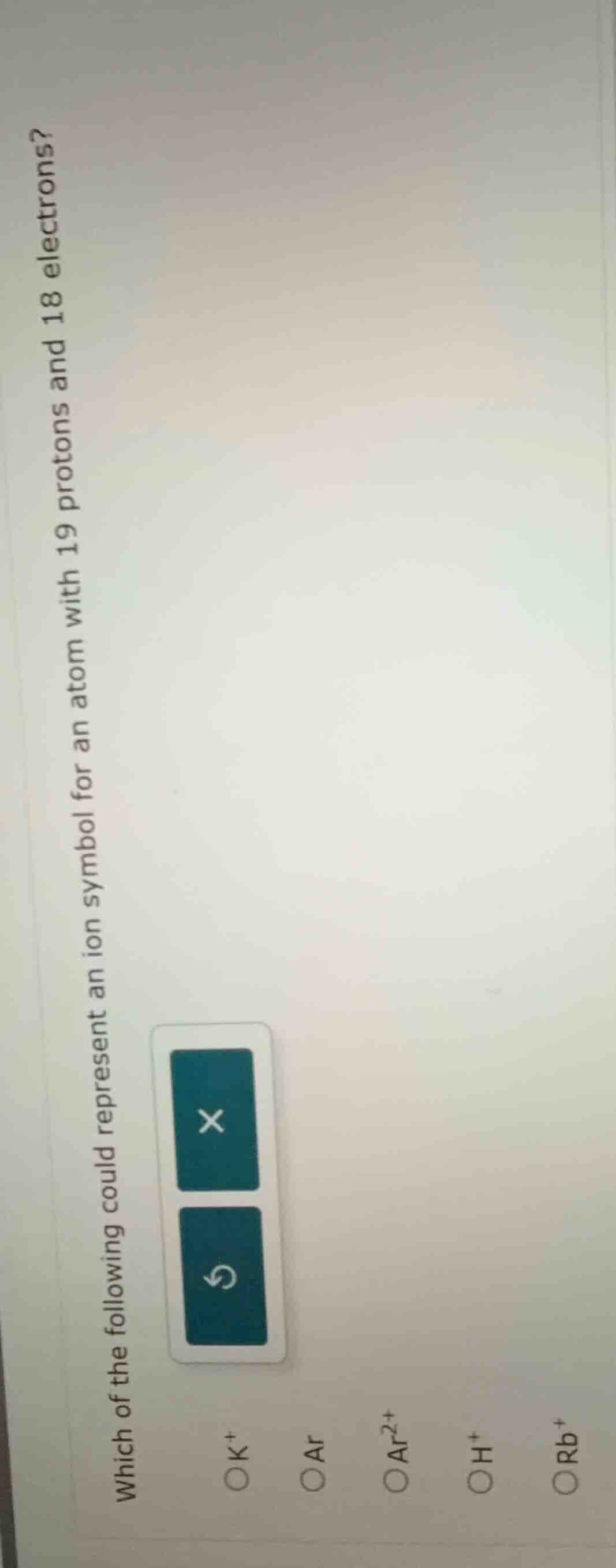
Question
which of the following could represent an ion symbol for an atom with 19 protons and 18 electrons? \\(\bigcirc \text{k}^+\\) \\(\bigcirc \text{ar}\\) \\(\bigcirc \text{ar}^{2+}\\) \\(\bigcirc \text{h}^+\\) \\(\bigcirc \text{rb}^+\\)
Step1: Recall proton and electron rules
The number of protons is equal to the atomic number. For a neutral atom, electrons = protons; for an ion, electrons = protons ± charge (positive charge means lost electrons, negative means gained).
Step2: Analyze each option
- Option \( \boldsymbol{K^+} \): Atomic number of K is 19 (protons = 19). Charge is +1, so electrons = 19 - 1 = 18. Matches 19 protons and 18 electrons.
- Option \( \boldsymbol{Ar} \): Atomic number of Ar is 18 (protons = 18). Neutral, so electrons = 18. Does not match 19 protons.
- Option \( \boldsymbol{Ar^{2+}} \): Protons = 18, electrons = 18 - 2 = 16. Does not match.
- Option \( \boldsymbol{H^+} \): Protons = 1, electrons = 0. Does not match.
- Option \( \boldsymbol{Rb^+} \): Atomic number of Rb is 37 (protons = 37). Electrons = 37 - 1 = 36. Does not match.

Snap & solve any problem in the app
Get step-by-step solutions on Sovi AI
Photo-based solutions with guided steps
Explore more problems and detailed explanations
\( \boldsymbol{K^+} \)