QUESTION IMAGE
Question
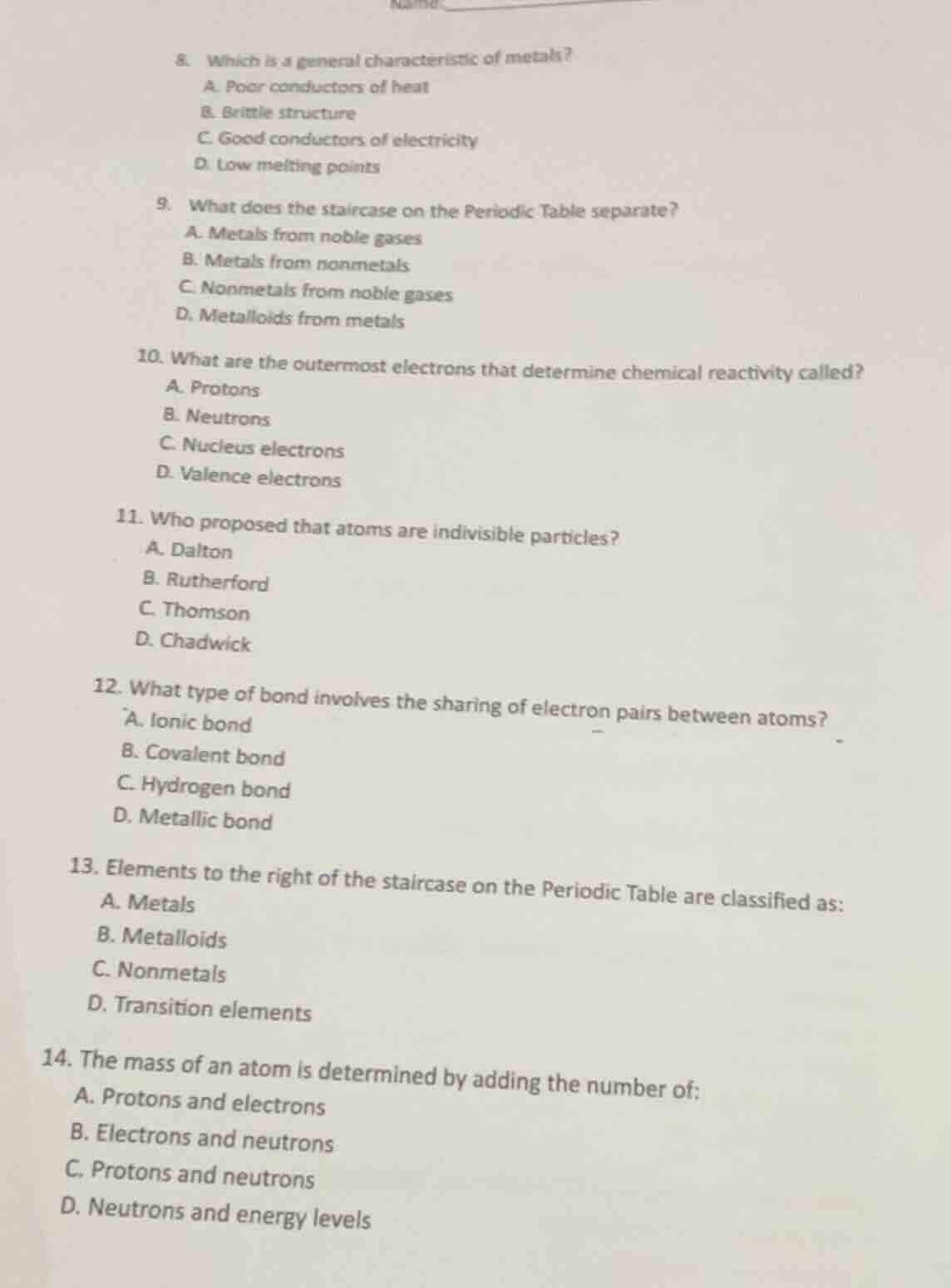
- which is a general characteristic of metals?
a. poor conductors of heat
b. brittle structure
c. good conductors of electricity
d. low melting points
- what does the staircase on the periodic table separate?
a. metals from noble gases
b. metals from nonmetals
c. nonmetals from noble gases
d. metalloids from metals
- what are the outermost electrons that determine chemical reactivity called?
a. protons
b. neutrons
c. nucleus electrons
d. valence electrons
- who proposed that atoms are indivisible particles?
a. dalton
b. rutherford
c. thomson
d. chadwick
- what type of bond involves the sharing of electron pairs between atoms?
a. ionic bond
b. covalent bond
c. hydrogen bond
d. metallic bond
- elements to the right of the staircase on the periodic table are classified as:
a. metals
b. metalloids
c. nonmetals
d. transition elements
- the mass of an atom is determined by adding the number of:
a. protons and electrons
b. electrons and neutrons
c. protons and neutrons
d. neutrons and energy levels
Brief Explanations
- Metals are known for high electrical conductivity; other options describe nonmetal properties.
- The periodic table staircase divides metals (left) and nonmetals (right).
- Valence electrons are the outermost electrons governing reactivity.
- Dalton's atomic theory stated atoms are indivisible.
- Covalent bonds form via shared electron pairs between atoms.
- Nonmetals lie to the right of the periodic table staircase.
- Atomic mass comes from protons + neutrons (electrons have negligible mass).

Snap & solve any problem in the app
Get step-by-step solutions on Sovi AI
Photo-based solutions with guided steps
Explore more problems and detailed explanations
- C. Good conductors of electricity
- B. Metals from nonmetals
- D. Valence electrons
- A. Dalton
- B. Covalent bond
- C. Nonmetals
- C. Protons and neutrons