QUESTION IMAGE
Question
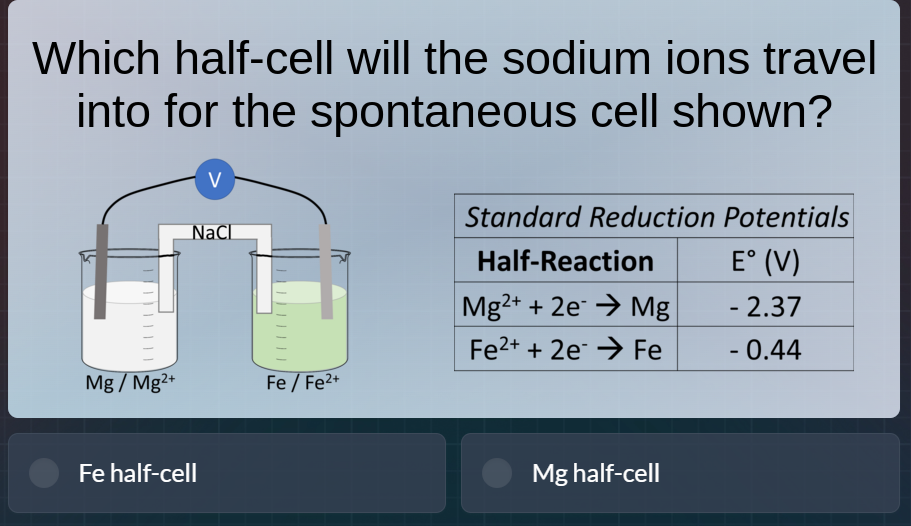
which half - cell will the sodium ions travel into for the spontaneous cell shown? standard reduction potentials half - reaction e° (v) mg²⁺ + 2e⁻ → mg - 2.37 fe²⁺ + 2e⁻ → fe - 0.44 options: fe half - cell, mg half - cell
Step1: Determine anode and cathode
In a spontaneous electrochemical cell, the half - reaction with the more negative standard reduction potential will be the oxidation (anode) reaction, and the one with the less negative (more positive) potential will be the reduction (cathode) reaction. The standard reduction potential of \(Mg^{2 +}+2e^-
ightarrow Mg\) is \(E^{\circ}=- 2.37\ V\) and for \(Fe^{2+}+2e^-
ightarrow Fe\) is \(E^{\circ}=-0.44\ V\). Since \(-2.37<- 0.44\), \(Mg\) will be oxidized (anode: \(Mg
ightarrow Mg^{2+}+2e^-\)) and \(Fe^{2+}\) will be reduced (cathode: \(Fe^{2+}+2e^-
ightarrow Fe\)).
Step2: Determine ion flow
In an electrochemical cell, cations (like \(Na^+\) from the salt bridge, and also the cations produced at the anode) move towards the cathode. The cathode is the \(Fe/Fe^{2+}\) half - cell (since \(Fe^{2+}\) is being reduced here). So sodium ions (cations) will travel into the \(Fe\) half - cell.

Snap & solve any problem in the app
Get step-by-step solutions on Sovi AI
Photo-based solutions with guided steps
Explore more problems and detailed explanations
Fe half - cell