QUESTION IMAGE
Question
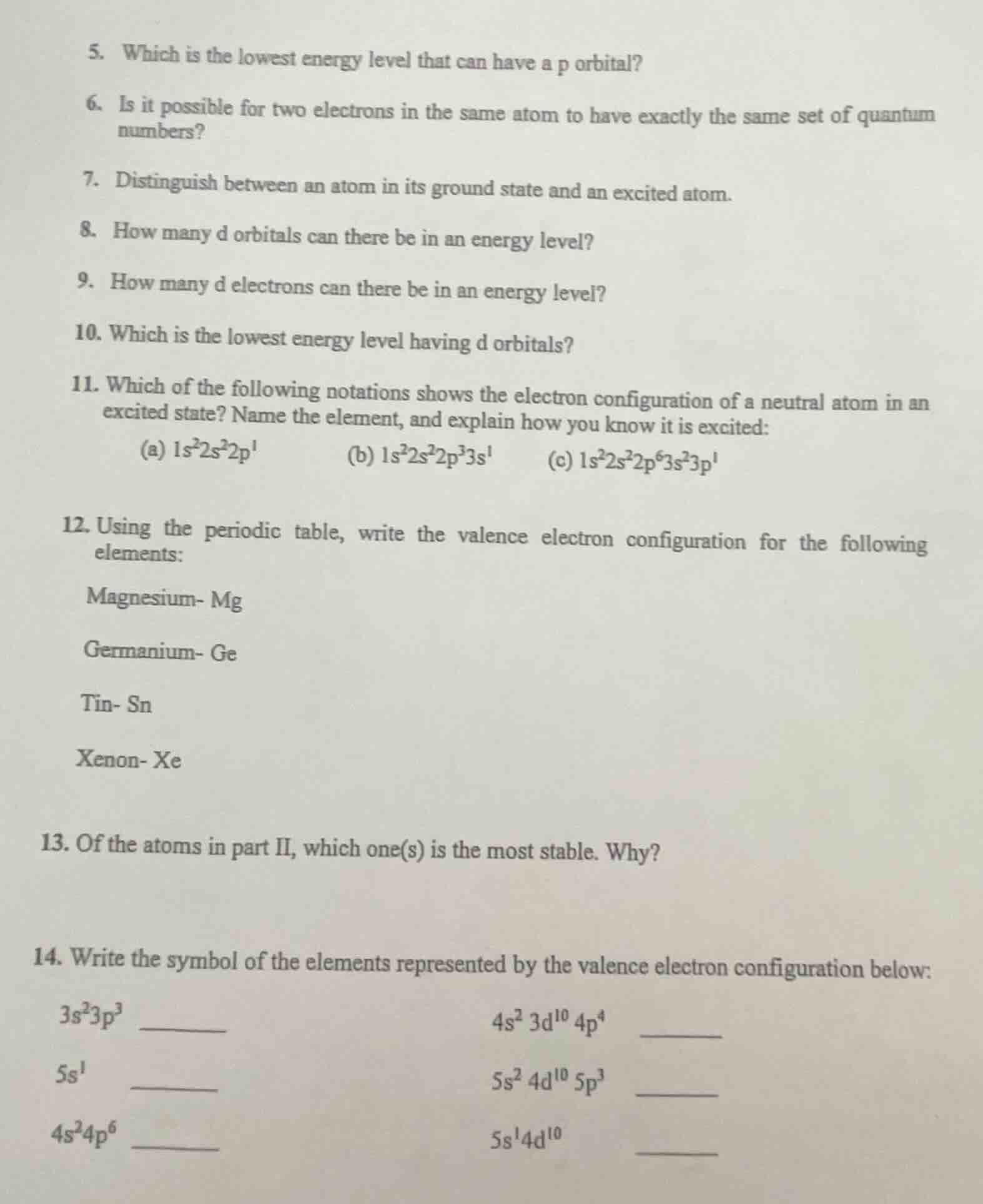
- which is the lowest energy level that can have a p orbital?
- is it possible for two electrons in the same atom to have exactly the same set of quantum numbers?
- distinguish between an atom in its ground state and an excited atom.
- how many d orbitals can there be in an energy level?
- how many d electrons can there be in an energy level?
- which is the lowest energy level having d orbitals?
- which of the following notations shows the electron configuration of a neutral atom in an excited state? name the element, and explain how you know it is excited:
(a) $1s^22s^22p^1$
(b) $1s^22s^22p^33s^1$
(c) $1s^22s^22p^63s^23p^1$
- using the periodic table, write the valence electron configuration for the following elements:
magnesium- mg
germanium- ge
tin- sn
xenon- xe
- of the atoms in part ii, which one(s) is the most stable. why?
- write the symbol of the elements represented by the valence electron configuration below:
$3s^23p^3$ ________
$4s^2 3d^{10} 4p^4$ ________
$5s^1$ ________
$5s^2 4d^{10} 5p^3$ ________
$4s^24p^6$ ________
$5s^14d^{10}$ ________
Question 5
Orbitals correspond to principal quantum numbers ($n$): s orbitals start at $n=1$, p orbitals start at $n=2$.
Question 6
This is governed by the Pauli Exclusion Principle, which states no two electrons in an atom can share all four quantum numbers.
Question 7
Ground state means electrons occupy the lowest possible energy levels; excited state means at least one electron has moved to a higher energy level.
Question 8
The number of orbitals in a subshell is given by $2l+1$, where $l=2$ for d orbitals.
Question 9
Each orbital holds a maximum of 2 electrons. Multiply the number of d orbitals by 2.
Question 10
d orbitals correspond to the azimuthal quantum number $l=2$, which requires the principal quantum number $n \geq l+1$.
Question 11
A ground state configuration fills lower energy subshells completely before higher ones. An excited state has an electron in a higher subshell while a lower one is not full.
Question 12
Valence electrons are the outermost electrons, determined by the element's position in the periodic table:
- Magnesium (Group 2, Period 3): valence electrons in 3s
- Germanium (Group 14, Period 4): valence electrons in 4s and 4p
- Tin (Group 14, Period 5): valence electrons in 5s and 5p
- Xenon (Group 18, Period 5): valence electrons in 5s and 5p
Question 13
Stability is highest for atoms with a full valence shell (octet or duet), which are noble gases.
Question 14
Match the valence electron configuration to the element's position in the periodic table:
- $3s^23p^3$: Period 3, Group 15
- $4s^23d^{10}4p^4$: Period 4, Group 16
- $5s^1$: Period 5, Group 1
- $5s^24d^{10}5p^3$: Period 5, Group 15
- $4s^24p^6$: Period 4, Group 18
- $5s^14d^{10}$: Period 5, Group 11 (exceptional configuration)

Snap & solve any problem in the app
Get step-by-step solutions on Sovi AI
Photo-based solutions with guided steps
Explore more problems and detailed explanations
- The lowest energy level is $n=2$
- No, it is not possible.
- A ground state atom has all electrons in the lowest available energy levels; an excited atom has at least one electron in a higher energy level than its ground state position.
- 5
- 10
- The lowest energy level is $n=3$
- (b) $1s^22s^22p^33s^1$; the element is oxygen (O). In the ground state, oxygen's 2p subshell would hold 4 electrons (full 2s, then fill 2p before 3s), but here one electron is in the higher energy 3s orbital while the 2p subshell is not full, indicating an excited state.
12.
- Magnesium (Mg): $3s^2$
- Germanium (Ge): $4s^24p^2$
- Tin (Sn): $5s^25p^2$
- Xenon (Xe): $5s^25p^6$
- Xenon (Xe) is the most stable. It is a noble gas with a full valence electron shell ($5s^25p^6$), which gives it high chemical stability and low reactivity.
14.
- $3s^23p^3$: P
- $4s^23d^{10}4p^4$: Se
- $5s^1$: Rb
- $5s^24d^{10}5p^3$: Sb
- $4s^24p^6$: Kr
- $5s^14d^{10}$: Ag