QUESTION IMAGE
Question
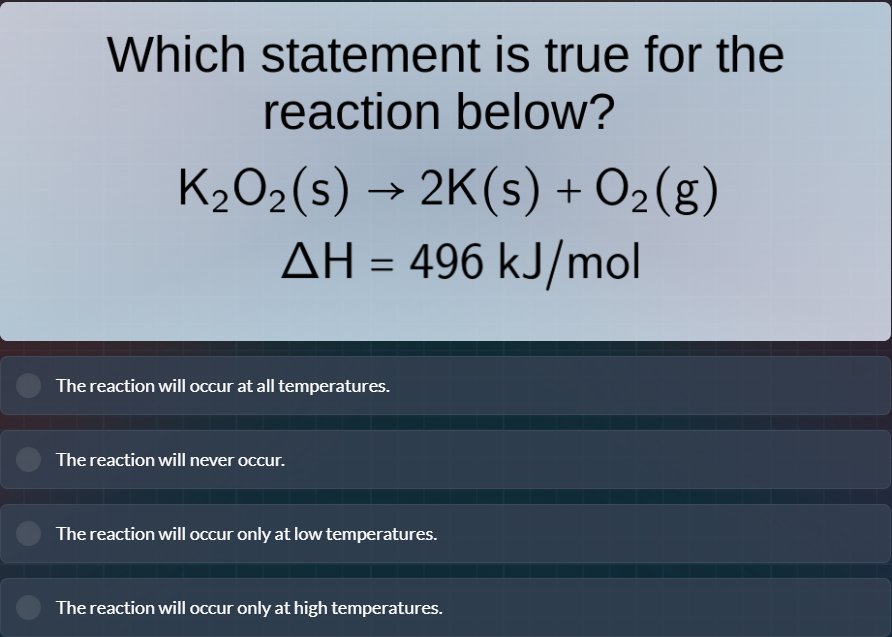
which statement is true for the reaction below?
k₂o₂(s) → 2k(s) + o₂(g)
δh = 496 kj/mol
the reaction will occur at all temperatures.
the reaction will never occur.
the reaction will occur only at low temperatures.
the reaction will occur only at high temperatures.
To determine the temperature dependence of the reaction \( \text{K}_2\text{O}_2(s)
ightarrow 2\text{K}(s) + \text{O}_2(g) \) with \( \Delta H = 496 \, \text{kJ/mol} \), we analyze the enthalpy (\( \Delta H \)) and entropy (\( \Delta S \)) changes:
- Enthalpy Change (\( \Delta H \)): The reaction has \( \Delta H = +496 \, \text{kJ/mol} \), meaning it is endothermic (heat is absorbed from the surroundings).
- Entropy Change (\( \Delta S \)): The reaction produces \( \text{O}_2(g) \) from a solid reactant (\( \text{K}_2\text{O}_2(s) \)). Gases have higher entropy than solids, so \( \Delta S \) is positive (disorder increases).
For a reaction to be spontaneous, the Gibbs free energy change (\( \Delta G \)) must be negative, where \( \Delta G = \Delta H - T\Delta S \).
- At low temperatures: \( T\Delta S \) is small (since \( T \) is low). Thus, \( \Delta G = \text{(positive } \Delta H) - \text{(small } T\Delta S) \) remains positive (non - spontaneous).
- At high temperatures: \( T\Delta S \) becomes large (since \( T \) is high). Thus, \( \Delta G = \text{(positive } \Delta H) - \text{(large } T\Delta S) \) can become negative (spontaneous).
The first option ("occurs at all temperatures") is wrong because \( \Delta H \) is positive (endothermic) and low \( T \) makes \( \Delta G \) positive. The second option ("never occurs") is wrong because high \( T \) can make \( \Delta G \) negative. The third option ("only at low temperatures") is wrong because low \( T \) gives positive \( \Delta G \). Only the fourth option ("only at high temperatures") matches the analysis: high \( T \) makes \( T\Delta S \) large enough to overcome the positive \( \Delta H \), leading to \( \Delta G < 0 \) (spontaneous reaction).

Snap & solve any problem in the app
Get step-by-step solutions on Sovi AI
Photo-based solutions with guided steps
Explore more problems and detailed explanations
The reaction will occur only at high temperatures.