QUESTION IMAGE
Question
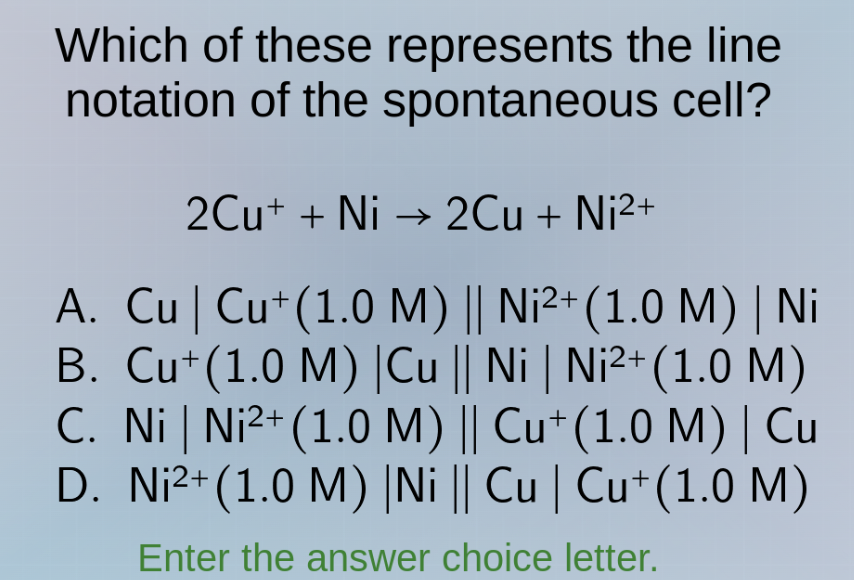
which of these represents the line notation of the spontaneous cell? 2cu⁺ + ni → 2cu + ni²⁺ a. cu | cu⁺(1.0 m) || ni²⁺(1.0 m) | ni b. cu⁺(1.0 m) |cu || ni | ni²⁺(1.0 m) c. ni | ni²⁺(1.0 m) || cu⁺(1.0 m) | cu d. ni²⁺(1.0 m) |ni || cu | cu⁺(1.0 m) enter the answer choice letter.
To determine the line notation of a spontaneous cell, we first identify the oxidation (anode) and reduction (cathode) half - reactions.
- For the given reaction \(2Cu^{+}+Ni
ightarrow2Cu + Ni^{2+}\):
- Oxidation half - reaction (anode): \(Ni
ightarrow Ni^{2+}+2e^{-}\) (Ni is oxidized as its oxidation state increases from 0 to +2).
- Reduction half - reaction (cathode): \(Cu^{+}+e^{-}
ightarrow Cu\) (Cu⁺ is reduced as its oxidation state decreases from +1 to 0).
- In line notation, the anode is written on the left, with the metal and its ion, and the cathode is written on the right, with the metal and its ion. The anode has the format \(Metal|Metal^{n +}\) (where oxidation occurs), and the cathode has the format \(Metal^{m+}|Metal\) (where reduction occurs), separated by \(||\) for the salt bridge.
- For the anode (oxidation of Ni), the notation is \(Ni|Ni^{2+}(1.0\ M)\).
- For the cathode (reduction of \(Cu^{+}\) to Cu), the notation is \(Cu^{+}(1.0\ M)|Cu\).
- Combining them, the line notation is \(Ni|Ni^{2+}(1.0\ M)||Cu^{+}(1.0\ M)|Cu\), which corresponds to option C.

Snap & solve any problem in the app
Get step-by-step solutions on Sovi AI
Photo-based solutions with guided steps
Explore more problems and detailed explanations
C