QUESTION IMAGE
Question
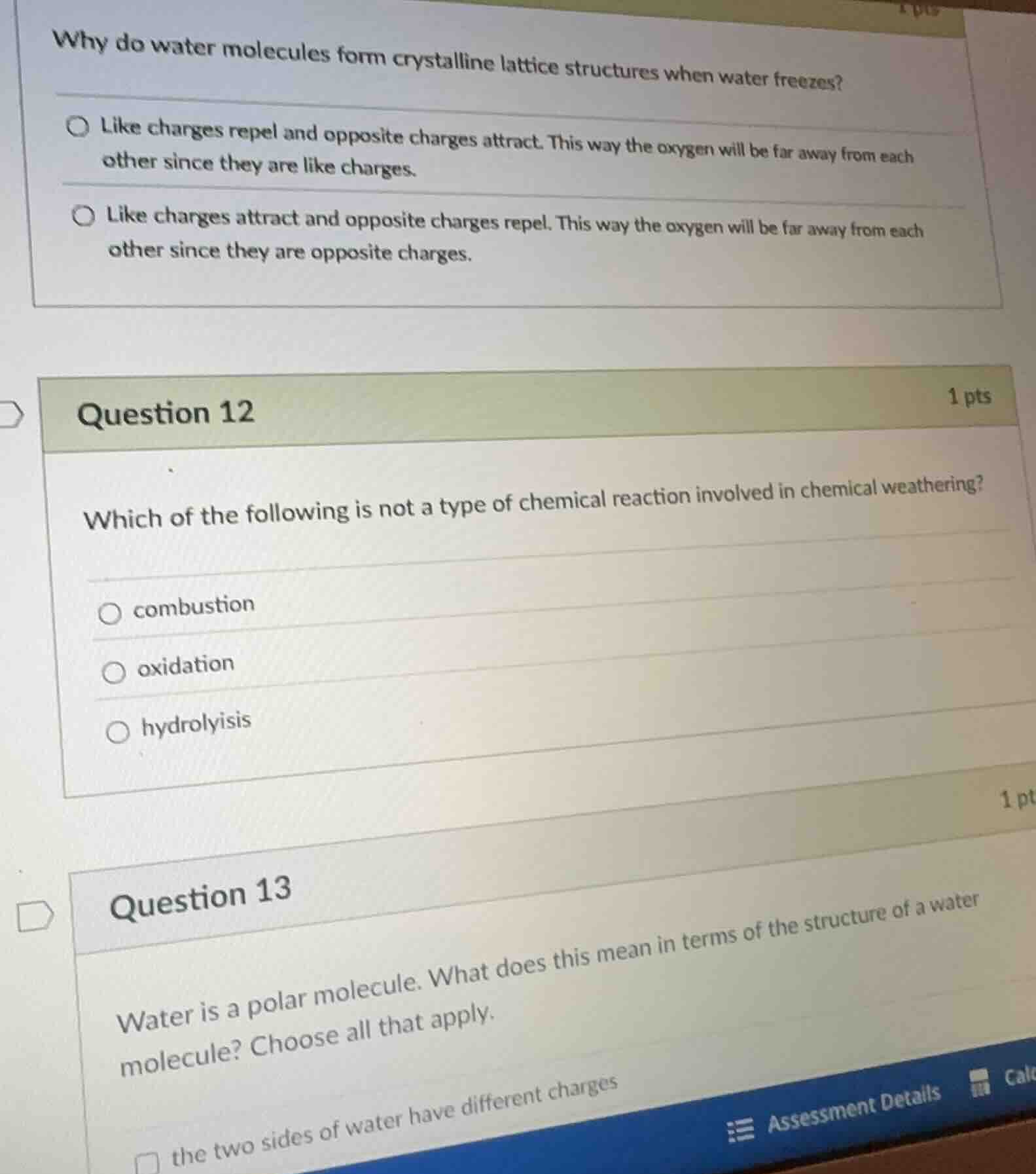
why do water molecules form crystalline lattice structures when water freezes?
like charges repel and opposite charges attract. this way the oxygen will be far away from each other since they are like charges.
like charges attract and opposite charges repel. this way the oxygen will be far away from each other since they are opposite charges.
question 12
1 pts
which of the following is not a type of chemical reaction involved in chemical weathering?
combustion
oxidation
hydrolyisis
question 13
1 pt
water is a polar molecule. what does this mean in terms of the structure of a water molecule? choose all that apply.
the two sides of water have different charges
Question (about water freezing lattice structure)
To determine the correct option, we recall the basic principle of electric charges: like charges repel, and opposite charges attract. In a water molecule, the oxygen atom has a partial negative charge, and hydrogen atoms have partial positive charges. When water freezes, the molecules arrange in a lattice due to these charge - based interactions. The first option states "Like charges repel and opposite charges attract. This way the oxygen will be far away from each other since they are like charges", which is consistent with the charge interaction principle. The second option has the incorrect rule (like charges attract and opposite charges repel), so it is wrong.
Chemical weathering involves reactions like oxidation (reaction with oxygen), hydrolysis (reaction with water). Combustion is a reaction that requires a fuel, an oxidizer, and heat, and it is not a type of reaction involved in chemical weathering. Oxidation and hydrolysis are typical in chemical weathering processes.
A polar molecule has a separation of charge, meaning different parts of the molecule have different electrical charges. For a water molecule (\(H_2O\)), the oxygen atom is more electronegative than the hydrogen atoms. This causes the oxygen side of the water molecule to have a partial negative charge and the hydrogen side to have a partial positive charge. So the statement "the two sides of water have different charges" is correct as it describes the polar nature of the water molecule (the oxygen - containing side is partially negative and the hydrogen - containing side is partially positive).

Snap & solve any problem in the app
Get step-by-step solutions on Sovi AI
Photo-based solutions with guided steps
Explore more problems and detailed explanations
The correct option is: "Like charges repel and opposite charges attract. This way the oxygen will be far away from each other since they are like charges."