QUESTION IMAGE
Question
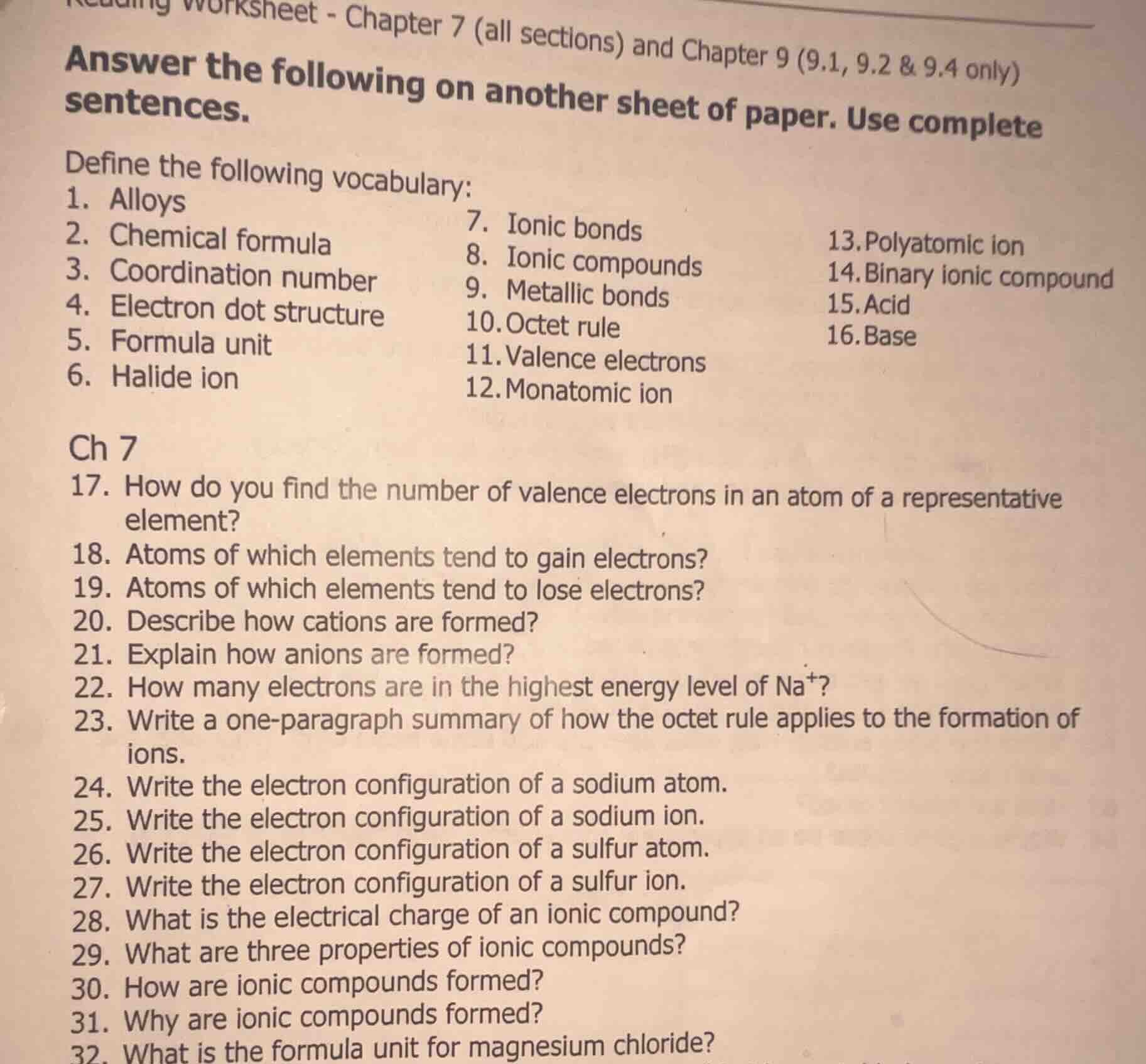
worksheet - chapter 7 (all sections) and chapter 9 (9.1, 9.2 & 9.4 only)answer the following on another sheet of paper. use complete sentences.define the following vocabulary:1. alloys2. chemical formula3. coordination number4. electron dot structure5. formula unit6. halide ion7. ionic bonds8. ionic compounds9. metallic bonds10. octet rule11. valence electrons12. monatomic ion13.polyatomic ion14.binary ionic compound15.acid16.basech 717. how do you find the number of valence electrons in an atom of a representative element?18. atoms of which elements tend to gain electrons?19. atoms of which elements tend to lose electrons?20. describe how cations are formed?21. explain how anions are formed?22. how many electrons are in the highest energy level of $na^+$?23. write a one-paragraph summary of how the octet rule applies to the formation of ions.24. write the electron configuration of a sodium atom.25. write the electron configuration of a sodium ion.26. write the electron configuration of a sulfur atom.27. write the electron configuration of a sulfur ion.28. what is the electrical charge of an ionic compound?29. what are three properties of ionic compounds?30. how are ionic compounds formed?31. why are ionic compounds formed?32. what is the formula unit for magnesium chloride?
Vocabulary Definitions:
- Alloys: Homogeneous mixtures of metals (or metal + non-metal) with enhanced properties.
- Chemical formula: Notation using element symbols and subscripts to show a compound's atom ratio.
- Coordination number: Number of adjacent atoms/ions bonded to a central atom/ion.
- Electron dot structure: Diagram showing valence electrons as dots around an element's symbol.
- Formula unit: Simplest whole-number ratio of ions in an ionic compound.
- Halide ion: Negatively charged ion formed by a halogen (Group 17) gaining 1 electron.
- Ionic bonds: Electrostatic attraction between positively and negatively charged ions.
- Ionic compounds: Neutral substances made of cations and anions held by ionic bonds.
- Metallic bonds: Attraction between metal cations and delocalized "sea of electrons".
- Octet rule: Atoms tend to gain/lose/share electrons to get 8 valence electrons (stable noble gas configuration).
- Valence electrons: Electrons in an atom's outermost energy level, involved in bonding.
- Monatomic ion: Ion formed from a single atom gaining or losing electrons.
- Polyatomic ion: Charged group of covalently bonded atoms that acts as a single ion.
- Binary ionic compound: Ionic compound made of exactly two different elements (one metal, one nonmetal).
- Acid: Substance that releases H⁺ ions in aqueous solution (Arrhenius definition).
- Base: Substance that releases OH⁻ ions in aqueous solution (Arrhenius definition).
Chapter 7 Questions:
- For representative elements, match the group number (1A-8A) to valence electron count (1-8, respectively).
- Nonmetals (right side of periodic table) tend to gain electrons to reach an octet.
- Metals (left side of periodic table) tend to lose electrons to reach an octet.
- Cations form when a metal atom loses valence electrons, becoming positively charged.
- Anions form when a nonmetal atom gains valence electrons, becoming negatively charged.
- Neutral Na has 11 electrons; Na⁺ loses 1, so its highest energy level (n=2) has 8 electrons.
- The octet rule drives ion formation: metals lose valence electrons to empty their outermost shell (matching the previous noble gas's full octet), while nonmetals gain electrons to fill their outermost shell to 8 electrons. This electron transfer creates charged ions, which are then attracted to each other to form stable ionic compounds, with each ion achieving a noble gas electron configuration.
- Sodium atom (11 electrons): 1s² 2s² 2p⁶ 3s¹
- Sodium ion (10 electrons, lost 1 valence electron): 1s² 2s² 2p⁶
- Sulfur atom (16 electrons): 1s² 2s² 2p⁶ 3s² 3p⁴
- Sulfur ion (18 electrons, gained 2 electrons): 1s² 2s² 2p⁶ 3s² 3p⁶
- Ionic compounds are neutral; total positive charge equals total negative charge.
- Common properties: high melting/boiling points, brittle, conduct electricity when molten/dissolved in water.
- Ionic compounds form when electrons transfer from a metal atom to a nonmetal atom, creating cations and anions that are held together by electrostatic attraction.
- They form to achieve stable, lower-energy electron configurations (octet rule) for the constituent atoms, resulting in a neutral, stable substance.
- Magnesium (Mg²⁺) and chloride (Cl⁻) combine in a 1:2 ratio to balance charge, so the formula unit is MgCl₂.

Snap & solve any problem in the app
Get step-by-step solutions on Sovi AI
Photo-based solutions with guided steps
Explore more problems and detailed explanations
Vocabulary Definitions:
- Alloys: Homogeneous mixtures of metals (or metal + non-metal) with enhanced properties.
- Chemical formula: Notation using element symbols and subscripts to show a compound's atom ratio.
- Coordination number: Number of adjacent atoms/ions bonded to a central atom/ion.
- Electron dot structure: Diagram showing valence electrons as dots around an element's symbol.
- Formula unit: Simplest whole-number ratio of ions in an ionic compound.
- Halide ion: Negatively charged ion formed by a halogen (Group 17) gaining 1 electron.
- Ionic bonds: Electrostatic attraction between positively and negatively charged ions.
- Ionic compounds: Neutral substances made of cations and anions held by ionic bonds.
- Metallic bonds: Attraction between metal cations and delocalized "sea of electrons".
- Octet rule: Atoms tend to gain/lose/share electrons to get 8 valence electrons (stable noble gas configuration).
- Valence electrons: Electrons in an atom's outermost energy level, involved in bonding.
- Monatomic ion: Ion formed from a single atom gaining or losing electrons.
- Polyatomic ion: Charged group of covalently bonded atoms that acts as a single ion.
- Binary ionic compound: Ionic compound made of exactly two different elements (one metal, one nonmetal).
- Acid: Substance that releases H⁺ ions in aqueous solution (Arrhenius definition).
- Base: Substance that releases OH⁻ ions in aqueous solution (Arrhenius definition).
Chapter 7 Questions:
- Match the element's main group number (1A-8A) to the number of valence electrons (1-8).
- Nonmetallic elements (right side of the periodic table)
- Metallic elements (left side of the periodic table)
- When a metal atom loses valence electrons, gaining a positive charge.
- When a nonmetal atom gains valence electrons, gaining a negative charge.
- 8 electrons
- The octet rule drives ion formation: metals lose valence electrons to match the electron configuration of the previous noble gas (a full octet in the next lower energy level), while nonmetals gain valence electrons to fill their outermost shell to 8 electrons. This electron transfer creates positively charged cations and negatively charged anions, which are attracted to one another via electrostatic forces to form stable ionic compounds, with each ion achieving the stable noble gas electron configuration.
- 1s² 2s² 2p⁶ 3s¹
- 1s² 2s² 2p⁶
- 1s² 2s² 2p⁶ 3s² 3p⁴
- 1s² 2s² 2p⁶ 3s² 3p⁶
- Neutral (zero net electrical charge)
- High melting/boiling points; brittle solid structure; conducts electricity when molten or dissolved in water
- When electrons transfer from a metal atom to a nonmetal atom, forming cations and anions that are held together by electrostatic attraction.
- To allow atoms to achieve a stable noble gas electron configuration (octet rule), creating a lower-energy, neutral stable substance.
- MgCl₂