QUESTION IMAGE
Question
- list 2 types of passive transport.
- a) the movement of a substance from a high concentration to where there is a low concentration is ________. (active or passive)
b) ________ is movement of water across a cell’s membrane. (active or passive)
c) ____________________ is the movement of a substance across a cell’s membrane with “help” from proteins. (active or passive)
- a. how does the concentration of dissolved substances of an isotonic solution compare to the concentration of dissolved substances inside the cell? in an isotonic solution, the concentrations are equal.
b. what about in a hypotonic solution? there is a higher concentration of solutes inside the cell than on the outside.
c. what about in a hypertonic solution? there is a higher concentration of solutes in the solution outside the cell.
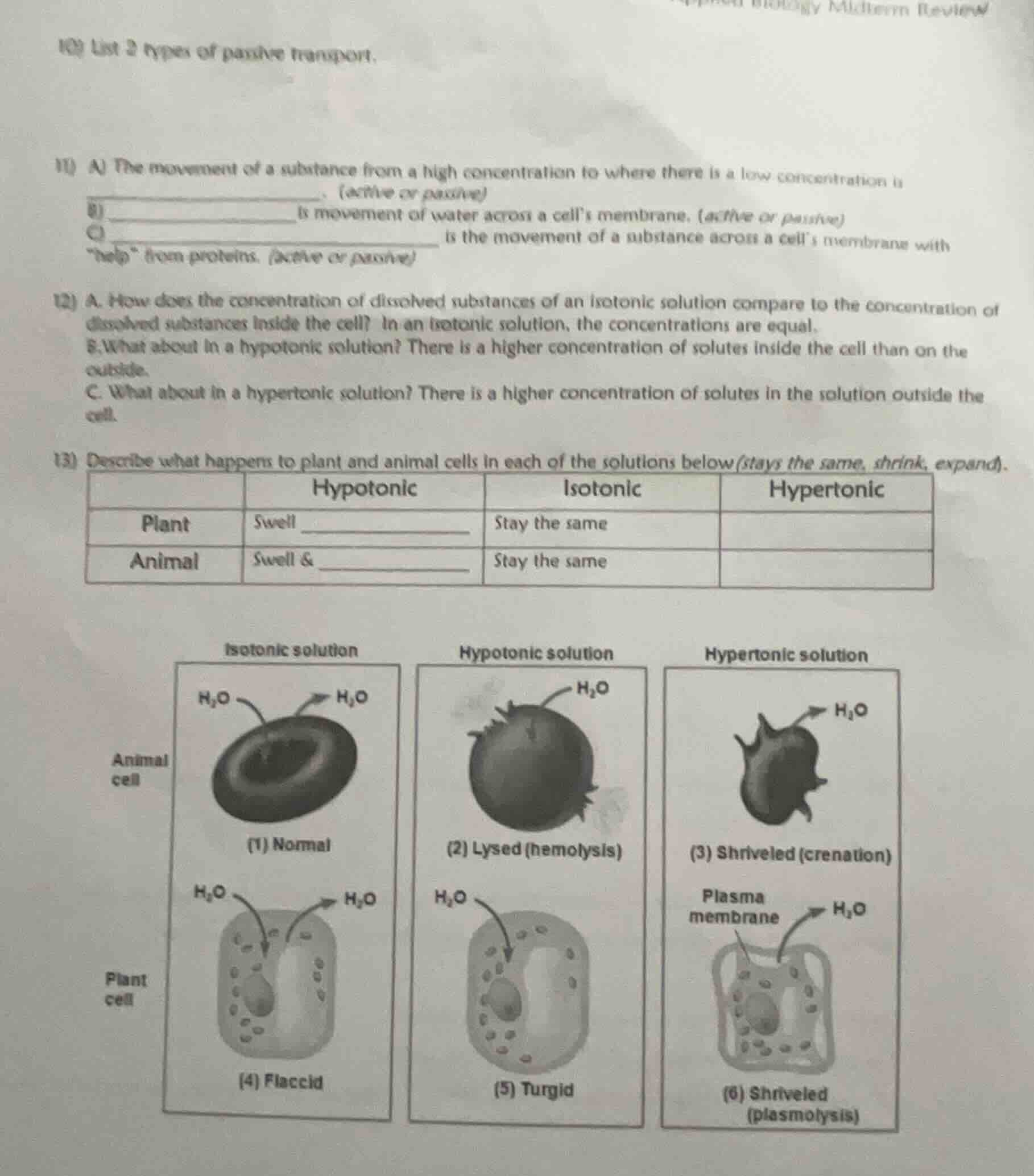
- describe what happens to plant and animal cells in each of the solutions below (stays the same, shrink, expand).
| hypotonic | isotonic | hypertonic | |
| plant | swell ____________ | stay the same | |
| animal | swell & ____________ | stay the same |
(images of animal and plant cells in isotonic, hypotonic, and hypertonic solutions: animal cell - (1) normal in isotonic, (2) lysed (hemolysis) in hypotonic, (3) shriveled (crenation) in hypertonic; plant cell - (4) flaccid in isotonic, (5) turgid in hypotonic, (6) shriveled (plasmolysis) in hypertonic)
Question 10:
Passive transport moves substances without energy. Diffusion (movement of solutes) and osmosis (movement of water) are two types.
Movement from high to low concentration (down concentration gradient) is passive transport (no energy needed). Active transport requires energy (low to high).
Osmosis is the specific term for water moving across a semipermeable membrane (cell membrane), and it’s passive (no energy, follows concentration gradient of water).

Snap & solve any problem in the app
Get step-by-step solutions on Sovi AI
Photo-based solutions with guided steps
Explore more problems and detailed explanations
Two types of passive transport are diffusion and osmosis.