QUESTION IMAGE
Question
- list the name and number of each molecule forming atp:
in order for the outer phosphate bond to break, an enzyme called atpase helps speed things up via hydrolysis. hydrolysis is a mechanism in which a bond is broken by adding water (hydro= water; lysis= to break). just as water was removed to create the bonds, it is added to break the bond.
- once the bond is broken, how many phosphate groups are left?
what is the name of this molecule?
this transformation is not permanent. there is a cycle between atp and adp. the energy required to do this is supplied by cellular respiration, specifically energy from glucose molecules that you obtain from food.
simply put: adp + phosphate + energy → atp
- in order to break the outer phosphate bond, an enzyme known as ____ aids in a mechanism known as ____ in which water is added | removed (circle one) to break the bond.
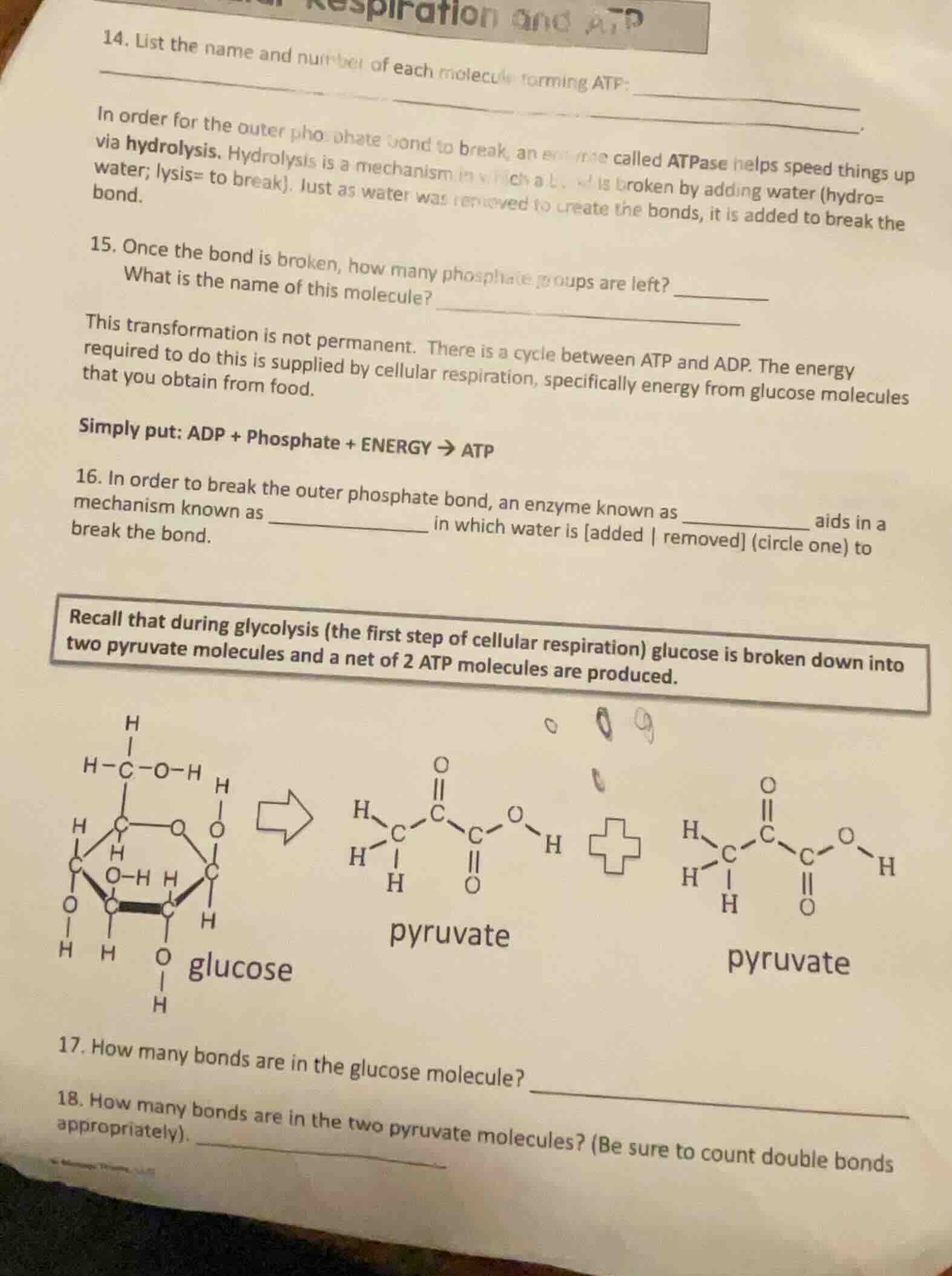
recall that during glycolysis (the first step of cellular respiration) glucose is broken down into two pyruvate molecules and a net of 2 atp molecules are produced.
- how many bonds are in the glucose molecule?
- how many bonds are in the two pyruvate molecules? (be sure to count double bonds appropriately).
Question 14
ATP (adenosine triphosphate) is formed from adenosine, ribose, and three phosphate groups. So the molecules forming ATP are 1 adenosine (or adenine + ribose), 3 phosphate groups.
ATP has three phosphate groups. When the outer phosphate bond breaks (hydrolysis of ATP), one phosphate group is removed, leaving two phosphate groups. The molecule with two phosphate groups is ADP (adenosine diphosphate).
From the text, it says "an enzyme called ATPase helps speed things up via hydrolysis". Hydrolysis is the mechanism where water is added to break a bond (hydro = water, lysis = break).

Snap & solve any problem in the app
Get step-by-step solutions on Sovi AI
Photo-based solutions with guided steps
Explore more problems and detailed explanations
- Adenosine (or Adenine + Ribose): 1
- Phosphate groups: 3