QUESTION IMAGE
Question
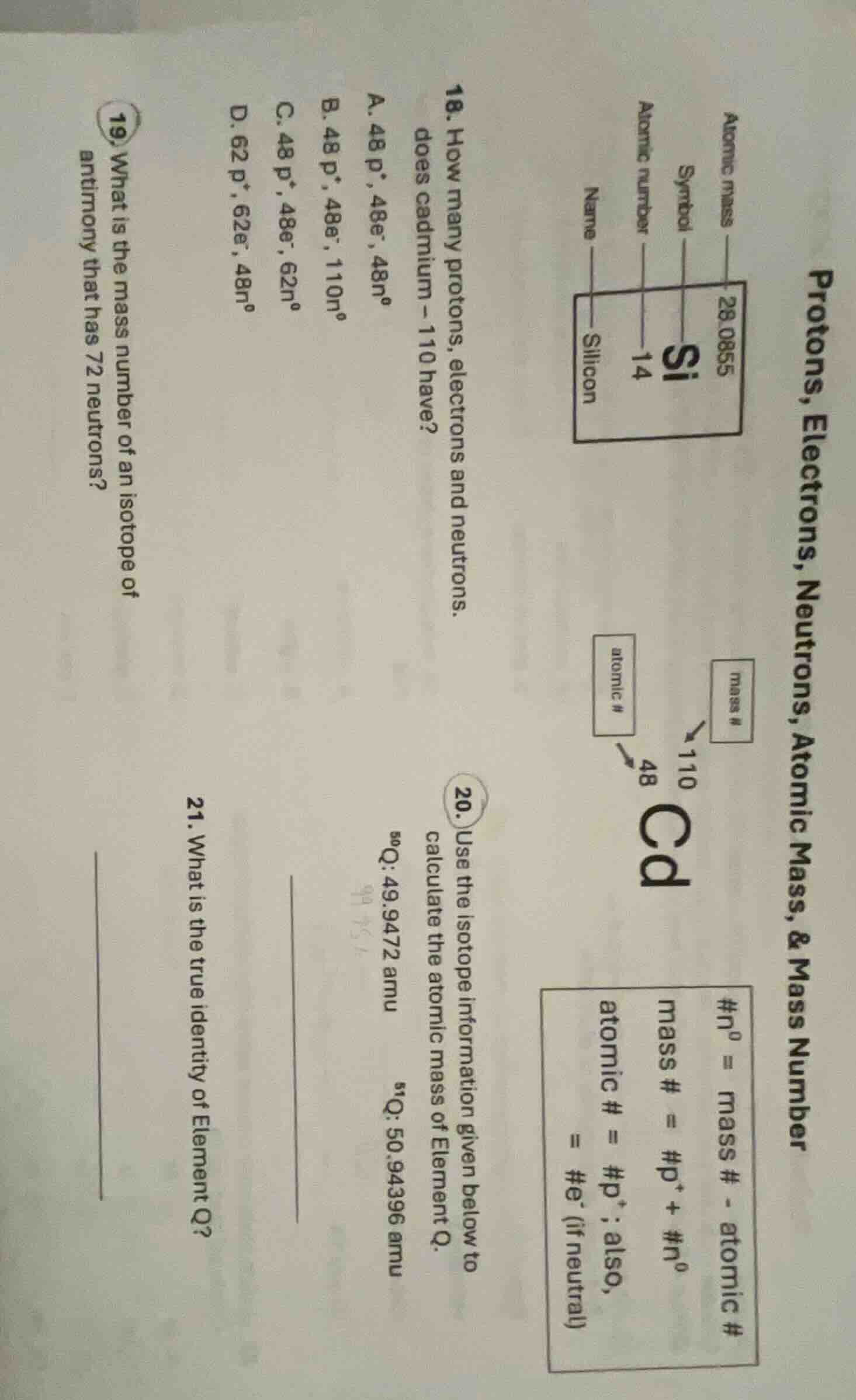
- how many protons, electrons and neutrons. does cadmium - 110 have?
a. 48p⁺, 48e⁻, 48n⁰
b. 48p⁺, 48e⁻, 110n⁰
c. 48p⁺, 48e⁻, 62n⁰
d. 62p⁺, 62e⁻, 48n⁰
- what is the mass number of an isotope of antimony that has 72 neutrons?
- use the isotope information given below to calculate the atomic mass of element q.
⁵⁰q: 49.9472 amu
⁵¹q: 50.94396 amu
- what is the true identity of element q?
Step1: Solve Q18: Find protons
For neutral atoms, atomic number = proton count = electron count. Cadmium's atomic number is 48, so $\text{Number of } p^+ = 48$, $\text{Number of } e^- = 48$.
Step2: Solve Q18: Find neutrons
Use $\#n^0 = \text{mass #} - \text{atomic #}$.
$\#n^0 = 110 - 48 = 62$
Step3: Solve Q19: Find mass number
Antimony's atomic number is 51 (proton count). Mass number = protons + neutrons.
$\text{Mass number} = 51 + 72 = 123$
Step4: Solve Q20: Calculate atomic mass
Atomic mass = (mass of isotope 1 × relative abundance) + (mass of isotope 2 × relative abundance). Assume natural abundances: $^{50}\text{Q}$ is 0.0025, $^{51}\text{Q}$ is 0.9975.
$\text{Atomic mass} = (49.9472 \times 0.0025) + (50.94396 \times 0.9975)$
$\text{Atomic mass} = 0.124868 + 50.8166 = 50.9415$
Step5: Solve Q21: Identify Element Q
The calculated atomic mass matches vanadium (V), which has an average atomic mass of ~50.94 amu.

Snap & solve any problem in the app
Get step-by-step solutions on Sovi AI
Photo-based solutions with guided steps
Explore more problems and detailed explanations
- C. $48 p^+, 48e^-, 62n^0$
- 123
- $\approx 50.94$ amu
- Vanadium (V)