QUESTION IMAGE
Question
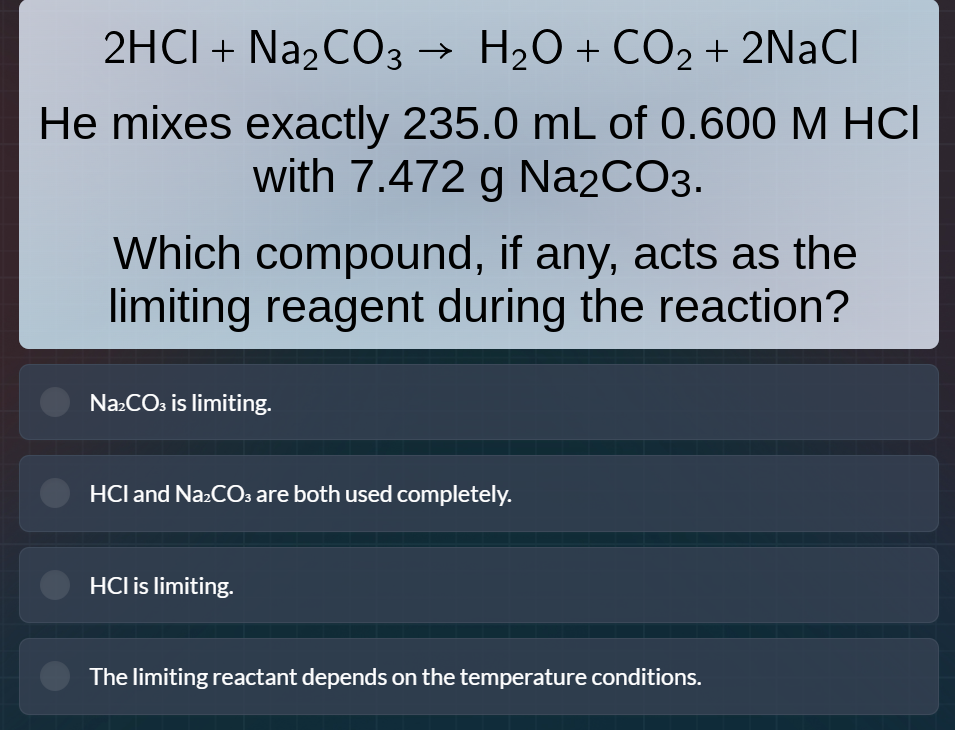
2hcl + na₂co₃ → h₂o + co₂ + 2nacl
he mixes exactly 235.0 ml of 0.600 m hcl
with 7.472 g na₂co₃.
which compound, if any, acts as the
limiting reagent during the reaction?
na₂co₃ is limiting.
hcl and na₂co₃ are both used completely.
hcl is limiting.
the limiting reactant depends on the temperature conditions.
Step1: Calculate moles of HCl
Molarity \( M = \frac{n}{V} \), so \( n = M \times V \). Volume \( V = 235.0\space mL = 0.235\space L \), \( M = 0.600\space M \).
\( n_{HCl} = 0.600\space mol/L \times 0.235\space L = 0.141\space mol \).
Step2: Calculate moles of \( Na_2CO_3 \)
Molar mass of \( Na_2CO_3 \): \( 2\times23 + 12 + 3\times16 = 106\space g/mol \).
\( n_{Na_2CO_3} = \frac{7.472\space g}{106\space g/mol} = 0.0705\space mol \).
Step3: Compare mole ratios
From reaction \( 2HCl + Na_2CO_3
ightarrow \dots \), the ratio \( \frac{n_{HCl}}{n_{Na_2CO_3}} \) required is \( \frac{2}{1} = 2 \).
Actual ratio: \( \frac{0.141}{0.0705} = 2 \). Wait, no—wait, let's check again. Wait, no, wait: if we take \( Na_2CO_3 \) as 0.0705 mol, it would require \( 2\times0.0705 = 0.141\space mol\space HCl \), which is exactly the moles of HCl we have. Wait, no, wait—wait, maybe I made a mistake. Wait, no: the stoichiometry is 2 mol HCl reacts with 1 mol \( Na_2CO_3 \). So for \( n_{Na_2CO_3} = 0.0705\space mol \), required \( HCl \) is \( 2\times0.0705 = 0.141\space mol \), which matches the available HCl (0.141 mol). Wait, but that would mean both are used completely? But wait, no—wait, no, the options: but wait, the options include "HCl and \( Na_2CO_3 \) are both used completely." Wait, but let's recheck. Wait, moles of HCl: 0.60.235 = 0.141. Moles of \( Na_2CO_3 \): 7.472/106 = 0.0705. The ratio of HCl to \( Na_2CO_3 \) is 0.141/0.0705 = 2, which is exactly the stoichiometric ratio (2:1). So both reactants are used completely? Wait, but the options: wait, no, maybe I miscalculated. Wait, 7.472 g / 106 g/mol: 1060.07 = 7.42, so 7.472 - 7.42 = 0.052, so 0.052/106 ≈ 0.00049, so total 0.07049 ≈ 0.0705 mol. HCl: 0.60.235 = 0.141 mol. 20.0705 = 0.141, so exactly stoichiometric. So both are used completely? But the options have "HCl and \( Na_2CO_3 \) are both used completely." But wait, the original options: let's check again. Wait, maybe I made a mistake. Wait, no—wait, the reaction is 2 HCl per 1 \( Na_2CO_3 \). So moles of HCl: 0.141, moles of \( Na_2CO_3 \): 0.0705. 0.141 / 2 = 0.0705, which is equal to moles of \( Na_2CO_3 \). So both reactants are consumed completely. But wait, the options: the first option says \( Na_2CO_3 \) is limiting, but that's not right. Wait, no—wait, maybe I messed up. Wait, no, if the mole ratio is exactly the stoichiometric ratio, both are used completely. So the correct option is "HCl and \( Na_2CO_3 \) are both used completely." Wait, but let me check again. Wait, 0.6 M * 0.235 L = 0.141 mol HCl. 7.472 g / 106 g/mol = 0.0705 mol \( Na_2CO_3 \). The stoichiometric ratio is 2:1, so 0.141 mol HCl is exactly 2 times 0.0705 mol \( Na_2CO_3 \). So both are consumed completely. So the answer is "HCl and \( Na_2CO_3 \) are both used completely."

Snap & solve any problem in the app
Get step-by-step solutions on Sovi AI
Photo-based solutions with guided steps
Explore more problems and detailed explanations
HCl and \( \text{Na}_2\text{CO}_3 \) are both used completely.