QUESTION IMAGE
Question
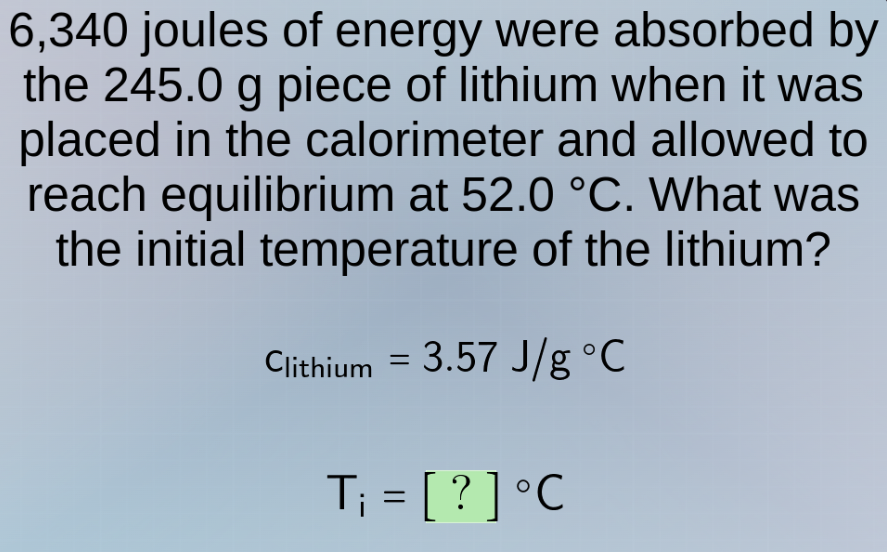
6,340 joules of energy were absorbed by the 245.0 g piece of lithium when it was placed in the calorimeter and allowed to reach equilibrium at 52.0 °c. what was the initial temperature of the lithium?
$c_{lithium} = 3.57$ j/g °c
$t_i = ?$ °c
Step1: Recall the heat formula
The formula for heat absorbed or released is \( Q = mc\Delta T \), where \( Q \) is heat, \( m \) is mass, \( c \) is specific heat capacity, and \( \Delta T = T_f - T_i \) (change in temperature, final minus initial). Here, \( Q = 6340 \, \text{J} \), \( m = 245.0 \, \text{g} \), \( c = 3.57 \, \text{J/g}^\circ\text{C} \), \( T_f = 52.0^\circ\text{C} \), and we need to find \( T_i \).
Step2: Rearrange the formula to solve for \( \Delta T \)
From \( Q = mc\Delta T \), we can solve for \( \Delta T \): \( \Delta T = \frac{Q}{mc} \)
Step3: Calculate \( \Delta T \)
Substitute the values: \( \Delta T = \frac{6340}{245.0 \times 3.57} \)
First, calculate the denominator: \( 245.0 \times 3.57 = 245.0 \times 3.57 = 874.65 \)
Then, \( \Delta T = \frac{6340}{874.65} \approx 7.25 \) (rounded to two decimal places)
Step4: Relate \( \Delta T \) to \( T_i \) and \( T_f \)
We know that \( \Delta T = T_f - T_i \), so we can rearrange to solve for \( T_i \): \( T_i = T_f - \Delta T \)
Step5: Calculate \( T_i \)
Substitute \( T_f = 52.0^\circ\text{C} \) and \( \Delta T \approx 7.25^\circ\text{C} \): \( T_i = 52.0 - 7.25 = 44.75^\circ\text{C} \) (Wait, no, wait. Wait, if the energy is absorbed, that means the temperature of lithium increased, so \( T_f > T_i \), so \( \Delta T = T_f - T_i \), so \( T_i = T_f - \Delta T \)? Wait, no, wait. Wait, if the lithium absorbed energy, its temperature should increase, so \( T_f = T_i + \Delta T \), so \( T_i = T_f - \Delta T \)? Wait, no, let's check the formula again. The heat absorbed is \( Q = mc(T_f - T_i) \) because the final temperature is higher than initial when absorbing heat. So we have \( 6340 = 245.0 \times 3.57 \times (52.0 - T_i) \)? Wait, no, wait, that can't be, because if \( T_f - T_i \) is positive, then \( T_f > T_i \), which is correct for absorbing heat (temperature increases). Wait, but when we calculated \( \Delta T = Q/(mc) = 6340/(245*3.57) \approx 6340/874.65 \approx 7.25 \). So \( 52.0 - T_i = 7.25 \), so \( T_i = 52.0 - 7.25 = 44.75 \)? Wait, but that would mean the temperature decreased, which contradicts the absorption of energy. Wait, I must have messed up the sign. Wait, no, the formula is \( Q = mc\Delta T \), where \( \Delta T = T_f - T_i \) when heat is absorbed (temperature increases). So if \( Q \) is positive (absorbed), then \( \Delta T \) is positive, so \( T_f > T_i \). So my calculation of \( \Delta T \) was correct as \( 7.25 \), so \( T_i = T_f - \Delta T = 52.0 - 7.25 = 44.75 \)? But that would mean the lithium was at 44.75 and heated to 52, absorbing energy. Wait, but let's recalculate \( \Delta T \):
\( 245.0 \times 3.57 = 245 * 3.57 \). Let's calculate 245 3 = 735, 245 0.57 = 245 0.5 + 245 0.07 = 122.5 + 17.15 = 139.65, so total is 735 + 139.65 = 874.65. Then 6340 / 874.65 ≈ 7.25. So \( T_f - T_i = 7.25 \), so \( T_i = T_f - 7.25 = 52.0 - 7.25 = 44.75 \). Wait, but that seems low. Wait, maybe I made a mistake in the formula. Wait, no, the specific heat of lithium is 3.57 J/g°C, which is relatively high. Let's recalculate \( \Delta T \): 6340 divided by (245 3.57). 245 3.57: 2003.57=714, 453.57=160.65, so total 714+160.65=874.65. Then 6340 / 874.65 ≈ 7.25. So 52 - 7.25 = 44.75. So the initial temperature is approximately 44.8 °C (rounded to three significant figures? Wait, the given values: 6340 J (four significant figures), 245.0 g (four), 3.57 J/g°C (three), 52.0 °C (three). So the least number of significant figures is three, so the answer should be 44.8 °C? Wait, 7.25 is approximately 7.25, 52.0 - 7…

Snap & solve any problem in the app
Get step-by-step solutions on Sovi AI
Photo-based solutions with guided steps
Explore more problems and detailed explanations
The initial temperature of the lithium is approximately \(\boxed{44.8}\) °C (or 44.75 °C, depending on rounding).