QUESTION IMAGE
Question
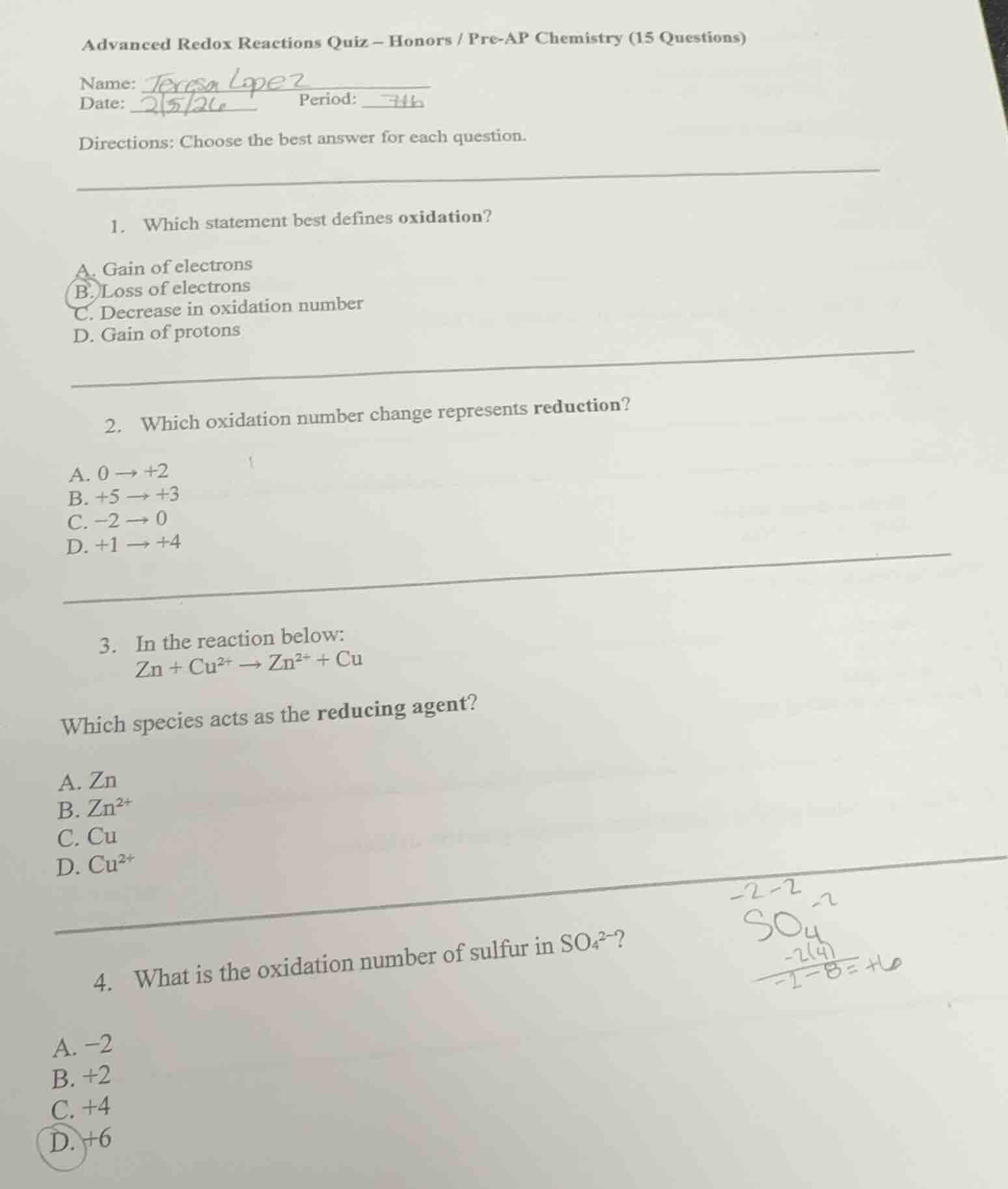
advanced redox reactions quiz – honors / pre-ap chemistry (15 questions)
name: teresa lopez
date: 2/5/26 period: 7th
directions: choose the best answer for each question.
- which statement best defines oxidation?
a. gain of electrons
b. loss of electrons
c. decrease in oxidation number
d. gain of protons
- which oxidation number change represents reduction?
a. 0 → +2
b. +5 → +3
c. −2 → 0
d. +1 → +4
- in the reaction below:
zn + cu²⁺ → zn²⁺ + cu
which species acts as the reducing agent?
a. zn
b. zn²⁺
c. cu
d. cu²⁺
- what is the oxidation number of sulfur in so₄²⁻?
a. −2
b. +2
c. +4
d. +6
Question 1
Oxidation in redox reactions is defined as the loss of electrons (while reduction is gain of electrons). A gain of electrons (A) and decrease in oxidation number (C) are reduction. Gain of protons (D) is not related to oxidation definition. So the best definition is loss of electrons.
Reduction is a decrease in oxidation number (gain of electrons). Option A: 0 → +2 (increase, oxidation). Option B: +5 → +3 (decrease, reduction). Option C: -2 → 0 (increase, oxidation). Option D: +1 → +4 (increase, oxidation). So the change representing reduction is +5 to +3.
A reducing agent is oxidized (loses electrons) in a reaction. In \( \text{Zn} + \text{Cu}^{2+}
ightarrow \text{Zn}^{2+} + \text{Cu} \), Zn goes from 0 to +2 (loses electrons, oxidized), so Zn is the reducing agent. \( \text{Zn}^{2+} \) (B) is the product of oxidation, Cu (C) is reduced, \( \text{Cu}^{2+} \) (D) is reduced (oxidizing agent).

Snap & solve any problem in the app
Get step-by-step solutions on Sovi AI
Photo-based solutions with guided steps
Explore more problems and detailed explanations
B. Loss of electrons