QUESTION IMAGE
Question
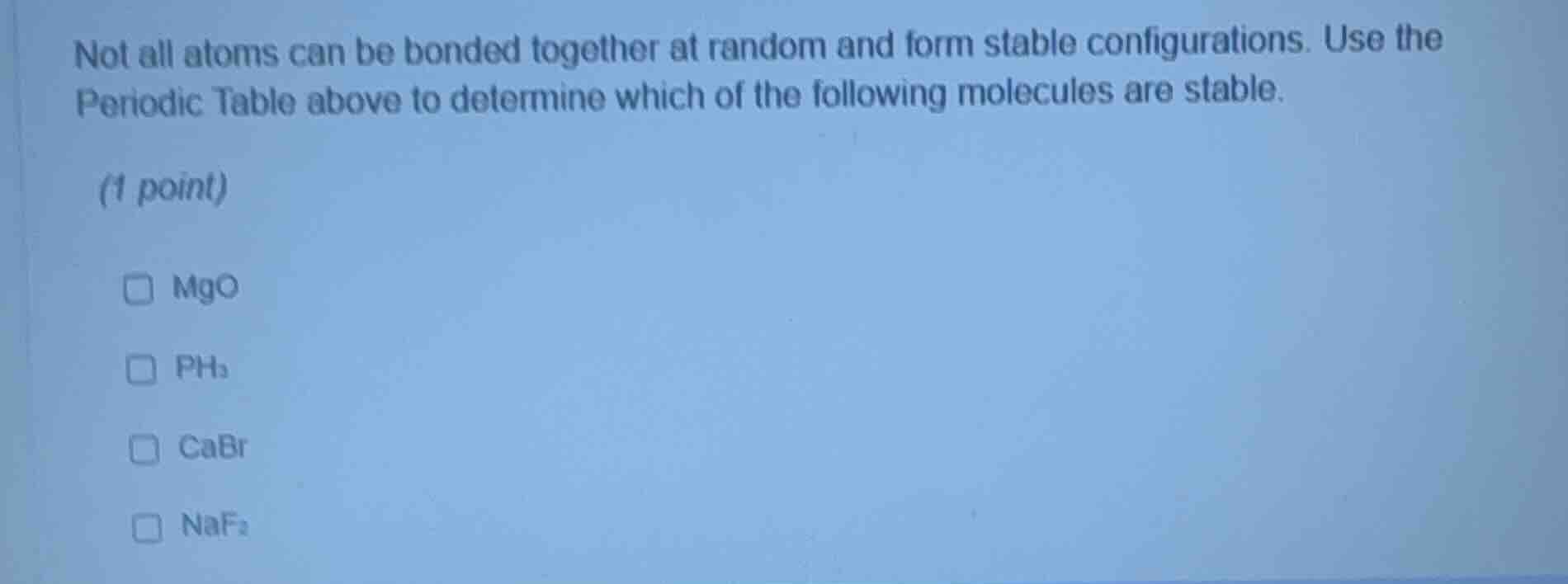
not all atoms can be bonded together at random and form stable configurations. use the periodic table above to determine which of the following molecules are stable. (1 point) mgo ph₃ cabr naf₂
Brief Explanations
To determine stable molecules, we analyze the valence and bonding:
- MgO: Mg (Group 2, +2) and O (Group 16, -2) have charges that balance (1:1 ratio), forming an ionic bond. Stable.
- PH₃: P (Group 15, 3 valence electrons) bonds with 3 H (1 each), satisfying octet/duet. Stable (like NH₃).
- CaBr: Ca (Group 2, +2) and Br (Group 17, -1) need a 1:2 ratio (CaBr₂) for charge balance. CaBr is unstable.
- NaF₂: Na (Group 1, +1) and F (Group 17, -1) need a 1:1 ratio (NaF). NaF₂ has unbalanced charges. Unstable.

Snap & solve any problem in the app
Get step-by-step solutions on Sovi AI
Photo-based solutions with guided steps
Explore more problems and detailed explanations
- MgO (stable)
- PH₃ (stable)
- CaBr (unstable)
- NaF₂ (unstable)
So the stable molecules are MgO and PH₃. The checkboxes for MgO and PH₃ should be selected.