QUESTION IMAGE
Question
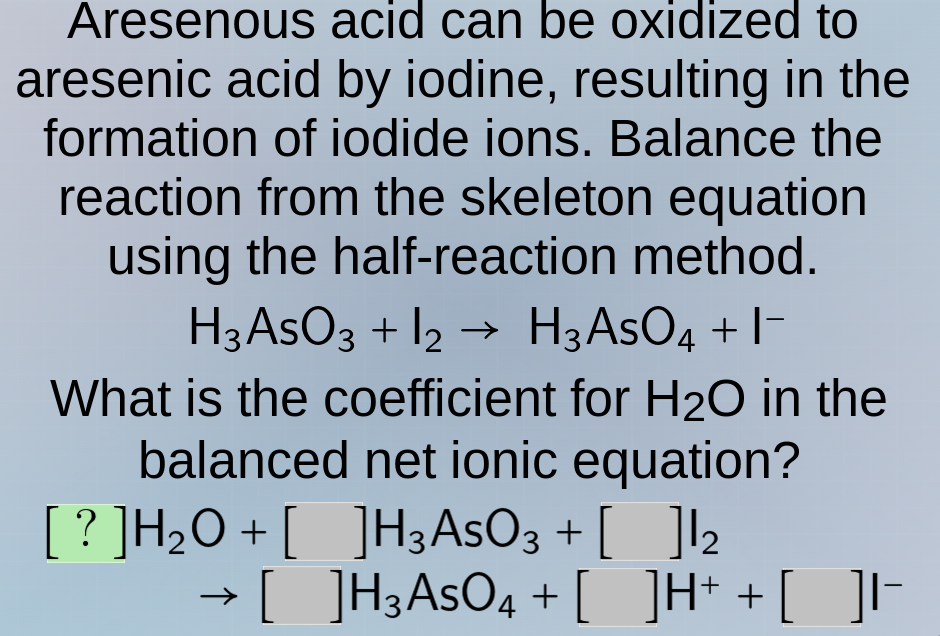
aresenous acid can be oxidized to aresenic acid by iodine, resulting in the formation of iodide ions. balance the reaction from the skeleton equation using the half - reaction method.
h₃aso₃ + i₂ → h₃aso₄ + i⁻
what is the coefficient for h₂o in the balanced net ionic equation?
?h₂o + h₃aso₃ + i₂
→ h₃aso₄ + h⁺ + i⁻
Step1: Identify Oxidation and Reduction Half - Reactions
- Oxidation Half - Reaction (As in \(H_3AsO_3\) to \(H_3AsO_4\)):
- The oxidation state of As in \(H_3AsO_3\): Let the oxidation state of As be \(x\). We know that for \(H\) (oxidation state = + 1) and \(O\) (oxidation state=-2). So, \(3\times( + 1)+x + 3\times(-2)=0\), which gives \(x = + 3\).
- In \(H_3AsO_4\), \(3\times( + 1)+x+4\times(-2)=0\), so \(x = + 5\). So, As is oxidized (oxidation state increases from + 3 to + 5).
- The unbalanced oxidation half - reaction: \(H_3AsO_3
ightarrow H_3AsO_4\)
- Balance O by adding \(H_2O\): \(H_3AsO_3 + H_2O
ightarrow H_3AsO_4\)
- Balance H by adding \(H^+\): \(H_3AsO_3 + H_2O
ightarrow H_3AsO_4+2H^+\)
- Balance charge by adding \(e^-\): The left - hand side charge is 0, the right - hand side charge is \(+ 2\) (from \(2H^+\)). So, we add \(2e^-\) to the right: \(H_3AsO_3 + H_2O
ightarrow H_3AsO_4+2H^++2e^-\)
- Reduction Half - Reaction ( \(I_2\) to \(I^-\)):
- The oxidation state of \(I\) in \(I_2\) is 0, and in \(I^-\) is - 1. So, \(I\) is reduced (oxidation state decreases from 0 to - 1).
- The unbalanced reduction half - reaction: \(I_2
ightarrow I^-\)
- Balance \(I\) atoms: \(I_2
ightarrow 2I^-\)
- Balance charge by adding \(e^-\): The left - hand side charge is 0, the right - hand side charge is \(-2\). So, we add \(2e^-\) to the left: \(I_2 + 2e^-
ightarrow 2I^-\)
Step2: Balance the Number of Electrons Transferred
- The oxidation half - reaction loses 2 electrons and the reduction half - reaction gains 2 electrons. So, the number of electrons transferred is already balanced.
Step3: Add the Two Half - Reactions
- Oxidation half - reaction: \(H_3AsO_3 + H_2O
ightarrow H_3AsO_4+2H^++2e^-\)
- Reduction half - reaction: \(I_2 + 2e^-
ightarrow 2I^-\)
- Adding them together: \(H_3AsO_3 + H_2O+I_2
ightarrow H_3AsO_4+2H^++2I^-\)

Snap & solve any problem in the app
Get step-by-step solutions on Sovi AI
Photo-based solutions with guided steps
Explore more problems and detailed explanations
The coefficient of \(H_2O\) in the balanced net ionic equation is 1.