QUESTION IMAGE
Question
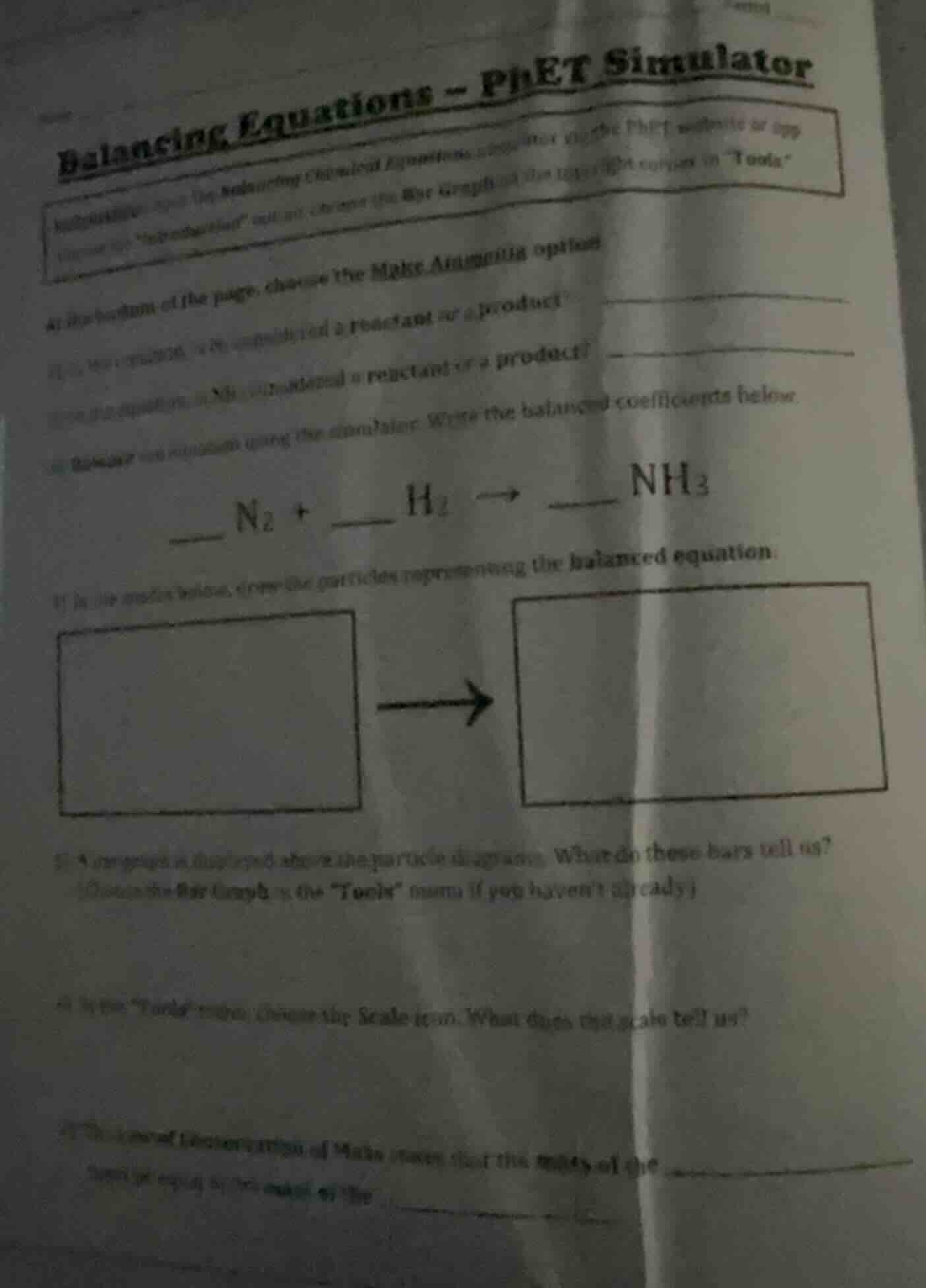
balancing equations - phet simulator
instructions: open the balancing chemical equations simulation on the phet website or app. open the “introduction” screen, choose the “my recipe” tab (top - right corner) in “tools”.
at the bottom of the page, choose the make ammonia option.
- in the equation, is n₂ considered a reactant or a product?
- in the equation, is nh₃ considered a reactant or a product?
- balance the equation using the simulator. write the balanced coefficients below.
__n₂ + h₂ → __nh₃
- in the boxes below, draw the particles representing the balanced equation.
(there are two boxes with an arrow between them)
- a bar graph is displayed above the particle diagram. what do these bars tell us? (choose the bar graph in the “tools” menu if you havent already)
- in the “tools” menu, choose the scale icon. what does that scale tell us?
- the law of conservation of mass states that the mass of the ____ (reactants or products) is equal to the mass of the ____ (reactants or products).
Step1: Balance nitrogen atoms
Count N atoms: Reactant side has 2 (from $\text{N}_2$), product side has 1 (from $\text{NH}_3$). Add coefficient 2 to $\text{NH}_3$:
$\text{N}_2 + \text{H}_2
ightarrow 2\text{NH}_3$
Step2: Balance hydrogen atoms
Now H atoms: Product side has 6 (2×3 from $2\text{NH}_3$), reactant side has 2 (from $\text{H}_2$). Add coefficient 3 to $\text{H}_2$:
$\text{N}_2 + 3\text{H}_2
ightarrow 2\text{NH}_3$
Step3: Verify balanced equation
Check atom counts: N=2 on both sides, H=6 on both sides.

Snap & solve any problem in the app
Get step-by-step solutions on Sovi AI
Photo-based solutions with guided steps
Explore more problems and detailed explanations
- For reactant/product identification:
- $\text{N}_2$: Reactant
- $\text{H}_2$: Reactant
- $\text{NH}_3$: Product
- Balanced coefficients: $\boldsymbol{1}$ $\text{N}_2 + \boldsymbol{3}$ $\text{H}_2
ightarrow \boldsymbol{2}$ $\text{NH}_3$
- Particle diagram:
- Left box (reactants): 1 molecule of $\text{N}_2$ (two bonded spheres) + 3 molecules of $\text{H}_2$ (two bonded spheres each)
- Right box (products): 2 molecules of $\text{NH}_3$ (one central sphere bonded to three smaller spheres)
- Bar graph meaning: The bar graph shows the relative number of moles (or particle counts) of each reactant and product, confirming the ratio from the balanced equation.
- Scale meaning: The scale shows that the total mass of the reactants equals the total mass of the products.
- Law of Conservation of Mass: The mass of the reactants is equal to the mass of the products