QUESTION IMAGE
Question
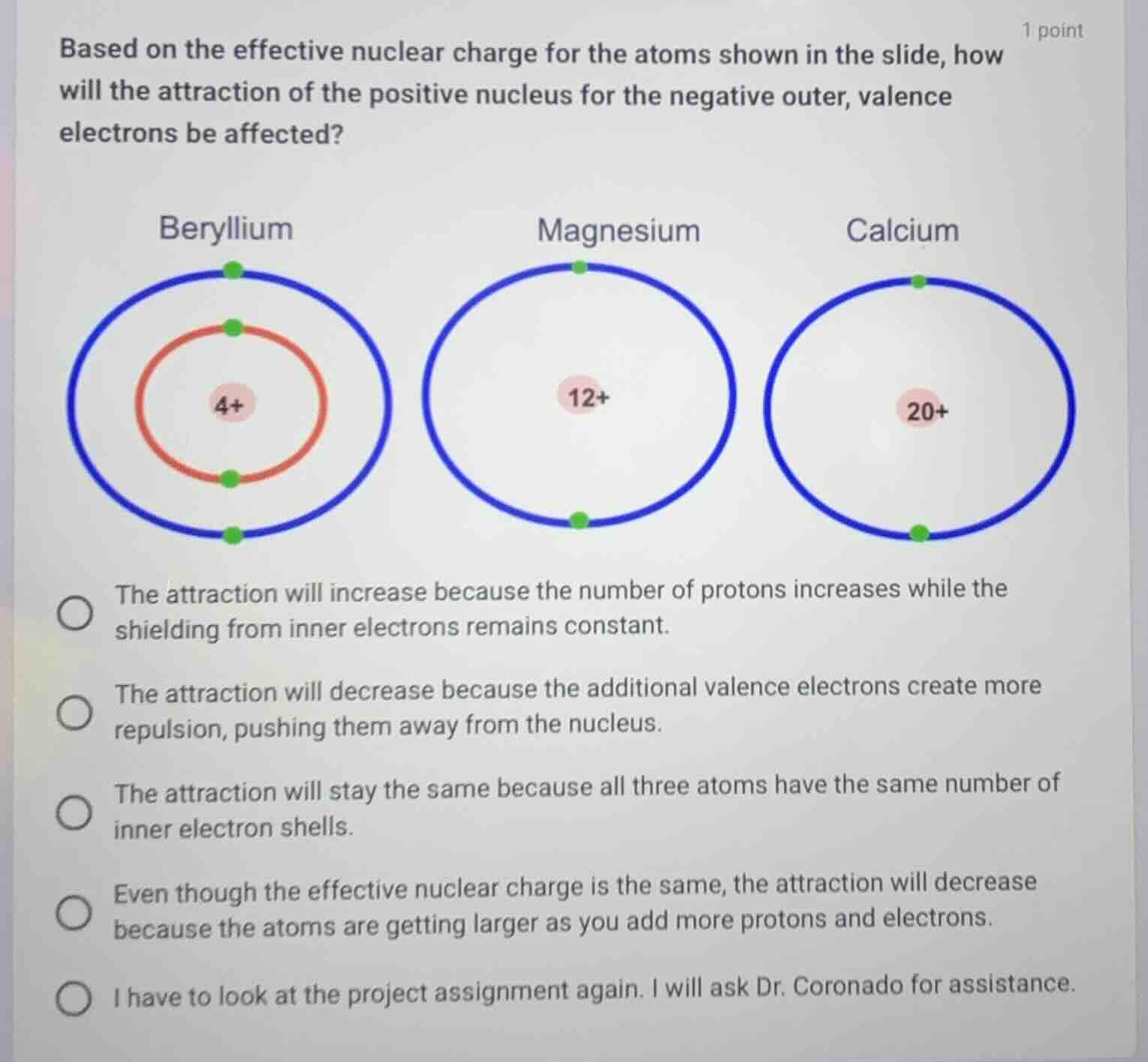
based on the effective nuclear charge for the atoms shown in the slide, how will the attraction of the positive nucleus for the negative outer, valence electrons be affected?
beryllium
magnesium
calcium
the attraction will increase because the number of protons increases while the shielding from inner electrons remains constant.
the attraction will decrease because the additional valence electrons create more repulsion, pushing them away from the nucleus.
the attraction will stay the same because all three atoms have the same number of inner electron shells.
even though the effective nuclear charge is the same, the attraction will decrease because the atoms are getting larger as you add more protons and electrons.
i have to look at the project assignment again. i will ask dr. coronado for assistance.
Beryllium, magnesium, and calcium are in Group 2 of the periodic table. All have 2 valence electrons, and as we move down the group, the number of inner electron shells increases (beryllium has 1 inner shell, magnesium has 2, calcium has 3), so shielding increases. Their effective nuclear charge for valence electrons is similar (~+2), but the atomic radius increases significantly. Coulomb's law shows that the electrostatic attraction between the nucleus and valence electrons decreases as the distance between them increases, even with the same effective nuclear charge.

Snap & solve any problem in the app
Get step-by-step solutions on Sovi AI
Photo-based solutions with guided steps
Explore more problems and detailed explanations
Even though the effective nuclear charge is the same, the attraction will decrease because the atoms are getting larger as you add more protons and electrons.