QUESTION IMAGE
Question
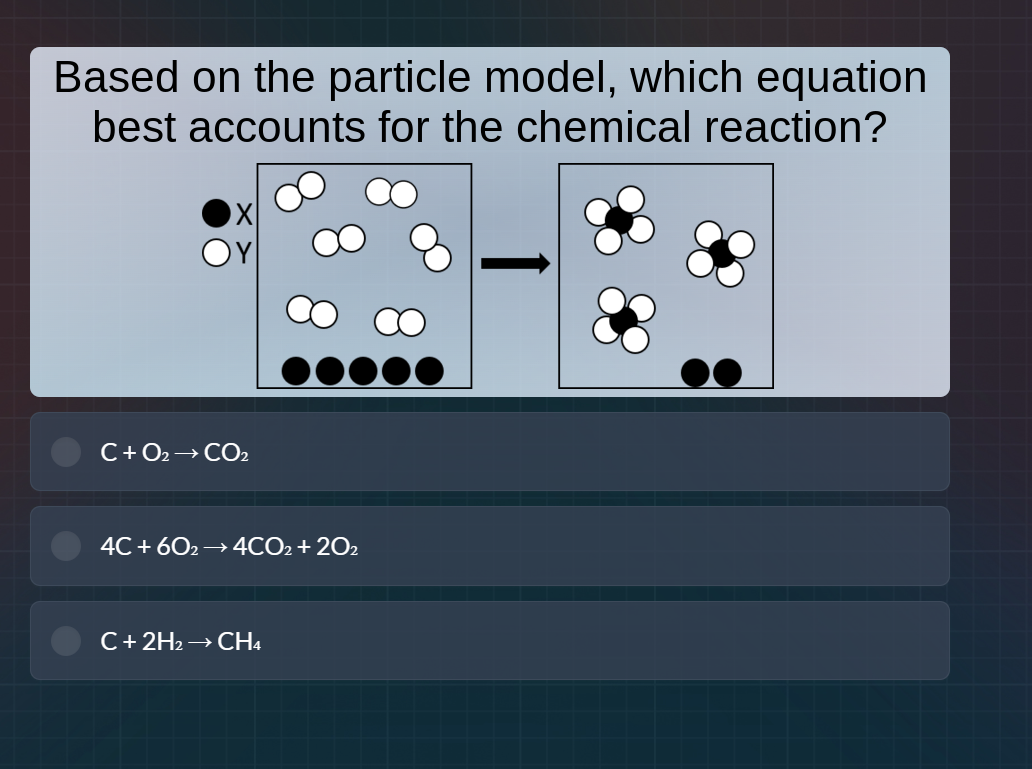
based on the particle model, which equation best accounts for the chemical reaction?
(image of particle model: left box has black x (5) and white y (molecules, 6 o₂-like?); right box has 3 ch₄-like (x with 4 y) and 1 o₂-like (2 y). options: c + o₂ → co₂; 4c + 6o₂ → 4co₂ + 2o₂; c + 2h₂ → ch₄)
Step1: Count reactant particles
- Black (X) particles (C?): Left has 5, right has 2 unreacted? Wait, no—wait, product has 3 molecules with 1 X each (so 3 X in products), and 2 X unreacted? Wait no, re-examine: Left: 5 X (black), 5 Y₂ (white diatomic, since 5 pairs? Wait no, left white: 5 groups of 2? Wait no, left white: let's count. Left white: 5 molecules? Wait no, the left box: white circles: how many? Let's see: the left has 5 pairs? Wait no, the left white: 5 "molecules" of Y₂? Wait no, the left has 5 Y₂ (each Y₂ is 2 white circles) and 5 X (black). Then product: 3 molecules of X Y₄ (each has 1 X and 4 Y) and 1 Y₂ (2 Y) unreacted? Wait no, product white: each product molecule has 4 Y (since 1 X and 4 Y). Wait, let's count atoms:
Left:
- X (black): 5
- Y (white): Each Y₂ is 2 Y, so 5 Y₂ → 10 Y (since 5×2=10)
Right:
- Product molecules: 3 molecules, each with 1 X and 4 Y → 3 X, 12 Y
- Unreacted: 1 Y₂ (2 Y) → total Y: 12 + 2 = 14? Wait, that doesn't match. Wait maybe I misread. Wait the left Y: how many Y₂? Let's count the left white circles: the left has 5 pairs? Wait no, the left white: let's count the number of Y₂ molecules. The left has 5 Y₂? Wait no, the left white: looking at the diagram, left white: 5 groups? Wait no, the left white: 5 "molecules" (each is 2 white circles) → 5 Y₂. So Y atoms: 5×2=10. X atoms: 5.
Product: 3 molecules (each with 1 X and 4 Y) → 3 X, 12 Y. Then unreacted Y: 10 +? Wait no, maybe the reactants are X (C) and Y₂ (H₂). Let's check the options. The third option is C + 2H₂ → CH₄. Let's see:
Reactants: 1 C (X) and 2 H₂ (Y₂, since H₂ is diatomic). Wait, let's check the particle counts.
Wait the left: X (black) count: 5, Y₂ (white) count: 5. Wait no, maybe the left X is 5, Y₂ is 5. Then product: 3 X Y₄ (CH₄) and 2 X unreacted? No, the right has 3 product molecules (each X Y₄) and 2 X unreacted? Wait the right black: 2. So left X: 5, right X: 3 (in products) + 2 (unreacted) = 5. Good. Y: left Y₂: 5 (each Y₂ is 2 Y → 10 Y). Product: 3 X Y₄ → 3×4=12 Y. Then unreacted Y: 12 - 10 = 2 Y → which is 1 Y₂. Perfect! So the reaction is: X (C) + Y₂ (H₂) → X Y₄ (CH₄), with some unreacted. Wait the third option: C + 2H₂ → CH₄. Let's check stoichiometry. Let's count the particles:
Left: X (C): 5, Y₂ (H₂): 5.
But the reaction C + 2H₂ → CH₄: 1 C reacts with 2 H₂ to make 1 CH₄.
Suppose we have 5 C and 5 H₂. But 2 H₂ per C. So 5 C would need 10 H₂, but we have 5 H₂. Wait no, maybe the diagram is simplified. Wait the third option: C + 2H₂ → CH₄. Let's check the other options:
First option: C + O₂ → CO₂. But CO₂ has 2 O, but the product here has 4 Y per X, so O would be 2, but here Y is 4, so not O₂.
Second option: 4C + 6O₂ → 4CO₂ + 2O₂. CO₂ has 2 O, but product here has 4 Y, so no.
Third option: C + 2H₂ → CH₄. CH₄ has 4 H (Y) per C (X). So let's see:
Reactants: C (X) and H₂ (Y₂). So 1 C reacts with 2 H₂ (which is 4 H) to make 1 CH₄ (1 C, 4 H).
In the diagram, left: 5 C (X) and 5 H₂ (Y₂). But if we take 3 C and 6 H₂ (but left has 5 C and 5 H₂). Wait maybe the diagram is showing 5 C and 5 H₂, but the reaction uses 3 C and 6 H₂? No, that doesn't match. Wait maybe the diagram has 5 C, 5 H₂, and the product is 3 CH₄ and 2 C unreacted, and 1 H₂ unreacted? Wait no, the product has 3 CH₄ (each with 1 C and 4 H) and 2 C unreacted, and 1 H₂ unreacted. Let's check atoms:
C: 3 (in CH₄) + 2 (unreacted) = 5 (matches left)
H: 3×4 (in CH₄) + 2 (in unreacted H₂) = 12 + 2 = 14? But left H: 5×2=10. Wait, that's not matching. Wait I must have misread the diagram. Let's re-express:
Alternative approach: count the number of each…

Snap & solve any problem in the app
Get step-by-step solutions on Sovi AI
Photo-based solutions with guided steps
Explore more problems and detailed explanations
C. C + 2H₂ → CH₄ (Wait, the options are: first option: C + O₂ → CO₂, second: 4C + 6O₂ → 4CO₂ + 2O₂, third: C + 2H₂ → CH₄. So the correct option is the third one, which is C + 2H₂ → CH₄. So the answer is the third option, which is labeled as the third choice (the last one). So in the options, the third option is "C + 2H₂ → CH₄", so the answer is that.