QUESTION IMAGE
Question
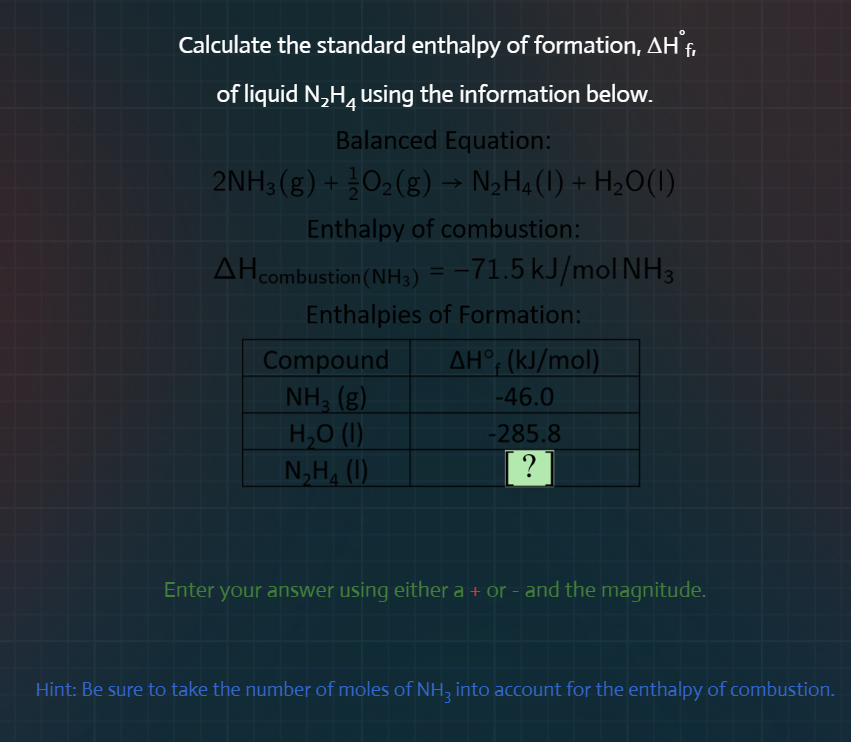
calculate the standard enthalpy of formation, $delta h_{f}^{circ}$, of liquid $ce{n_{2}h_{4}}$ using the information below. balanced equation: $2ce{nh_{3}(g)} + \frac{1}{2}ce{o_{2}(g)}
ightarrow ce{n_{2}h_{4}(l)} + ce{h_{2}o(l)}$ enthalpy of combustion: $delta h_{\text{combustion}(ce{nh_{3}})} = -71.5 \text{kj/mol} ce{nh_{3}}$ enthalpies of formation: | compound | $delta h_{f}^{circ}$ (kj/mol) | | --- | --- | | $ce{nh_{3}(g)}$ | -46.0 | | $ce{h_{2}o(l)}$ | -285.8 | | $ce{n_{2}h_{4}(l)}$ |? | enter your answer using either a + or - and the magnitude. hint: be sure to take the number of moles of $ce{nh_{3}}$ into account for the enthalpy of combustion.
Step1: Recall the formula for enthalpy change of a reaction
The enthalpy change of a reaction ($\Delta H_{rxn}$) is given by the sum of the enthalpies of formation of the products minus the sum of the enthalpies of formation of the reactants, i.e., $\Delta H_{rxn} = \sum \Delta H_f^{\circ}(\text{products}) - \sum \Delta H_f^{\circ}(\text{reactants})$. Also, the enthalpy of combustion of $\ce{NH3}$ is related to the reaction. For the given reaction: $2\ce{NH3}(g) + \frac{1}{2}\ce{O2}(g)
ightarrow \ce{N2H4}(l) + \ce{H2O}(l)$, the enthalpy change of this reaction can also be calculated using the enthalpy of combustion of $\ce{NH3}$. The enthalpy of combustion of 1 mole of $\ce{NH3}$ is -71.5 kJ/mol, so for 2 moles, it will be $2 \times (-71.5)$ kJ.
Step2: Calculate $\Delta H_{rxn}$ from combustion data
$\Delta H_{rxn} = 2 \times \Delta H_{\text{combustion}}(\ce{NH3}) = 2 \times (-71.5) = -143.0$ kJ.
Step3: Apply the enthalpy of formation formula to the reaction
$\Delta H_{rxn} = [\Delta H_f^{\circ}(\ce{N2H4}(l)) + \Delta H_f^{\circ}(\ce{H2O}(l))] - [2 \times \Delta H_f^{\circ}(\ce{NH3}(g)) + \frac{1}{2} \times \Delta H_f^{\circ}(\ce{O2}(g))]$. Since the enthalpy of formation of an element in its standard state (like $\ce{O2}(g)$) is 0, $\Delta H_f^{\circ}(\ce{O2}(g)) = 0$. Substituting the known values:
$-143.0 = [\Delta H_f^{\circ}(\ce{N2H4}(l)) + (-285.8)] - [2 \times (-46.0) + 0]$
Step4: Solve for $\Delta H_f^{\circ}(\ce{N2H4}(l))$
First, simplify the right-hand side:
$[\Delta H_f^{\circ}(\ce{N2H4}(l)) - 285.8] - [-92.0] = \Delta H_f^{\circ}(\ce{N2H4}(l)) - 285.8 + 92.0 = \Delta H_f^{\circ}(\ce{N2H4}(l)) - 193.8$
Now, set equal to $\Delta H_{rxn}$:
$\Delta H_f^{\circ}(\ce{N2H4}(l)) - 193.8 = -143.0$
Add 193.8 to both sides:
$\Delta H_f^{\circ}(\ce{N2H4}(l)) = -143.0 + 193.8 = 50.8$ kJ/mol. Wait, that can't be right. Wait, let's check the signs again. Wait, maybe I messed up the direction. Wait, no, let's re-express the formula correctly.
Wait, the correct formula is $\Delta H_{rxn} = \sum \Delta H_f^{\circ}(\text{products}) - \sum \Delta H_f^{\circ}(\text{reactants})$. So products are $\ce{N2H4}(l)$ and $\ce{H2O}(l)$, reactants are $2\ce{NH3}(g)$ and $\frac{1}{2}\ce{O2}(g)$. So:
$\Delta H_{rxn} = [\Delta H_f^{\circ}(\ce{N2H4}) + \Delta H_f^{\circ}(\ce{H2O})] - [2\Delta H_f^{\circ}(\ce{NH3}) + \frac{1}{2}\Delta H_f^{\circ}(\ce{O2})]$
We know $\Delta H_{rxn} = 2 \times \Delta H_{\text{combustion}}(\ce{NH3}) = 2 \times (-71.5) = -143$ kJ (since combustion is exothermic, the reaction as written has $\Delta H$ equal to the combustion enthalpy for 2 moles).
Substitute the known $\Delta H_f^{\circ}$ values:
$-143 = [\Delta H_f^{\circ}(\ce{N2H4}) + (-285.8)] - [2 \times (-46.0) + 0]$ (since $\Delta H_f^{\circ}(\ce{O2}) = 0$)
Simplify the right-hand side:
$[\Delta H_f^{\circ}(\ce{N2H4}) - 285.8] - [-92] = \Delta H_f^{\circ}(\ce{N2H4}) - 285.8 + 92 = \Delta H_f^{\circ}(\ce{N2H4}) - 193.8$
Now, solve for $\Delta H_f^{\circ}(\ce{N2H4})$:
$\Delta H_f^{\circ}(\ce{N2H4}) - 193.8 = -143$
$\Delta H_f^{\circ}(\ce{N2H4}) = -143 + 193.8 = 50.8$? Wait, but let's check again. Wait, maybe the reaction is the combustion of $\ce{NH3}$, but the given reaction is not the combustion reaction. Wait, the combustion of $\ce{NH3}$ would be $\ce{NH3} + \frac{3}{4}\ce{O2}
ightarrow \frac{1}{2}\ce{N2} + \frac{3}{2}\ce{H2O}$, but the given reaction is different. Wait, maybe I made a mistake in relating the reaction to the combustion. Let's re-express the given reaction.
Wait, the enthalpy of combustion of $\ce{NH3}$ is the enthalpy change wh…

Snap & solve any problem in the app
Get step-by-step solutions on Sovi AI
Photo-based solutions with guided steps
Explore more problems and detailed explanations
+50.8