QUESTION IMAGE
Question
capacity before moving on.
- electrons on the outer most ring are known as valence electrons. these are the electrons that participate in chemical bonding.
- each dot represents one electron.
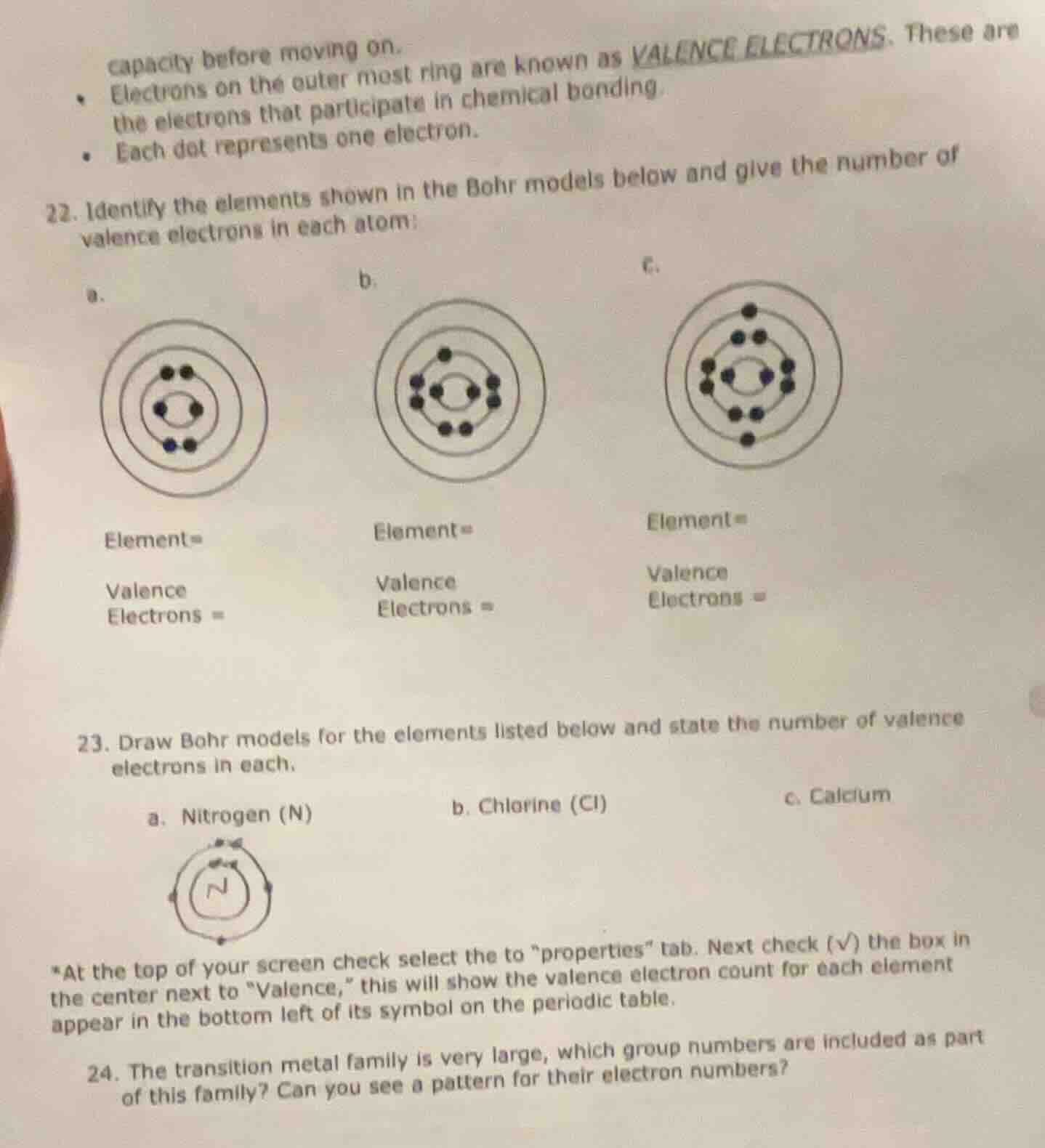
- identify the elements shown in the bohr models below and give the number of valence electrons in each atom:
a.
element=
valence electrons =
b.
element=
valence electrons =
c.
element=
valence electrons =
- draw bohr models for the elements listed below and state the number of valence electrons in each.
a. nitrogen (n)
b. chlorine (cl)
c. calcium
*at the top of your screen check select the to \properties\ tab. next check (√) the box in the center next to \valence,\ this will show the valence electron count for each element appear in the bottom left of its symbol on the periodic table.
- the transition metal family is very large, which group numbers are included as part of this family? can you see a pattern for their electron numbers?
Problem 22 (assuming we analyze part a first, and we'll follow the same logic for b and c)
Part a:
Step 1: Count total electrons (protons = electrons in neutral atom)
Looking at the Bohr model for part a: Inner shell (first) has 2 electrons, middle shell (second) has 4 electrons, outer shell (third? Wait, no, wait—wait, Bohr model: first shell (n=1) holds max 2, second (n=2) max 8, third (n=3) max 18, etc. Wait, in the diagram, the innermost circle (n=1) has 2 electrons (let's say the black dots? Wait, maybe the colors: let's count all electrons. Let's see: the innermost (n=1) has 2 (maybe the dark blue? Wait, the diagram: center, then first shell (n=1) with 2, second shell (n=2) with 4, third shell (n=3) with 2? Wait, no, the circles: the first (innermost) circle (n=1) has 2, second (n=2) has 4, third (n=3) has 2? Wait, total electrons: 2 + 4 + 2 = 8? No, wait, maybe I miscounted. Wait, the Bohr model:[LLM SSE On Failure]

Snap & solve any problem in the app
Get step-by-step solutions on Sovi AI
Photo-based solutions with guided steps
Explore more problems and detailed explanations
Step 1: Count total electrons (protons = electrons in neutral atom)
Looking at the Bohr model for part a: Inner shell (first) has 2 electrons, middle shell (second) has 4 electrons, outer shell (third? Wait, no, wait—wait, Bohr model: first shell (n=1) holds max 2, second (n=2) max 8, third (n=3) max 18, etc. Wait, in the diagram, the innermost circle (n=1) has 2 electrons (let's say the black dots? Wait, maybe the colors: let's count all electrons. Let's see: the innermost (n=1) has 2 (maybe the dark blue? Wait, the diagram: center, then first shell (n=1) with 2, second shell (n=2) with 4, third shell (n=3) with 2? Wait, no, the circles: the first (innermost) circle (n=1) has 2, second (n=2) has 4, third (n=3) has 2? Wait, total electrons: 2 + 4 + 2 = 8? No, wait, maybe I miscounted. Wait, the Bohr model:[LLM SSE On Failure]