QUESTION IMAGE
Question
- choose the the answer.
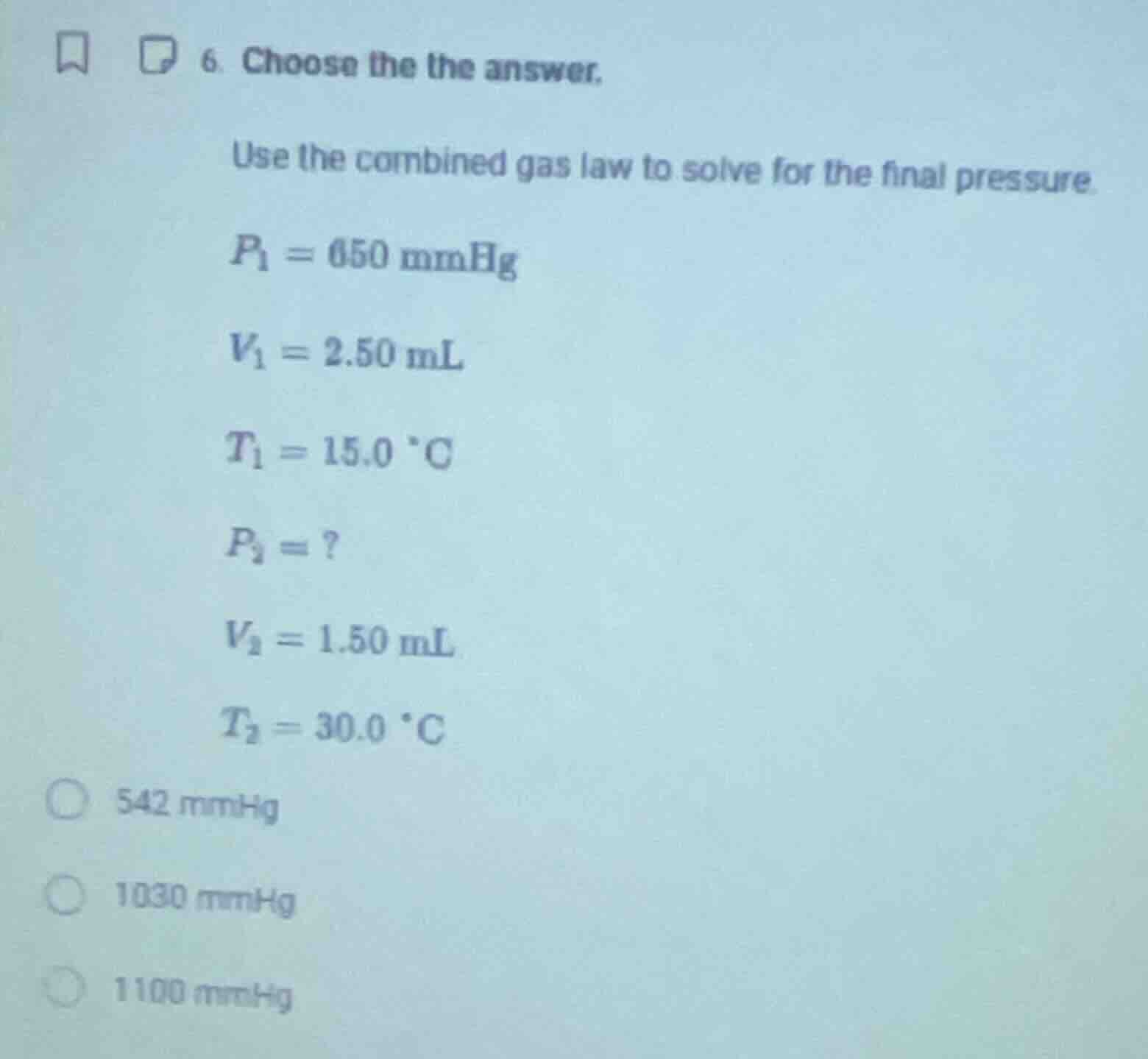
use the combined gas law to solve for the final pressure.
$p_1 = 650\\ mmhg$
$v_1 = 2.50\\ ml$
$t_1 = 15.0\\ ^\circ c$
$p_2 = ?$
$v_2 = 1.50\\ ml$
$t_2 = 30.0\\ ^\circ c$
542 mmhg
1030 mmhg
1100 mmhg
Step1: Convert temps to Kelvin
$T_1 = 15.0 + 273.15 = 288.15\ \text{K}$
$T_2 = 30.0 + 273.15 = 303.15\ \text{K}$
Step2: State combined gas law
$$\frac{P_1V_1}{T_1} = \frac{P_2V_2}{T_2}$$
Step3: Rearrange for $P_2$
$$P_2 = \frac{P_1V_1T_2}{V_2T_1}$$
Step4: Substitute values
$$P_2 = \frac{650\ \text{mmHg} \times 2.50\ \text{mL} \times 303.15\ \text{K}}{1.50\ \text{mL} \times 288.15\ \text{K}}$$
Step5: Calculate final pressure
$$P_2 \approx 1100\ \text{mmHg}$$

Snap & solve any problem in the app
Get step-by-step solutions on Sovi AI
Photo-based solutions with guided steps
Explore more problems and detailed explanations
1100 mmHg