QUESTION IMAGE
Question
- choose the best answer.
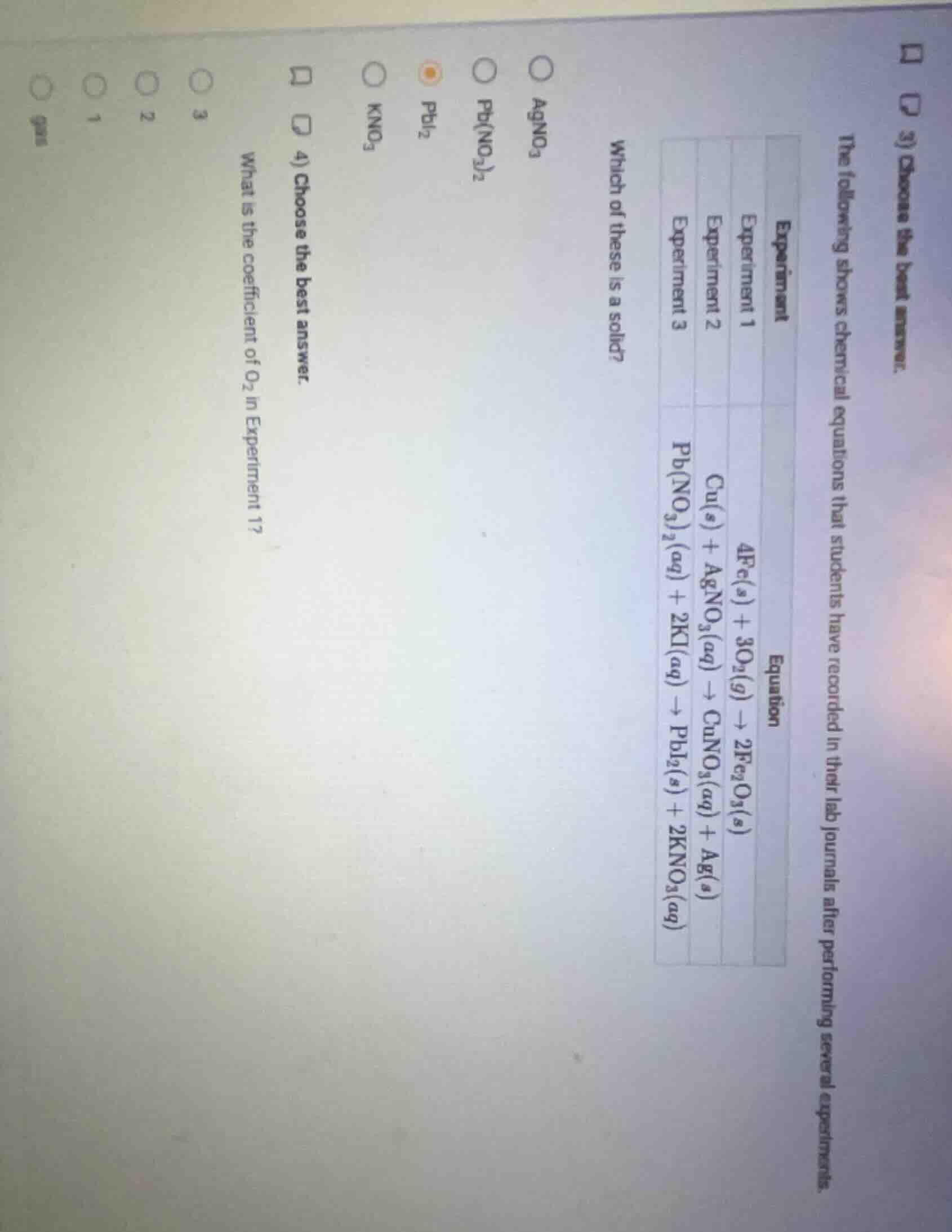
the following shows chemical equations that students have recorded in their lab journals after performing several experiments.
| experiment | equation |
|---|
| experiment 1 | $4fe(s) + 3o_2(g) \
ightarrow 2fe_2o_3(s)$ |
| experiment 2 | $cu(s) + agno_3(aq) \
ightarrow cuno_3(aq) + ag(s)$ |
| experiment 3 | $pb(no_3)_2(aq) + 2ki(aq) \
ightarrow pbi_2(s) + 2kno_3(aq)$ |
which of these is a solid?
- $agno_3$
- $pb(no_3)_2$
- $pbi_2$ (selected)
- $kno_3$
- choose the best answer.
what is the coefficient of $o_2$ in experiment 1?
Step1: Identify solid from options
Check solubility states:
- $\text{AgNO}_3$: soluble (aqueous, $aq$)
- $\text{Pb(NO}_3\text{)}_2$: soluble (aqueous, $aq$)
- $\text{PbI}_2$: insoluble (solid, $s$, from Experiment 3 equation)
- $\text{KNO}_3$: soluble (aqueous, $aq$)
Step2: Locate $\text{O}_2$ coefficient
Look at Experiment 1 equation:
$$4\text{Fe}(s) + 3\text{O}_2(g)
ightarrow 2\text{Fe}_2\text{O}_3(s)$$
The coefficient of $\text{O}_2$ is 3.

Snap & solve any problem in the app
Get step-by-step solutions on Sovi AI
Photo-based solutions with guided steps
Explore more problems and detailed explanations
- $\text{PbI}_2$
- 3