QUESTION IMAGE
Question
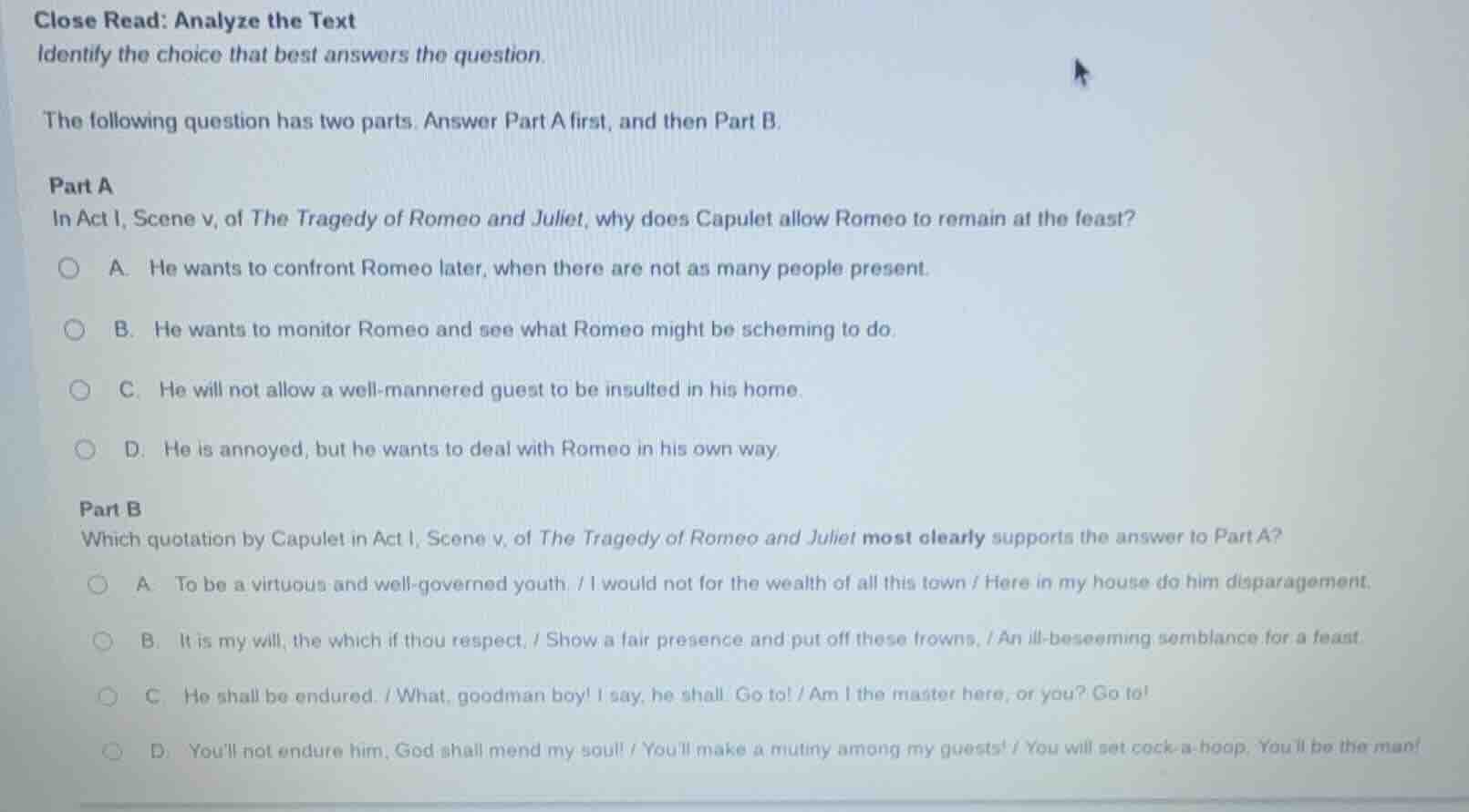
close read: analyze the text
identify the choice that best answers the question.
the following question has two parts. answer part a first, and then part b.
part a
in act i, scene v, of the tragedy of romeo and juliet, why does capulet allow romeo to remain at the feast?
a. he wants to confront romeo later, when there are not as many people present.
b. he wants to monitor romeo and see what romeo might be scheming to do.
c. he will not allow a well - mannered guest to be insulted in his home.
d. he is annoyed, but he wants to deal with romeo in his own way.
part b
which quotation by capulet in act i, scene v, of the tragedy of romeo and juliet most clearly supports the answer to part a?
a. to be a virtuous and well - governed youth, / i would not for the wealth of all this town / here in my house do him disparagement.
b. it is my will, the which if thou respect, / show a fair presence and put off these frowns, / an ill - beseeming semblance for a feast.
c. he shall be endured. / what, goodman boy! i say, he shall. go to! / am i the master here, or you? go to!
d. youll not endure him, god shall mend my soul! / youll make a mutiny among my guests! / you will set cock - a - hoop, youll be the man!
Part A: In Romeo and Juliet Act 1, Scene v, Capulet notices Romeo is a polite, well-behaved guest and refuses to let him be insulted in his home, as he values hospitality and proper conduct for his feast.
Part B: The quotation in option A directly states that Romeo is a virtuous youth and Capulet will not let him be disrespected in his house, which aligns perfectly with the reasoning for Part A.

Snap & solve any problem in the app
Get step-by-step solutions on Sovi AI
Photo-based solutions with guided steps
Explore more problems and detailed explanations
Part A: C. He will not allow a well-mannered guest to be insulted in his home.
Part B: A. To be a virtuous and well-governed youth. / I would not for the wealth of all this town / Here in my house do him disparagement.