QUESTION IMAGE
Question
comprehension check
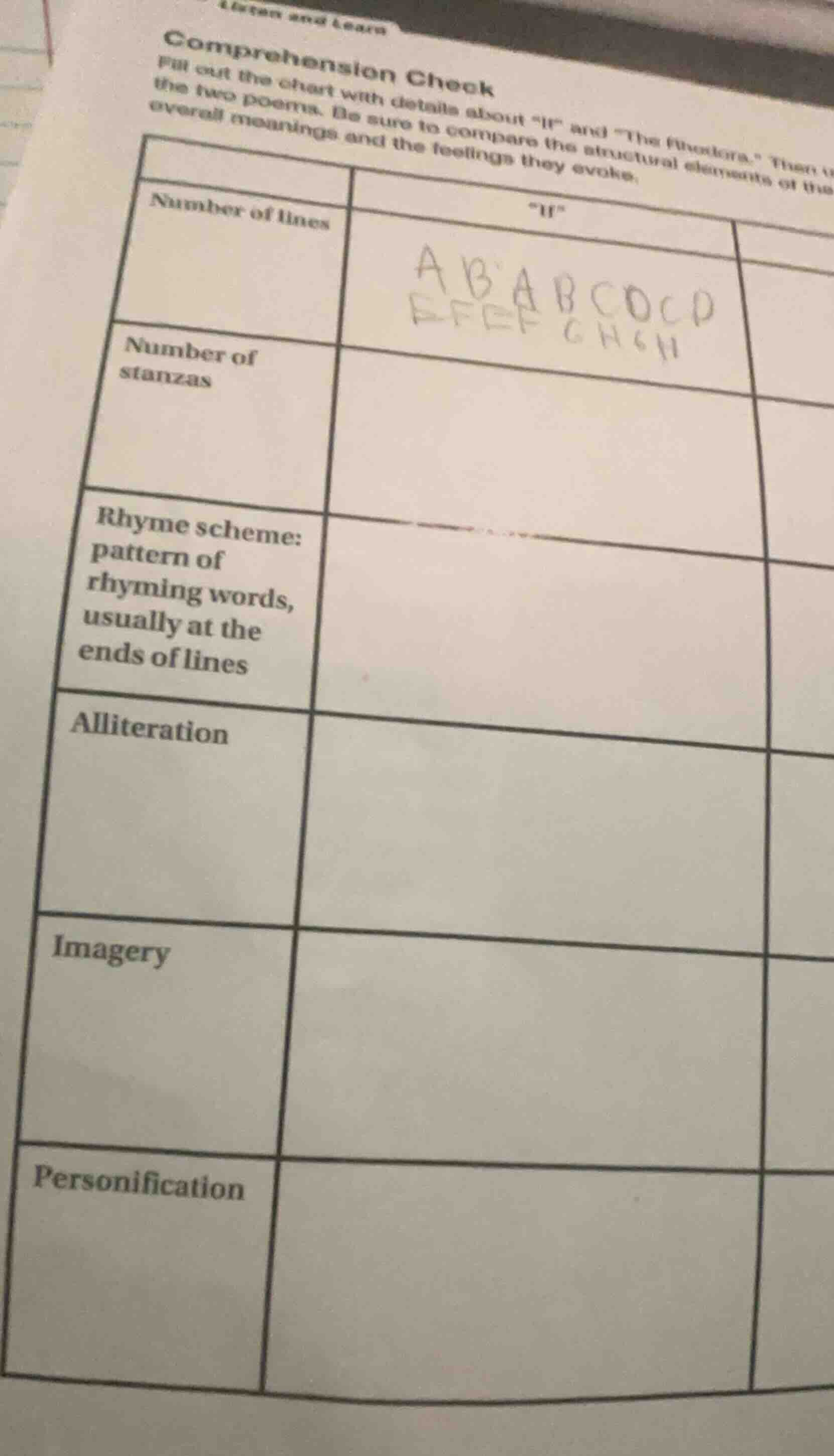
fill out the chart with details about \if\ and \the fiendera.\ then u
the two poems. be sure to compare the structural elements of the
overall meanings and the feelings they evoke.
| \if\ |
|---|
| number of lines | abab cdcd
efef ghgh |
| number of stanzas |
| rhyme scheme:
pattern of
rhyming words,
usually at the
ends of lines | |
| alliteration | |
| imagery | |
| personification |
To solve this, we analyze the poem "If" by Rudyard Kipling:
Number of Lines
The poem "If" has 32 lines (organized into 4 stanzas of 8 lines each).
Number of Stanzas
It has 4 stanzas (each stanza is 8 lines long).
Rhyme Scheme
The rhyme scheme is ABAB CDCD EFEF GHGH (alternating rhymes in each 8 - line stanza).
Alliteration
Examples include:
- "If you can dream - and not make dreams your master" (repetition of "d").
- "If you can think - and not make thoughts your aim" (repetition of "t").
- "With win and will and working - with the wind of the years" (repetition of "w").
Imagery
- Visual Imagery: "If you can meet with Triumph and Disaster / And treat those two impostors just the same" (imagines Triumph and Disaster as people, giving a visual of two figures).
- Tactile Imagery: "If you can force your heart and nerve and sinew / To serve your turn long after they are gone" (implies the physical strain of pushing one’s body to keep going).
- Kinesthetic Imagery: "If you can make one heap of all your winnings / And risk it on one turn of pitch - and - toss" (imagines the action of gambling, a physical and kinesthetic action).
Personification
- "Triumph and Disaster" are personified as "two impostors" (giving human - like qualities of deception to abstract concepts).
- "the Will" (implied to be a personified force that one can serve).
For the chart, we can fill it as follows (focusing on "If"):
| Literary Element | Details about "If" |
|---|---|
| Number of Stanzas | 4 |
| Rhyme Scheme | ABAB CDCD EFEF GHGH |
| Alliteration | Examples: "dream - and not make dreams", "think - and not make thoughts", "win and will and working" |
| Imagery | Visual: Triumph/Disaster as impostors; Tactile: heart/nerve/sinew serving; Kinesthetic: gambling winnings |
| Personification | Triumph, Disaster (as impostors); the Will (implied) |
(Note: For "The Financier", you would analyze its own structural and literary elements and then compare with "If".)

Snap & solve any problem in the app
Get step-by-step solutions on Sovi AI
Photo-based solutions with guided steps
Explore more problems and detailed explanations
To solve this, we analyze the poem "If" by Rudyard Kipling:
Number of Lines
The poem "If" has 32 lines (organized into 4 stanzas of 8 lines each).
Number of Stanzas
It has 4 stanzas (each stanza is 8 lines long).
Rhyme Scheme
The rhyme scheme is ABAB CDCD EFEF GHGH (alternating rhymes in each 8 - line stanza).
Alliteration
Examples include:
- "If you can dream - and not make dreams your master" (repetition of "d").
- "If you can think - and not make thoughts your aim" (repetition of "t").
- "With win and will and working - with the wind of the years" (repetition of "w").
Imagery
- Visual Imagery: "If you can meet with Triumph and Disaster / And treat those two impostors just the same" (imagines Triumph and Disaster as people, giving a visual of two figures).
- Tactile Imagery: "If you can force your heart and nerve and sinew / To serve your turn long after they are gone" (implies the physical strain of pushing one’s body to keep going).
- Kinesthetic Imagery: "If you can make one heap of all your winnings / And risk it on one turn of pitch - and - toss" (imagines the action of gambling, a physical and kinesthetic action).
Personification
- "Triumph and Disaster" are personified as "two impostors" (giving human - like qualities of deception to abstract concepts).
- "the Will" (implied to be a personified force that one can serve).
For the chart, we can fill it as follows (focusing on "If"):
| Literary Element | Details about "If" |
|---|---|
| Number of Stanzas | 4 |
| Rhyme Scheme | ABAB CDCD EFEF GHGH |
| Alliteration | Examples: "dream - and not make dreams", "think - and not make thoughts", "win and will and working" |
| Imagery | Visual: Triumph/Disaster as impostors; Tactile: heart/nerve/sinew serving; Kinesthetic: gambling winnings |
| Personification | Triumph, Disaster (as impostors); the Will (implied) |
(Note: For "The Financier", you would analyze its own structural and literary elements and then compare with "If".)