QUESTION IMAGE
Question
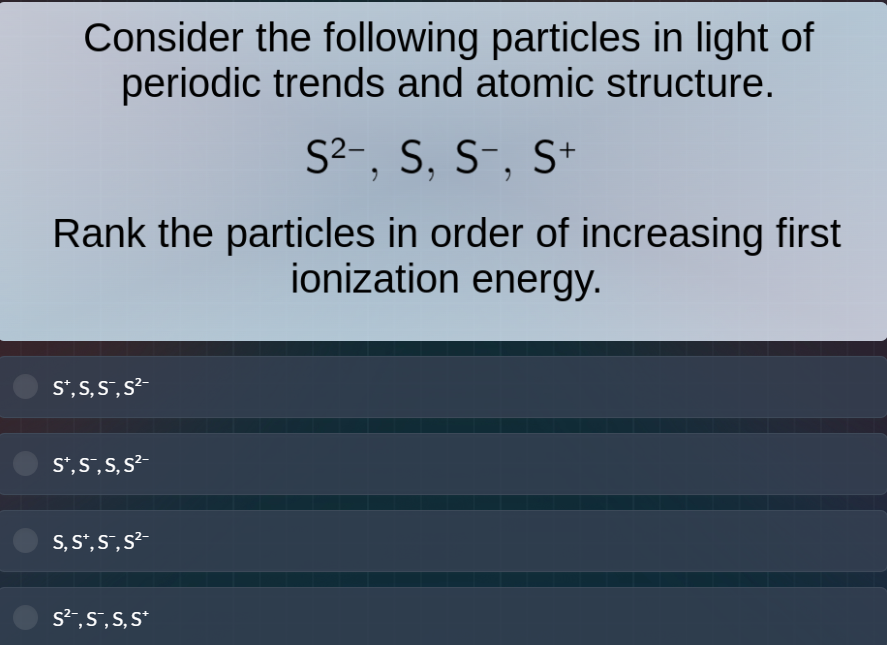
consider the following particles in light of periodic trends and atomic structure.
$s^{2-}$, $s$, $s^-$, $s^+$
rank the particles in order of increasing first ionization energy.
$s^+, s, s^-, s^{2-}$
$s^+, s^-, s, s^{2-}$
$s, s^+, s^-, s^{2-}$
$s^{2-}, s^-, s, s^+$
Step1: Relate charge to electron count
All particles are sulfur-based:
- $S^{2-}$: 18 electrons (2 more than neutral S)
- $S^-$: 17 electrons (1 more than neutral S)
- $S$: 16 electrons (neutral)
- $S^+$: 15 electrons (1 less than neutral S)
Step2: Link electrons to ionization energy
Ionization energy (IE) is the energy to remove an electron. More electrons mean greater electron-electron repulsion, so electrons are easier to remove (lower IE). Cations have fewer electrons, higher nuclear charge per electron, so electrons are harder to remove (higher IE).
Step3: Rank by increasing IE
From lowest to highest IE (easiest to hardest to remove an electron): $S^{2-}$ < $S^-$ < $S$ < $S^+$

Snap & solve any problem in the app
Get step-by-step solutions on Sovi AI
Photo-based solutions with guided steps
Explore more problems and detailed explanations
$S^{2-}, S^-, S, S^+$