QUESTION IMAGE
Question
date
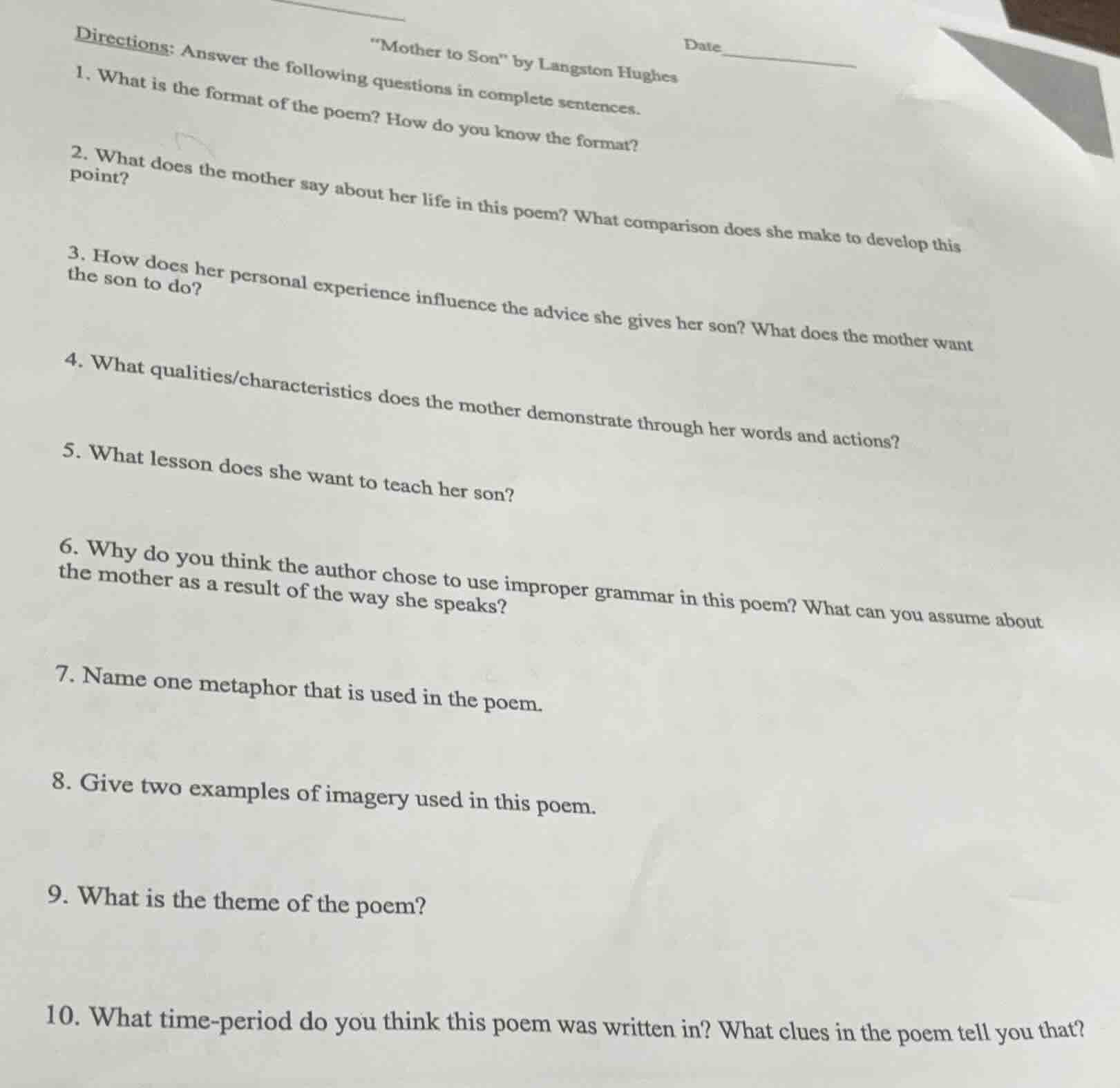
\mother to son\ by langston hughes
directions: answer the following questions in complete sentences.
- what is the format of the poem? how do you know the format?
- what does the mother say about her life in this poem? what comparison does she make to develop this point?
- how does her personal experience influence the advice she gives her son? what does the mother want the son to do?
- what qualities/characteristics does the mother demonstrate through her words and actions?
- what lesson does she want to teach her son?
- why do you think the author chose to use improper grammar in this poem? what can you assume about the mother as a result of the way she speaks?
- name one metaphor that is used in the poem.
- give two examples of imagery used in this poem.
- what is the theme of the poem?
- what time - period do you think this poem was written in? what clues in the poem tell you that?
Brief Explanations
- The poem uses free verse format, identifiable by the lack of a consistent rhyme scheme, regular meter, or stanza structure; it follows the natural rhythm of spoken speech.
- The mother describes her life as full of hardship, with no easy "crystal stair"—she compares her life to a tattered, splintered, dark staircase with obstacles like tacks, splinters, and bare floors to emphasize her struggles.
- Her experience of overcoming unrelenting hardship leads her to advise her son to never give up, even when life is difficult; she wants him to keep climbing forward instead of turning back.
- The mother demonstrates resilience, perseverance, wisdom, and unconditional love—she speaks from lived struggle to guide her son, showing she is determined and caring.
- She wants to teach her son that life will be filled with challenges, but he must persist through them rather than surrendering to difficulty.
- The improper grammar reflects authentic, working-class Black Vernacular English of the era, which grounds the character in a specific cultural and socioeconomic context; we can assume the mother likely has limited formal education but deep, lived wisdom.
- The central metaphor is "Life for me ain't been no crystal stair"—the staircase represents the journey of life, with a "crystal stair" symbolizing an easy, unobstructed life.
- Two examples of imagery are "It's had tacks in it, / And splinters" (tactile imagery of physical harm from the staircase) and "And places with no carpet on the floor— / Bare" (visual and tactile imagery of a harsh, unforgiving path).
- The core theme is the perseverance required to overcome life's hardships, passed down through intergenerational wisdom from a parent to a child.
- The poem was likely written in the early to mid-20th century (1920s-1930s, part of the Harlem Renaissance). Clues include the use of Black Vernacular English, the focus on working-class Black struggle, and Langston Hughes' association with the Harlem Renaissance movement of that period.

Snap & solve any problem in the app
Get step-by-step solutions on Sovi AI
Photo-based solutions with guided steps
Explore more problems and detailed explanations
- The poem is in free verse format. We know this because it has no consistent rhyme scheme, fixed meter, or regular stanza structure, and it mimics the natural flow of spoken conversation.
- The mother says her life has been filled with unrelenting hardship and obstacles. She develops this point by comparing her life to a broken, uncarpeted staircase with tacks, splinters, and dark, bare spaces, contrasting it with the idea of an easy "crystal stair."
- Her experience of surviving constant hardship leads her to advise her son to never stop pushing forward through life's difficulties; she wants him to avoid giving up or turning back when faced with struggle.
- The mother demonstrates resilience, perseverance, hard-won wisdom, and fierce love for her son through her honest, urgent words about her life and her desire to guide him.
- She wants to teach her son that life will present many challenges, but he must persist through adversity rather than surrendering to hardship.
- The author uses improper grammar to create an authentic, realistic voice for the mother, reflecting the working-class Black Vernacular English of her background. We can assume she likely has little formal education but holds deep, lived wisdom from her struggles.
- One key metaphor is: "Life for me ain't been no crystal stair."
- Two examples of imagery are: 1) "It's had tacks in it, / And splinters" 2) "And places with no carpet on the floor— / Bare"
- The theme of the poem is the necessity of perseverance through life's hardships, conveyed through intergenerational wisdom from a mother to her son.
- The poem was likely written in the early to mid-20th century (1920s–1930s, during the Harlem Renaissance). Clues include the use of Black Vernacular English, the focus on working-class Black struggle, and Langston Hughes' connection to the Harlem Renaissance literary movement of that era.