QUESTION IMAGE
Question
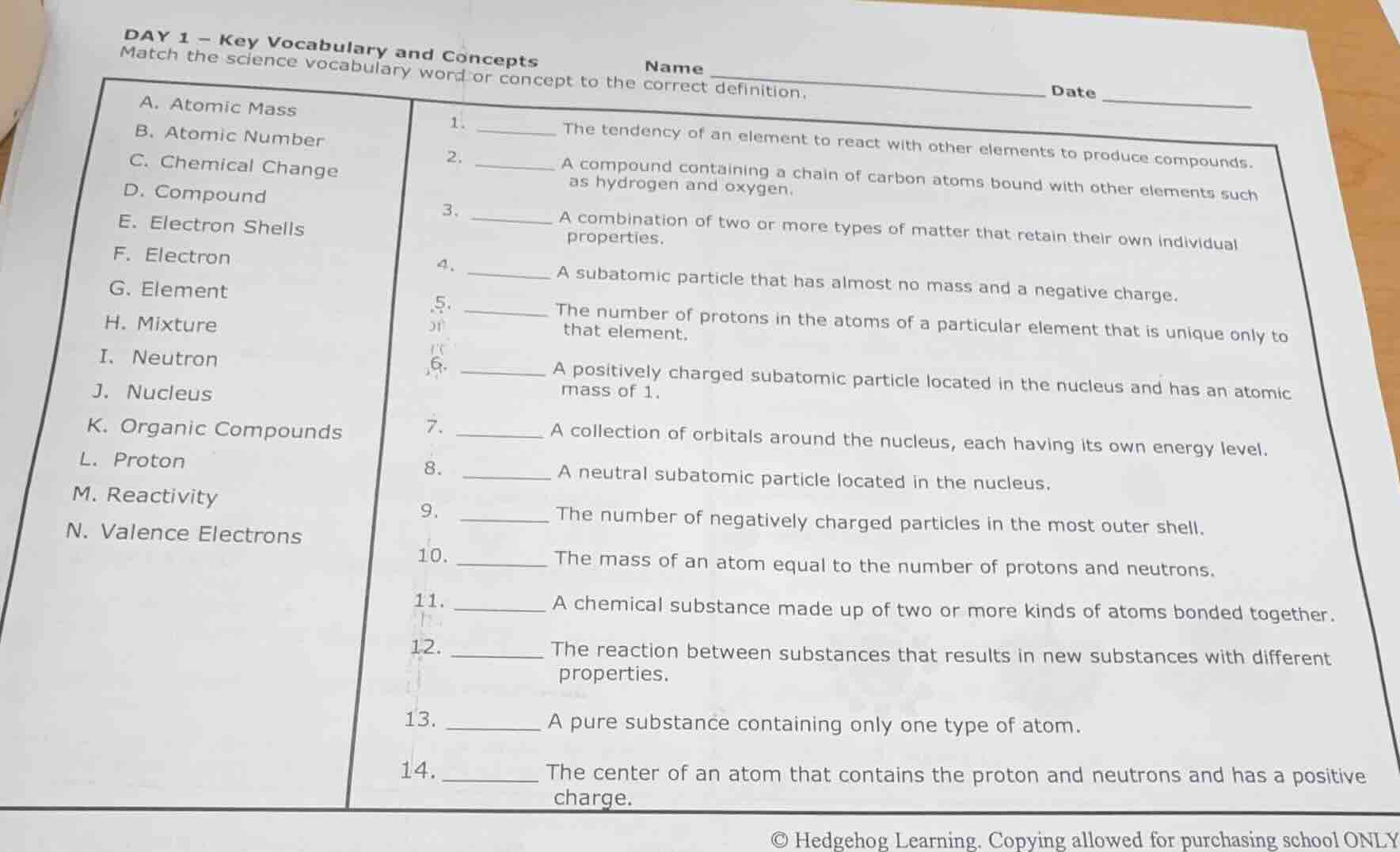
day 1 – key vocabulary and concepts name date match the science vocabulary word or concept to the correct definition. a. atomic mass b. atomic number c. chemical change d. compound e. electron shells f. electron g. element h. mixture i. neutron j. nucleus k. organic compounds l. proton m. reactivity n. valence electrons 1. the tendency of an element to react with other elements to produce compounds. 2. a compound containing a chain of carbon atoms bound with other elements such as hydrogen and oxygen. 3. a combination of two or more types of matter that retain their own individual properties. 4. a subatomic particle that has almost no mass and a negative charge. 5. the number of protons in the atoms of a particular element that is unique only to that element. 6. a positively charged subatomic particle located in the nucleus and has an atomic mass of 1. 7. a collection of orbitals around the nucleus, each having its own energy level. 8. a neutral subatomic particle located in the nucleus. 9. the number of negatively charged particles in the most outer shell. 10. the mass of an atom equal to the number of protons and neutrons. 11. a chemical substance made up of two or more kinds of atoms bonded together. 12. the reaction between substances that results in new substances with different properties. 13. a pure substance containing only one type of atom. 14. the center of an atom that contains the proton and neutrons and has a positive charge. © hedgehog learning. copying allowed for purchasing school only
Each vocabulary term is matched to its precise scientific definition based on core chemistry concepts.

Snap & solve any problem in the app
Get step-by-step solutions on Sovi AI
Photo-based solutions with guided steps
Explore more problems and detailed explanations
- M. Reactivity
- K. Organic Compounds
- H. Mixture
- F. Electron
- B. Atomic Number
- L. Proton
- E. Electron Shells
- I. Neutron
- N. Valence Electrons
- A. Atomic Mass
- D. Compound
- C. Chemical Change
- G. Element
- J. Nucleus