QUESTION IMAGE
Question
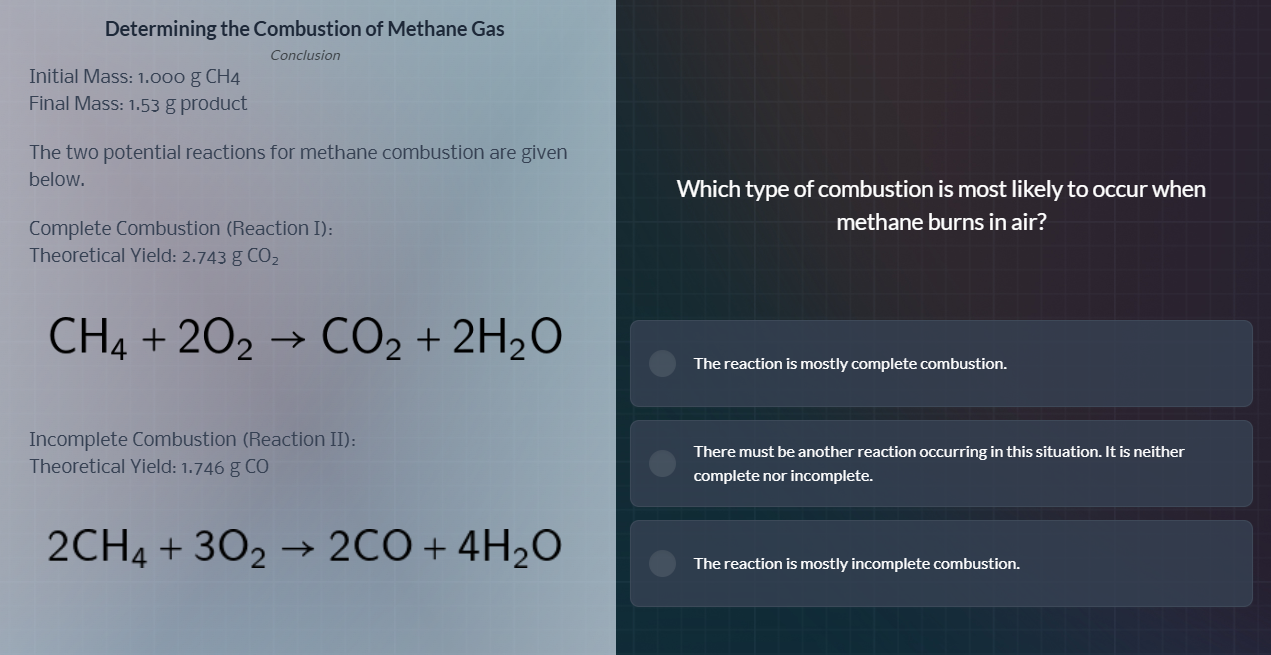
determining the combustion of methane gas
conclusion
initial mass: 1.000 g ch₄
final mass: 1.53 g product
the two potential reactions for methane combustion are given
below.
complete combustion (reaction i):
theoretical yield: 2.743 g co₂
ch₄ + 2o₂ → co₂ + 2h₂o
incomplete combustion (reaction ii):
theoretical yield: 1.746 g co
2ch₄ + 3o₂ → 2co + 4h₂o
which type of combustion is most likely to occur when
methane burns in air?
the reaction is mostly complete combustion.
there must be another reaction occurring in this situation. it is neither
complete nor incomplete.
the reaction is mostly incomplete combustion.
- First, we analyze the given data: the initial mass of \( \text{CH}_4 \) is \( 1.000 \, \text{g} \), and the final mass of the product is \( 1.53 \, \text{g} \).
- For complete combustion (Reaction I), the theoretical yield of \( \text{CO}_2 \) is \( 2.743 \, \text{g} \). For incomplete combustion (Reaction II), the theoretical yield of \( \text{CO} \) is \( 1.746 \, \text{g} \).
- The final product mass (\( 1.53 \, \text{g} \)) is closer to the theoretical yield of incomplete combustion (\( 1.746 \, \text{g} \)) than to that of complete combustion (\( 2.743 \, \text{g} \)). However, we also consider the nature of methane combustion in air. Air is about 21% oxygen, and methane generally undergoes incomplete combustion when oxygen is limited, but in air, while oxygen isn't in excess like in pure oxygen, the final product mass here is closer to incomplete combustion's theoretical yield. Wait, no, wait: Wait, the final mass is \( 1.53 \, \text{g} \), and the incomplete combustion theoretical yield is \( 1.746 \, \text{g} \), which is closer than the complete combustion's \( 2.743 \, \text{g} \). But also, we need to think about the reaction conditions. Methane burning in air: if there's not enough oxygen, incomplete combustion occurs. The product mass here is closer to incomplete combustion's yield. Wait, but let's check the values again. The final product mass is \( 1.53 \, \text{g} \), incomplete combustion theoretical yield is \( 1.746 \, \text{g} \), which is more than \( 1.53 \), but complete combustion's is \( 2.743 \), which is much higher. Wait, maybe I made a mistake. Wait, the product in complete combustion is \( \text{CO}_2 \), in incomplete is \( \text{CO} \). The final mass is \( 1.53 \, \text{g} \), which is less than the incomplete combustion's theoretical yield (\( 1.746 \, \text{g} \)) and much less than complete's (\( 2.743 \, \text{g} \)). Wait, maybe there's a miscalculation. Wait, no, the question is about which type is most likely. Wait, actually, when methane burns in air, if oxygen is sufficient, complete combustion occurs, but air has limited oxygen. However, the final product mass here is \( 1.53 \, \text{g} \), which is closer to the incomplete combustion's theoretical yield (\( 1.746 \, \text{g} \)) than to complete's (\( 2.743 \, \text{g} \)). But also, maybe the answer is that the reaction is mostly incomplete combustion? Wait, no, wait: Wait, the final mass is \( 1.53 \, \text{g} \), incomplete combustion's theoretical yield is \( 1.746 \, \text{g} \), so it's close. Complete combustion's is \( 2.743 \, \text{g} \), which is much higher. So the product mass is closer to incomplete combustion, so the reaction is mostly incomplete combustion? Wait, but let's re - evaluate. Wait, maybe I messed up the reaction products. In complete combustion, the product is \( \text{CO}_2 \) (molar mass \( 44 \, \text{g/mol} \)), in incomplete it's \( \text{CO} \) (molar mass \( 28 \, \text{g/mol} \)). The initial mass of \( \text{CH}_4 \) is \( 1.000 \, \text{g} \) (molar mass \( 16 \, \text{g/mol} \)), so moles of \( \text{CH}_4 = 1/16 = 0.0625 \, \text{mol} \). For complete combustion, moles of \( \text{CO}_2 \) produced should be \( 0.0625 \, \text{mol} \), mass \( = 0.0625\times44 = 2.75 \, \text{g} \) (close to the given \( 2.743 \, \text{g} \)). For incomplete combustion, from the reaction \( 2\text{CH}_4+3\text{O}_2
ightarrow2\text{CO}+4\text{H}_2\text{O} \), moles of \( \text{CO} \) produced from \( 0.0625 \, \text{mol} \) of \( \text{CH}_4 \): from the stoichiometry, 2 moles of \( \text{CH}_4 \) produce 2 moles…

Snap & solve any problem in the app
Get step-by-step solutions on Sovi AI
Photo-based solutions with guided steps
Explore more problems and detailed explanations
The reaction is mostly incomplete combustion.