QUESTION IMAGE
Question
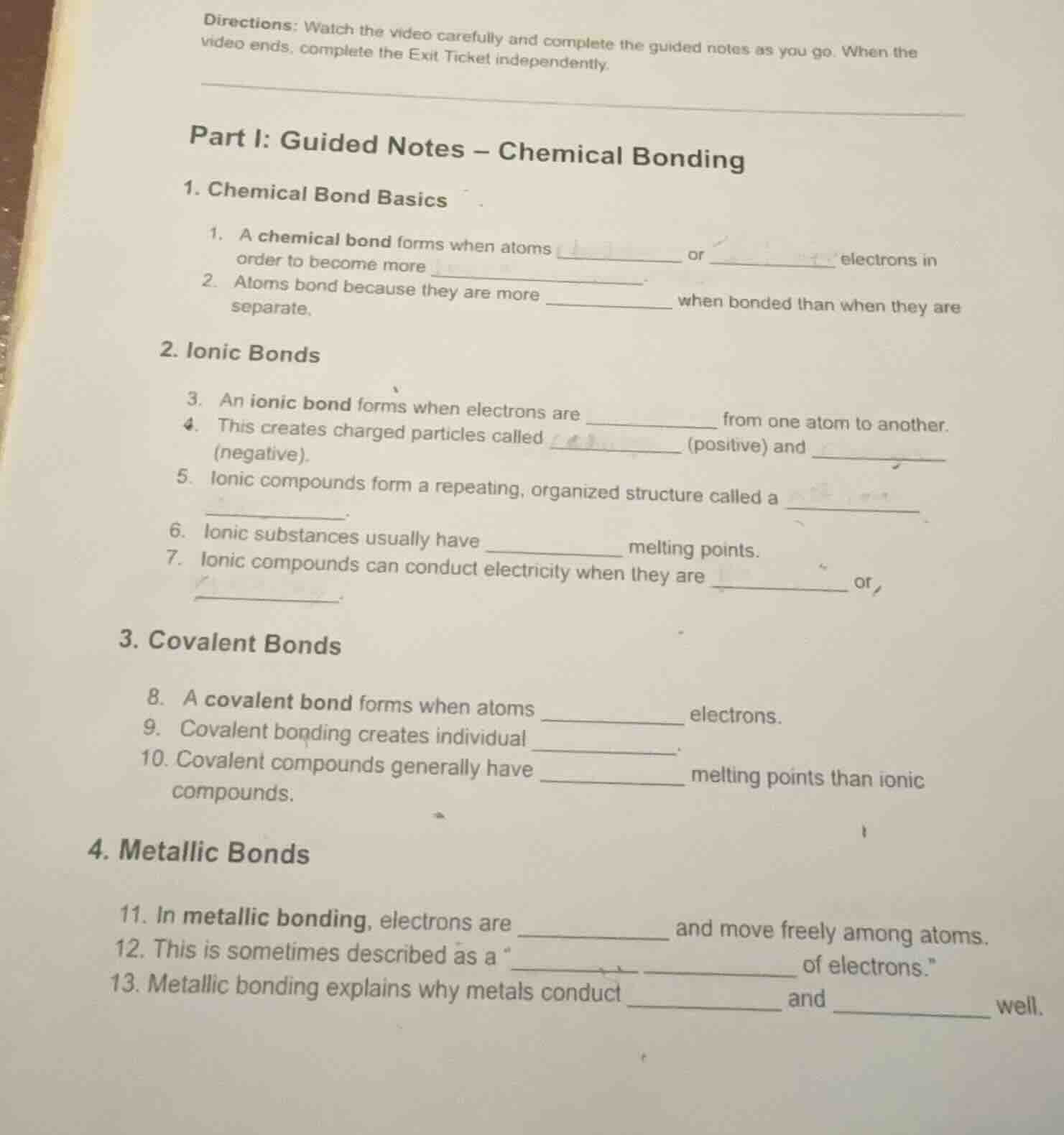
directions: watch the video carefully and complete the guided notes as you go. when the video ends, complete the exit ticket independently.
part i: guided notes – chemical bonding
- chemical bond basics
- a chemical bond forms when atoms ____ or __ electrons in order to become more ____.
- atoms bond because they are more ______ when bonded than when they are separate.
- ionic bonds
- an ionic bond forms when electrons are ______ from one atom to another.
- this creates charged particles called ____ (positive) and ____ (negative).
- ionic compounds form a repeating, organized structure called a ______.
- ionic substances usually have ______ melting points.
- ionic compounds can conduct electricity when they are ____ or ____.
- covalent bonds
- a covalent bond forms when atoms ______ electrons.
- covalent bonding creates individual ______.
- covalent compounds generally have ______ melting points than ionic compounds.
- metallic bonds
- in metallic bonding, electrons are ______ and move freely among atoms.
- this is sometimes described as a “____ ____ of electrons.”
- metallic bonding explains why metals conduct ____ and ____ well.
Brief Explanations
These are fill-in-the-blank questions about chemical bonding, covering the core properties of ionic, covalent, and metallic bonds, as well as basic bonding principles. The answers are based on foundational chemistry concepts for each bond type.

Snap & solve any problem in the app
Get step-by-step solutions on Sovi AI
Photo-based solutions with guided steps
Explore more problems and detailed explanations
- Chemical Bond Basics
- transfer; share; stable
- stable
- Ionic Bonds
- transferred
- cations; anions
- crystal lattice
- high
- dissolved in water; melted
- Covalent Bonds
- share
- molecules
- lower
- Metallic Bonds
- delocalized
- sea
- electricity; heat