QUESTION IMAGE
Question
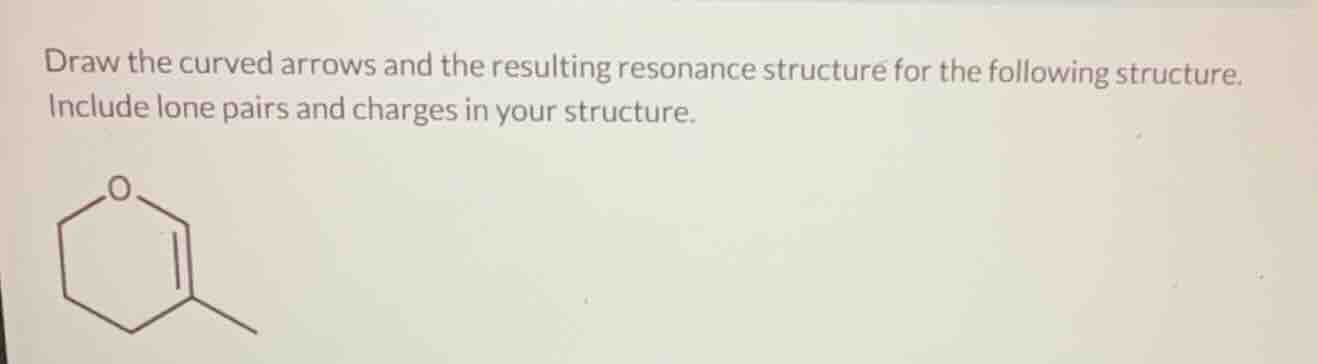
draw the curved arrows and the resulting resonance structure for the following structure. include lone pairs and charges in your structure.
Brief Explanations
- Identify the electron source: the π bond in the double bond adjacent to the oxygen atom.
- Draw a curved arrow from the π bond to the oxygen atom, which accepts the electron pair. This leaves the original carbon of the double bond with a positive formal charge.
- Add a lone pair to the oxygen (now bearing a negative formal charge, as it has gained an electron pair) and show the positive charge on the carbon that lost the π bond electrons.
- The resulting resonance structure has a single bond between the two former double-bond carbons, a negatively charged oxygen with three lone pairs, and a positively charged tertiary carbon.

Snap & solve any problem in the app
Get step-by-step solutions on Sovi AI
Photo-based solutions with guided steps
Explore more problems and detailed explanations
Curved Arrow Mechanism:
- A curved arrow starts from the π bond of the C=C double bond and points towards the oxygen atom.
Resulting Resonance Structure:
A six-membered ring where:
- The oxygen atom has three lone pairs of electrons and a -1 formal charge.
- The carbon that was originally part of the double bond (and attached to the methyl group) has a +1 formal charge, and is now singly bonded to its adjacent ring carbon.
- All other single bonds in the ring remain intact, and the methyl group is still attached to the positively charged carbon.
Structurally, it can be represented as:
     O⁻ (3 lone pairs)
     |
CH₃-C⁺-CH₂-CH₂-CH₂-O⁻ (ring structure, with the positive charge on the methyl-substituted carbon, and negative charge on the oxygen with an extra lone pair)
(Standard skeletal structure: six-membered ring, with one oxygen (with 3 lone pairs, -1 charge), a positively charged carbon bonded to CH₃, and single bonds connecting all ring atoms.)