QUESTION IMAGE
Question
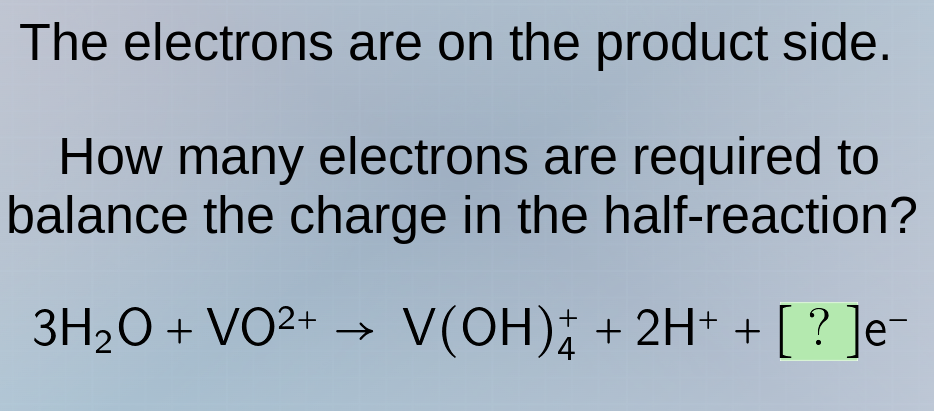
the electrons are on the product side.
how many electrons are required to
balance the charge in the half - reaction?
$3h_2o + vo^{2+} \
ightarrow v(oh)_4^+ + 2h^+ + ?e^-$
Step1: Calculate charge on left side
The left - hand side has \(VO^{2 +}\). The charge contribution from \(VO^{2+}\) is \(+ 2\) (since the overall charge of \(VO^{2+}\) is \(+2\), and \(H_2O\) is neutral with a charge of \(0\)). So the total charge on the left side is \(+2\).
Step2: Calculate charge on right side
For the right - hand side:
- The charge of \(V(OH)_4^+\) is \(+ 1\).
- The charge of \(H^+\) is \(+1\) per ion, and there are \(2\) \(H^+\) ions, so the total charge from \(H^+\) is \(2\times(+ 1)=+2\).
- Let the number of electrons be \(n\). Each electron has a charge of \(-1\), so the charge from electrons is \(-n\).
The total charge on the right side is \(+1 + 2\times(+1)-n=+3 - n\).
Step3: Set left and right charges equal
Since the charge must be balanced in a half - reaction, the charge on the left side equals the charge on the right side. So we set up the equation:
\(+2=+3 - n\)
To solve for \(n\), we can rearrange the equation:
\(n = 3 - 2\)
\(n = 1\)

Snap & solve any problem in the app
Get step-by-step solutions on Sovi AI
Photo-based solutions with guided steps
Explore more problems and detailed explanations
\(1\)