QUESTION IMAGE
Question
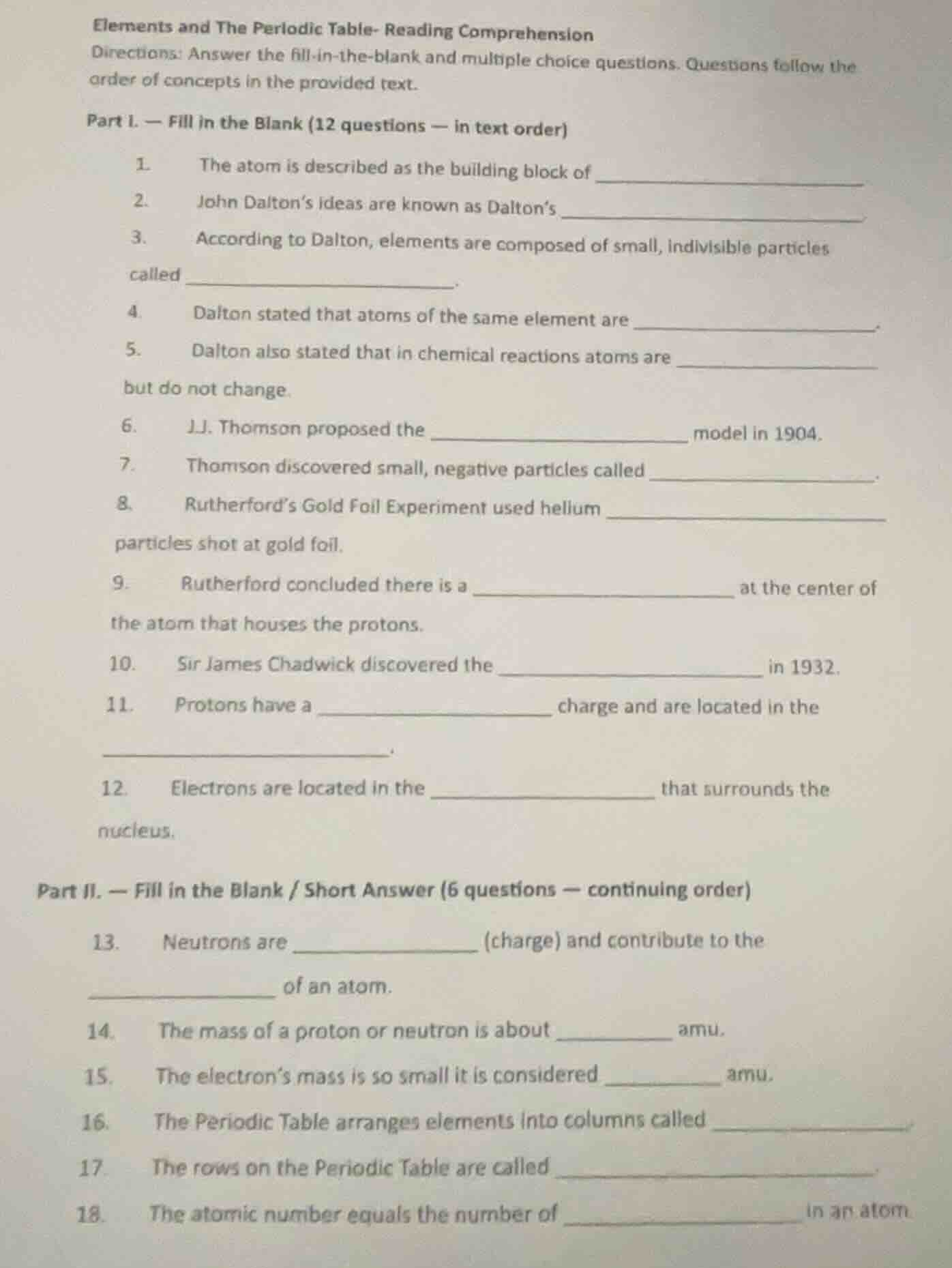
elements and the periodic table- reading comprehension
directions: answer the fill-in-the-blank and multiple choice questions. questions follow the
order of concepts in the provided text.
part i. — fill in the blank (12 questions — in text order)
- the atom is described as the building block of
- john dalton’s ideas are known as dalton’s
- according to dalton, elements are composed of small, indivisible particles
called
- dalton stated that atoms of the same element are
- dalton also stated that in chemical reactions atoms are
but do not change.
- j.j. thomson proposed the model in 1904.
- thomson discovered small, negative particles called
- rutherford’s gold foil experiment used helium
particles shot at gold foil.
- rutherford concluded there is a at the center of
the atom that houses the protons.
- sir james chadwick discovered the in 1932.
- protons have a charge and are located in the
- electrons are located in the that surrounds the
nucleus.
part ii. — fill in the blank / short answer (6 questions — continuing order)
- neutrons are (charge) and contribute to the
of an atom.
- the mass of a proton or neutron is about amu.
- the electron’s mass is so small it is considered amu.
- the periodic table arranges elements into columns called
- the rows on the periodic table are called
- the atomic number equals the number of in an atom
Response
Part I: Fill in the Blank
- Explanation for Q1: Atoms are the basic units of matter.

Snap & solve any problem in the app
Get step-by-step solutions on Sovi AI
Photo-based solutions with guided steps
Explore more problems and detailed explanations
**: matter
- Explanation for Q2: John Dalton’s atomic theory is known as Dalton’s Atomic Theory.