QUESTION IMAGE
Question
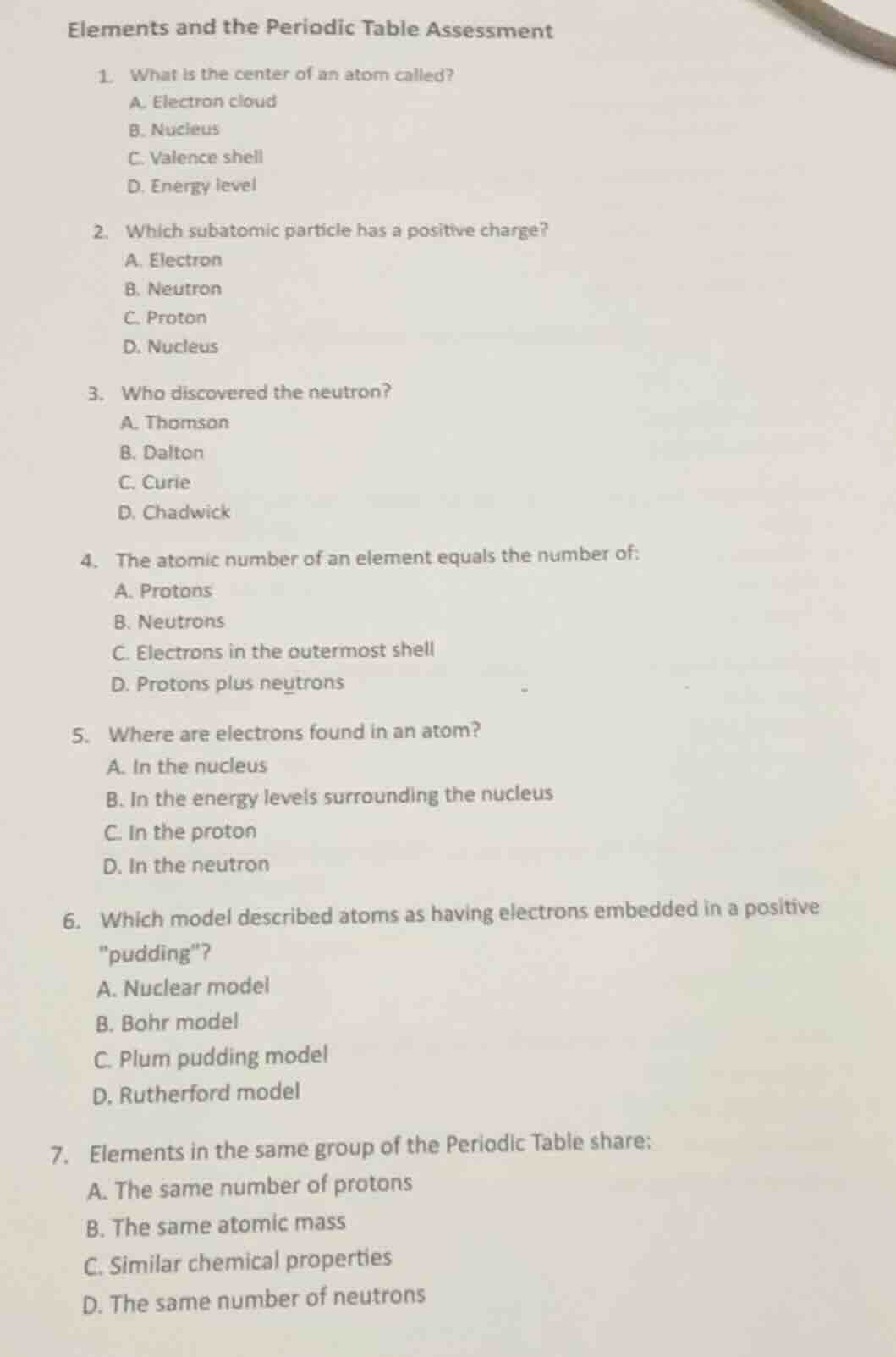
elements and the periodic table assessment
- what is the center of an atom called?
a. electron cloud
b. nucleus
c. valence shell
d. energy level
- which subatomic particle has a positive charge?
a. electron
b. neutron
c. proton
d. nucleus
- who discovered the neutron?
a. thomson
b. dalton
c. curie
d. chadwick
- the atomic number of an element equals the number of:
a. protons
b. neutrons
c. electrons in the outermost shell
d. protons plus neutrons
- where are electrons found in an atom?
a. in the nucleus
b. in the energy levels surrounding the nucleus
c. in the proton
d. in the neutron
- which model described atoms as having electrons embedded in a positive \pudding\?
a. nuclear model
b. bohr model
c. plum pudding model
d. rutherford model
- elements in the same group of the periodic table share:
a. the same number of protons
b. the same atomic mass
c. similar chemical properties
d. the same number of neutrons
Brief Explanations
- The dense central core of an atom is its nucleus.
- Protons are positively charged subatomic particles.
- James Chadwick is credited with discovering the neutron.
- An element's atomic number is defined by its proton count.
- Electrons occupy energy levels (electron cloud) around the nucleus.
- The plum pudding model describes electrons in a positive "pudding" matrix.
- Elements in the same periodic table group have the same valence electron configuration, leading to similar chemical properties.

Snap & solve any problem in the app
Get step-by-step solutions on Sovi AI
Photo-based solutions with guided steps
Explore more problems and detailed explanations
- B. Nucleus
- C. Proton
- D. Chadwick
- A. Protons
- B. In the energy levels surrounding the nucleus
- C. Plum pudding model
- C. Similar chemical properties