QUESTION IMAGE
Question
energy changes and rates of reaction
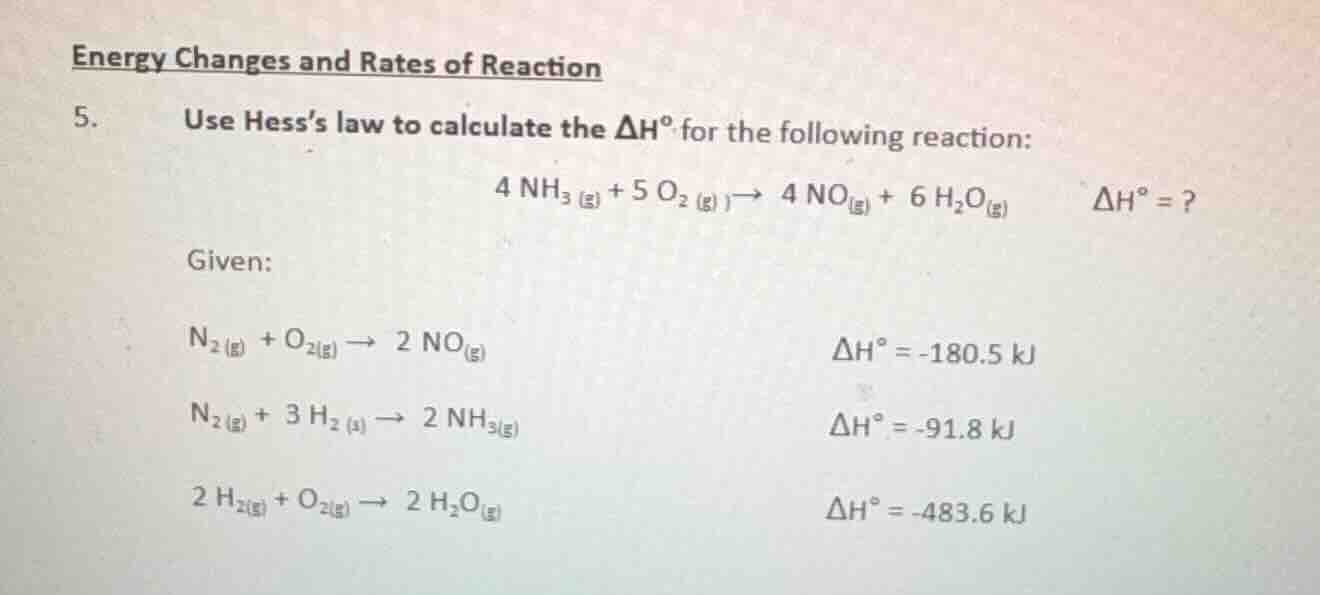
- use hess’s law to calculate the $\delta h^\circ$ for the following reaction:
$\ce{4 nh_{3 (g)} + 5 o_{2 (g)} \
ightarrow 4 no_{(g)} + 6 h_{2}o_{(g)}}$ $\delta h^\circ = ?$
given:
$\ce{n_{2 (g)} + o_{2(g)} \
ightarrow 2 no_{(g)}}$ $\delta h^\circ = -180.5$ kj
$\ce{n_{2 (g)} + 3 h_{2 (g)} \
ightarrow 2 nh_{3(g)}}$ $\delta h^\circ = -91.8$ kj
$\ce{2 h_{2(g)} + o_{2(g)} \
ightarrow 2 h_{2}o_{(g)}}$ $\delta h^\circ = -483.6$ kj
Step1: Adjust the first given reaction
We need 4 NO in the target reaction. The first given reaction is \( \ce{N2(g) + O2(g) -> 2 NO(g)} \) with \( \Delta H^\circ = -180.5 \, \text{kJ} \). Multiply this reaction by 2 to get 4 NO:
\( 2 \times (\ce{N2(g) + O2(g) -> 2 NO(g)}) \)
\( \ce{2 N2(g) + 2 O2(g) -> 4 NO(g)} \)
\( \Delta H_1^\circ = 2 \times (-180.5 \, \text{kJ}) = -361.0 \, \text{kJ} \)
Step2: Adjust the second given reaction
We need 4 \( \ce{NH3} \) in the target reaction. The second given reaction is \( \ce{N2(g) + 3 H2(g) -> 2 NH3(g)} \) with \( \Delta H^\circ = -91.8 \, \text{kJ} \). Reverse this reaction and multiply by 2 to get 4 \( \ce{NH3} \) as reactants:
Reverse: \( \ce{2 NH3(g) -> N2(g) + 3 H2(g)} \)
Multiply by 2: \( 2 \times (\ce{2 NH3(g) -> N2(g) + 3 H2(g)}) \)
\( \ce{4 NH3(g) -> 2 N2(g) + 6 H2(g)} \)
\( \Delta H_2^\circ = 2 \times (91.8 \, \text{kJ}) = 183.6 \, \text{kJ} \) (since reversing a reaction changes the sign of \( \Delta H \))
Step3: Adjust the third given reaction
We need 6 \( \ce{H2O} \) in the target reaction. The third given reaction is \( \ce{2 H2(g) + O2(g) -> 2 H2O(g)} \) with \( \Delta H^\circ = -483.6 \, \text{kJ} \). Multiply this reaction by 3 to get 6 \( \ce{H2O} \):
\( 3 \times (\ce{2 H2(g) + O2(g) -> 2 H2O(g)}) \)
\( \ce{6 H2(g) + 3 O2(g) -> 6 H2O(g)} \)
\( \Delta H_3^\circ = 3 \times (-483.6 \, \text{kJ}) = -1450.8 \, \text{kJ} \)
Step4: Sum the adjusted reactions
Now, add the three adjusted reactions together:
Reaction 1: \( \ce{2 N2(g) + 2 O2(g) -> 4 NO(g)} \) \( \Delta H_1^\circ = -361.0 \, \text{kJ} \)
Reaction 2: \( \ce{4 NH3(g) -> 2 N2(g) + 6 H2(g)} \) \( \Delta H_2^\circ = 183.6 \, \text{kJ} \)
Reaction 3: \( \ce{6 H2(g) + 3 O2(g) -> 6 H2O(g)} \) \( \Delta H_3^\circ = -1450.8 \, \text{kJ} \)
Adding the reactions:
\( \ce{2 N2(g) + 2 O2(g) + 4 NH3(g) + 6 H2(g) + 3 O2(g) -> 4 NO(g) + 2 N2(g) + 6 H2(g) + 6 H2O(g)} \)
Simplify by canceling out common species (2 \( \ce{N2} \), 6 \( \ce{H2} \)):
\( \ce{4 NH3(g) + 5 O2(g) -> 4 NO(g) + 6 H2O(g)} \) (which is the target reaction)
Now, sum the \( \Delta H \) values:
\( \Delta H^\circ = \Delta H_1^\circ + \Delta H_2^\circ + \Delta H_3^\circ \)
\( \Delta H^\circ = -361.0 \, \text{kJ} + 183.6 \, \text{kJ} - 1450.8 \, \text{kJ} \)
\( \Delta H^\circ = (-361.0 + 183.6 - 1450.8) \, \text{kJ} \)
\( \Delta H^\circ = -1628.2 \, \text{kJ} \)

Snap & solve any problem in the app
Get step-by-step solutions on Sovi AI
Photo-based solutions with guided steps
Explore more problems and detailed explanations
\( \Delta H^\circ = -1628.2 \, \text{kJ} \)